



$ cnpm install simple-xml-to-json
A simple XML to JSON converter



Install
Simply install using NPM in your project directory
npm install simple-xml-to-json
Usage and API
1. convertXML(xmlToConvert [,customConverter])
xmlToConvert<string>customConverter<function>- Returns: <JSON> by default or other if
customConverteris used
2. createAST(xmlToConvert)
xmlToConvert<string>- Returns: An AST representation of the XML <JSON>
CommonJS (Node.js):
const { convertXML, createAST } = require("simple-xml-to-json")

const myJson = convertXML(myXMLString)
const myYaml = convertXML(myXMLString, yamlConverter)
const myAst = createAST(myXMLString)
ESM (modern frontend apps, Node.js with "type": "module", bundlers):
import { convertXML, createAST } from "simple-xml-to-json"

const myJson = convertXML(myXMLString)
const myYaml = convertXML(myXMLString, yamlConverter)
const myAst = createAST(myXMLString)
 Typescript compatible
Notes and how to use code
- The easiest thing to start is to run
node example/example.js(CJS) ornode example/example.mjs(ESM) in your terminal and see what happens. - There's the
xmlToJson.jsfile for convenience. Just pass in the XML as a String. - MIT licensed allowing code customization
- Profit
How this works in a nutshell
- The library converts the XML to an AST
- There is a JSON converter that takes the AST and spits out a JSON
- You can write your own converters if you need XML-to-ANY-OTHER-FORMAT
Benchmark
Take these results with a grain of salt.
According to a simple benchmark test I performed in April 2024 with a random XML. YMMV.
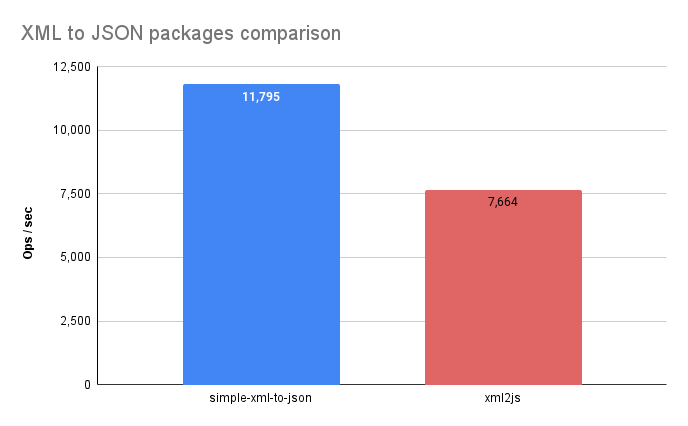
- The chart results may be outdated. Run the test yourself
Current Drawbacks
- All values are translated to strings in JSON
- There are currently reserved words in the JSON converter:
- "content" - up to version 1.2.3
- "children"
Default Mapping & Collisions
By default, an element's text content is mapped to a "content" property, while its attributes are mapped directly to JSON properties of the same name.
The Risk
If an XML element possesses an attribute actually named content while also containing text content, a name collision occurs. This typically results in a parsing error or data loss due to duplicate keys.
Example Collision:
<MyElement content="attr-value">text-content</MyElement>
Version 1.2.3+ Fix
To prevent these collisions, versions newer than 1.2.3 will specifically prefix the "content" attribute name with an @ symbol. So the attribute "content" now becomes the "@content" JSON property.
[!NOTE] If you need to, you can write your own converter from the AST created by the parser, and pass it as a 2nd parameter after the xml string
Current Tags
- 1.2.7 ... latest (4 days ago)
26 Versions
- 1.2.7 ... 4 days ago
- 1.2.6 ... 4 days ago
- 1.2.5 ... 7 days ago
- 1.2.4 ... 24 days ago
- 1.2.3 ... 2 years ago
- 1.2.2 ... 2 years ago
- 1.2.1 ... 2 years ago
- 1.2.0 ... 2 years ago
- 1.1.7 ... 3 years ago
- 1.1.6 ... 3 years ago
- 1.1.5 ... 3 years ago
- 1.1.4 ... 3 years ago
- 1.1.3 ... 3 years ago
- 1.1.2 ... 3 years ago
- 1.1.1 ... 3 years ago
- 1.1.0 ... 3 years ago
- 1.0.9 ... 4 years ago
- 1.0.8 ... 5 years ago
- 1.0.7 ... 6 years ago
- 1.0.6 ... 6 years ago
- 1.0.5 ... 6 years ago
- 1.0.4 ... 6 years ago
- 1.0.3 ... 6 years ago
- 1.0.2 ... 6 years ago
- 1.0.1 ... 6 years ago
- 1.0.0 ... 6 years ago
- @rollup/plugin-commonjs 29.0.2
- @rollup/plugin-replace 6.0.3
- @rollup/plugin-terser 1.0.0
- acorn 8.16.0
- acorn-walk 8.3.5
- eslint 10.2.0
- eslint-config-prettier 10.1.8
- eslint-plugin-jest 29.15.1
- globals 17.4.0
- jest 30.3.0
- magic-string ^0.30.10
- prettier 3.2.5
- rollup 4.60.1