



$ cnpm install rambda
Rambda
Rambda is TypeScript-focused utility library similar to Remeda, Ramda and Radashi. - Documentation site




❯ Example use
import { pipe, filter, map } from 'rambda'

const result = pipe(
  [1, 2, 3, 4],
  filter(x => x > 2),
  map(x => x * 2),
)
//=> [6, 8]
You can test this example in Rambda's REPL

❯ Rambda's features
❯ Goals
Typescript focus
Mixing Functional Programming and TypeScript is not easy.
One way to solve this is to focus what can be actually achieved and refrain from what is not possible.
R.pipe as the main way to use Rambda
-
All methods are meant to be used as part of
R.pipechain -
This is the main purpose of functional programming, i.e. to pass data through a chain of functions.
-
Having
R.pipe(input, ...fns)helps TypeScript to infer the types of the input and the output.
Here is one example why R.pipe is better than Ramda.pipe:
const list = [1, 2, 3];

it('within pipe', () => {
	const result = pipe(
		list,
		filter((x) => {
			x; // $ExpectType number
			return x > 1;
		}),
	);
	result; // $ExpectType number[]
});
it('within Ramda.pipe requires explicit types', () => {
	Ramda.pipe(
		(x) => x,
		filter<number>((x) => {
			x; // $ExpectType number
			return x > 1;
		}),
		filter((x: number) => {
			x; // $ExpectType number
			return x > 1;
		}),
	)(list);
});
:exclamation: IMPORTANT - all methods are tested to deliver correct types when they are part of R.pipe/R.pipeAsync chains.
In other words:
R.filter(x => x > 1)([1,2,3])
might trigger TS error as it not the same as
R.pipe([1,2,3], R.filter(x => x > 1)
:exclamation: All methods are curried
There is one way to use Rambda methods and it is with currying, i.e. using R.filter(fn, list) will not work as it is inteded to be R.filter(fn)(list).
The reason is that all methods are supposed to be used inside R.pipe. After all, building chains is the very base of functional programming.
Of course, there is value in supporting the case where you can pass all inputs at once, but I find that the price in terms of maintainability is not worth it.
Keep only the most useful methods
The idea is to give TypeScript users only the most useful methods and let them implement the rest. No magic logic methods that are hard to remember. You shouldn't need to read the documentation to understand what a method does. Its name and signature should be enough.
-
Methods that are simply to remember only by its name. Complex logic shouldn't be part of utility library, but part of your codebase.
-
Keep only methods which are both useful and which behaviour is obvious from its name. For example,
R.innerJoinis kept, butR.identical,R.moveis removed. Methods such asR.toLower,R.lengthprovide little value. Such method are omitted from Rambda on purpose. -
Some generic methods such as
curryandassocis not easy to be expressed in TypeScript. For this reasonRambdaomits such methods. -
No
R.condorR.ifElseas they make the chain less readable. -
No
R.lengthas it adds very little value. -
No
R.differenceas user must remember the order of the inputs, i.e. which is compared to and which is compared against.
One way to use each method
Because of the focus on R.pipe, there is only one way to use each method. This helps with testing and also with TypeScript definitions.
- All methods that 2 inputs, will have to be called with
R.methodName(input1)(input2) - All methods that 3 inputs, will have to be called with
R.methodName(input1, input2)(input3)
Deno support
import * as R from "https://deno.land/x/rambda/mod.ts";

R.filter(x => x > 1)([1, 2, 3])
Dot notation for R.path
Standard usage of R.path is R.path(['a', 'b'])({a: {b: 1} }).
In Rambda you have the choice to use dot notation(which is arguably more readable):
R.path('a.b')({a: {b: 1} })
Please note that since path input is turned into array, i.e. if you want R.path(['a','1', 'b'])({a: {'1': {b: 2}}}) to return 2, you will have to pass array path, not string path. If you pass a.1.b, it will turn path input to ['a', 1, 'b'].
Comma notation for R.pick and R.omit
Similar to dot notation, but the separator is comma(,) instead of dot(.).
R.pick('a,b', {a: 1 , b: 2, c: 3} })
// No space allowed between properties
Differences between Rambda and Ramda
Up until version 9.4.2, the aim of Rambda was to match as much as possible the Ramda API.
You can find documentation site of Rambda version 9.4.2 is here.
From version 10.0.0 onwards, Rambda is no longer aiming to be drop-in replacement for Ramda.
API
addProp
addProp<T extends object, P extends PropertyKey, V extends unknown>(
	prop: P,
	value: V
): (obj: T) => MergeTypes<T & Record<P, V>>
It adds new key-value pair to the object.
const result = R.pipe(
	{ a: 1, b: 'foo' },
	R.addProp('c', 3)
)
// => { a: 1, b: 'foo', c: 3 }
Try this R.addProp example in Rambda REPL
addProp<T extends object, P extends PropertyKey, V extends unknown>(
	prop: P,
	value: V
): (obj: T) => MergeTypes<T & Record<P, V>>;
export function addProp(key, value) {
  return obj => ({ ...obj, [key]: value })
}
import { addProp } from './addProp.js'

test('happy', () => {
	const result = addProp('a', 1)({ b: 2 })
	const expected = { a: 1, b: 2 }

	expect(result).toEqual(expected)
})
import { addProp, pipe } from 'rambda'

it('R.addProp', () => {
	const result = pipe({ a: 1, b: 'foo' }, addProp('c', 3))
	result.a // $ExpectType number
	result.b // $ExpectType string
	result.c // $ExpectType number
})
addPropToObjects
addPropToObjects<
  T extends object,
  K extends string,
  R
>(
	property: K,
  fn: (input: T) => R
): (list: T[]) => MergeTypes<T & { [P in K]: R }>[]
It receives list of objects and add new property to each item.
The value is based on result of fn function, which receives the current object as argument.
const result = R.pipe(
	[
		{a: 1, b: 2},
		{a: 3, b: 4},
	],
	R.addPropToObjects(
		'c',
		(x) => String(x.a + x.b),
	)
)
// => [{a: 1, b: 2, c: '3'}, {a: 3, b: 4, c: '7'}]
Try this R.addPropToObjects example in Rambda REPL
addPropToObjects<
  T extends object,
  K extends string,
  R
>(
	property: K,
  fn: (input: T) => R
): (list: T[]) => MergeTypes<T & { [P in K]: R }>[];
import { mapFn } from './map.js'

export function addPropToObjects (
	property,
	fn
){
	return listOfObjects => mapFn(
		(obj) => ({
			...(obj),
			[property]: fn(obj)
		}),
		listOfObjects
	)
}
import { pipe } from './pipe.js'
import { addPropToObjects } from './addPropToObjects.js'

test('R.addPropToObjects', () => {
		let result = pipe(
			[
				{a: 1, b: 2},
				{a: 3, b: 4},
			],
			addPropToObjects(
				'c',
				(x) => String(x.a + x.b),
			)
		)
		expect(result).toEqual([
			{ a: 1, b: 2, c: '3' },
			{ a: 3, b: 4, c: '7' },
		])
})
import { addPropToObjects, pipe } from 'rambda'

it('R.addPropToObjects', () => {
		let result = pipe(
			[
				{a: 1, b: 2},
				{a: 3, b: 4},
			],
			addPropToObjects(
				'c',
				(x) => String(x.a + x.b),
			)
		)
		result // $ExpectType { a: number; b: number; c: string; }[]
})
all
all<T>(predicate: (x: T) => boolean): (list: T[]) => boolean
It returns true, if all members of array list returns true, when applied as argument to predicate function.
const list = [ 0, 1, 2, 3, 4 ]
const predicate = x => x > -1

const result = R.pipe(
	list,
	R.all(predicate)
) // => true
Try this R.all example in Rambda REPL
all<T>(predicate: (x: T) => boolean): (list: T[]) => boolean;
export function all(predicate) {
  return list => {
    for (let i = 0; i < list.length; i++) {
      if (!predicate(list[i])) {
        return false
      }
    }

    return true
  }
}
import { all } from './all.js'

const list = [0, 1, 2, 3, 4]

test('when true', () => {
  const fn = x => x > -1

  expect(all(fn)(list)).toBeTruthy()
})

test('when false', () => {
  const fn = x => x > 2

  expect(all(fn)(list)).toBeFalsy()
})
import * as R from 'rambda'

describe('all', () => {
  it('happy', () => {
    const result = R.pipe(
      [1, 2, 3],
      R.all(x => {
        x // $ExpectType number
        return x > 0
      }),
    )
    result // $ExpectType boolean
  })
})
allPass
allPass<F extends (...args: any[]) => boolean>(predicates: readonly F[]): F
It returns true, if all functions of predicates return true, when input is their argument.
const list = [[1, 2, 3, 4], [3, 4, 5]]
const result = R.pipe(
	list,
	R.filter(R.allPass([R.includes(2), R.includes(3)]))
) // => [[1, 2, 3, 4]]
Try this R.allPass example in Rambda REPL
allPass<F extends (...args: any[]) => boolean>(predicates: readonly F[]): F;
export function allPass(predicates) {
  return input => {
    let counter = 0
    while (counter < predicates.length) {
      if (!predicates[counter](input)) {
        return false
      }
      counter++
    }

    return true
  }
}
import { allPass } from './allPass.js'
import { filter } from './filter.js'
import { pipe } from './pipe.js'

const list = [
  [1, 2, 3, 4],
  [3, 4, 5],
]
test('happy', () => {
  const result = pipe(list, filter(allPass([x => x.includes(2), x => x.includes(3)])))
  expect(result).toEqual([[1, 2, 3, 4]])
})

test('when returns false', () => {
  const result = pipe(list, filter(allPass([x => x.includes(12), x => x.includes(31)])))
  expect(result).toEqual([])
})
import * as R from 'rambda'

describe('allPass', () => {
  it('happy', () => {
    const list = [
      [1, 2, 3, 4],
      [3, 4, 5],
    ]
    const result = R.pipe(list, R.map(R.allPass([
			(x) => x.length > 2,
			(x) => x.includes(3)
		])))
    result // $ExpectType boolean[]
  })
})
any
any<T>(predicate: (x: T) => boolean): (list: T[]) => boolean
It returns true, if at least one member of list returns true, when passed to a predicate function.
const list = [1, 2, 3]
const predicate = x => x * x > 8
R.any(predicate)(list)
// => true
Try this R.any example in Rambda REPL
any<T>(predicate: (x: T) => boolean): (list: T[]) => boolean;
export function any(predicate) {
  return list => {
    let counter = 0
    while (counter < list.length) {
      if (predicate(list[counter], counter)) {
        return true
      }
      counter++
    }

    return false
  }
}
import { any } from './any.js'

const list = [1, 2, 3]

test('happy', () => {
  expect(any(x => x > 2)(list)).toBeTruthy()
})
import { any, pipe } from 'rambda'

it('R.any', () => {
  const result = pipe(
    [1, 2, 3],
    any(x => {
      x // $ExpectType number
      return x > 2
    }),
  )
  result // $ExpectType boolean
})
anyPass
anyPass<T, TF1 extends T, TF2 extends T>(
  predicates: [(a: T) => a is TF1, (a: T) => a is TF2],
): (a: T) => a is TF1 | TF2
It accepts list of predicates and returns a function. This function with its input will return true, if any of predicates returns true for this input.
const isBig = x => x > 20
const isOdd = x => x % 2 === 1
const input = 11

const fn = R.anyPass(
  [isBig, isOdd]
)

const result = fn(input)
// => true
Try this R.anyPass example in Rambda REPL
anyPass<T, TF1 extends T, TF2 extends T>(
  predicates: [(a: T) => a is TF1, (a: T) => a is TF2],
): (a: T) => a is TF1 | TF2;
anyPass<T, TF1 extends T, TF2 extends T, TF3 extends T>(
  predicates: [(a: T) => a is TF1, (a: T) => a is TF2, (a: T) => a is TF3],
): (a: T) => a is TF1 | TF2 | TF3;
anyPass<T, TF1 extends T, TF2 extends T, TF3 extends T>(
  predicates: [(a: T) => a is TF1, (a: T) => a is TF2, (a: T) => a is TF3],
): (a: T) => a is TF1 | TF2 | TF3;
anyPass<T, TF1 extends T, TF2 extends T, TF3 extends T, TF4 extends T>(
  predicates: [(a: T) => a is TF1, (a: T) => a is TF2, (a: T) => a is TF3, (a: T) => a is TF4],
): (a: T) => a is TF1 | TF2 | TF3 | TF4;
...
...
export function anyPass(predicates) {
  return input => {
    let counter = 0
    while (counter < predicates.length) {
      if (predicates[counter](input)) {
        return true
      }
      counter++
    }

    return false
  }
}
import { anyPass } from './anyPass.js'

test('happy', () => {
  const rules = [x => typeof x === 'string', x => x > 10]
  const predicate = anyPass(rules)
  expect(predicate('foo')).toBeTruthy()
  expect(predicate(6)).toBeFalsy()
})

test('happy', () => {
  const rules = [x => typeof x === 'string', x => x > 10]

  expect(anyPass(rules)(11)).toBeTruthy()
  expect(anyPass(rules)(undefined)).toBeFalsy()
})

const obj = {
  a: 1,
  b: 2,
}

test('when returns true', () => {
  const conditionArr = [val => val.a === 1, val => val.a === 2]

  expect(anyPass(conditionArr)(obj)).toBeTruthy()
})

test('when returns false', () => {
  const conditionArr = [val => val.a === 2, val => val.b === 3]

  expect(anyPass(conditionArr)(obj)).toBeFalsy()
})

test('with empty predicates list', () => {
  expect(anyPass([])(3)).toBeFalsy()
})
import { anyPass, filter } from 'rambda'

describe('anyPass', () => {
  it('issue #604', () => {
    const plusEq = (w: number, x: number, y: number, z: number) => w + x === y + z
    const result = anyPass([plusEq])(3, 3, 3, 3)

    result // $ExpectType boolean
  })
  it('issue #642', () => {
    const isGreater = (num: number) => num > 5
    const pred = anyPass([isGreater])
    const xs = [0, 1, 2, 3]

    const filtered1 = filter(pred)(xs)
    filtered1 // $ExpectType number[]
    const filtered2 = xs.filter(pred)
    filtered2 // $ExpectType number[]
  })
  it('functions as a type guard', () => {
    const isString = (x: unknown): x is string => typeof x === 'string'
    const isNumber = (x: unknown): x is number => typeof x === 'number'
    const isBoolean = (x: unknown): x is boolean => typeof x === 'boolean'

    const isStringNumberOrBoolean = anyPass([isString, isNumber, isBoolean])

    const aValue: unknown = 1

    if (isStringNumberOrBoolean(aValue)) {
      aValue // $ExpectType string | number | boolean
    }
  })
})
append
append<T>(el: T): (list: readonly T[]) => T[]
It adds element x at the end of iterable.
const result = R.append('foo')(['bar', 'baz'])
// => ['bar', 'baz', 'foo']
Try this R.append example in Rambda REPL
append<T>(el: T): (list: readonly T[]) => T[];
append<T>(el: T): (list: T[]) => T[];
import { cloneList } from './_internals/cloneList.js'

export function append(x) {
  return list => {
    const clone = cloneList(list)
    clone.push(x)

    return clone
  }
}
import { append } from './append.js'

test('happy', () => {
  expect(append('tests')(['write', 'more'])).toEqual(['write', 'more', 'tests'])
})

test('append to empty array', () => {
  expect(append('tests')([])).toEqual(['tests'])
})
import { append, pipe, prepend } from 'rambda'

const listOfNumbers = [1, 2, 3]

describe('R.append/R.prepend', () => {
  it('happy', () => {
    const result = pipe(listOfNumbers, append(4), prepend(0))
    result // $ExpectType number[]
  })
  it('with object', () => {
    const result = pipe([{ a: 1 }], append({ a: 10 }), prepend({ a: 20 }))
    result // $ExpectType { a: number; }[]
  })
})
ascend
ascend<T>(fn: (obj: T) => Ord): (a: T, b: T)=> Ordering
Helper function to be used with R.sort to sort list in ascending order.
const result = R.pipe(
	[{a: 1}, {a: 2}, {a: 0}],
	R.sort(R.ascend(R.prop('a')))
)
// => [{a: 0}, {a: 1}, {a: 2}]
Try this R.ascend example in Rambda REPL
ascend<T>(fn: (obj: T) => Ord): (a: T, b: T)=> Ordering;
export function createCompareFunction(a, b, winner, loser) {
  if (a === b) {
    return 0
  }

  return a < b ? winner : loser
}

export function ascend(getFunction) {
	return (a, b) => {
  const aValue = getFunction(a)
  const bValue = getFunction(b)

  return createCompareFunction(aValue, bValue, -1, 1)
}
}
import { ascend } from './ascend.js'
import { descend } from './descend.js'
import { sort } from './sort.js'

test('ascend', () => {
  const result = sort(
    ascend(x => x.a))(
    [{a:1}, {a:3}, {a:2}],
  )
  expect(result).toEqual([{a:1}, {a:2}, {a:3}])
})

test('descend', () => {
  const result = sort(
    descend(x => x.a))(
    [{a:1}, {a:3}, {a:2}],
  )
  expect(result).toEqual([{a:3}, {a:2}, {a:1}])
})
import { pipe, ascend, sort } from 'rambda'

it('R.ascend', () => {
	const result = pipe(
		[{a:1}, {a:2}],
		sort(ascend(x => x.a))
	)
	result // $ExpectType { a: number; }[]
})
assertType
assertType<T, U extends T>(fn: (x: T) => x is U) : (x: T) => U
It helps to make sure that input is from specific type. Similar to R.convertToType, but it actually checks the type of the input value. If fn input returns falsy value, then the function will throw an error.
assertType<T, U extends T>(fn: (x: T) => x is U) : (x: T) => U;
export function assertType(fn) {
  return (x) => {
    if (fn(x)) {
      return x
    }
    throw new Error('type assertion failed in R.assertType')
  }
}
import { assertType } from './assertType.js'
import { pipe } from './pipe.js'

test('happy', () => {
  const result = pipe(
		[1, 2, 3],
		assertType((x) => x.length === 3),
	)
	expect(result).toEqual([1, 2, 3])
})

test('throw', () => {
	expect(() => {
		pipe(
			[1, 2, 3],
			assertType((x) => x.length === 4),
		)
	}).toThrow('type assertion failed in R.assertType')
})
import { pipe, assertType } from 'rambda'

type Book = {
	title: string
	year: number
}

type BookToRead = Book & {
	bookmarkFlag: boolean
}

function isBookToRead(book: Book): book is BookToRead {
	return (book as BookToRead).bookmarkFlag !== undefined
}

it('R.assertType', () => {
	const result = pipe(
		{ title: 'Book1', year: 2020, bookmarkFlag: true },
		assertType(isBookToRead),
	)
	result // $ExpectType BookToRead
})
checkObjectWithSpec
checkObjectWithSpec<T>(spec: T): <U>(testObj: U) => boolean
It returns true if all each property in conditions returns true when applied to corresponding property in input object.
const condition = R.checkObjectWithSpec({
  a : x => typeof x === "string",
  b : x => x === 4
})
const input = {
  a : "foo",
  b : 4,
  c : 11,
}

const result = condition(input)
// => true
Try this R.checkObjectWithSpec example in Rambda REPL
checkObjectWithSpec<T>(spec: T): <U>(testObj: U) => boolean;
export function checkObjectWithSpec(conditions) {
  return input => {
    let shouldProceed = true
    for (const prop in conditions) {
      if (!shouldProceed) {
        continue
      }
      const result = conditions[prop](input[prop])
      if (shouldProceed && result === false) {
        shouldProceed = false
      }
    }

    return shouldProceed
  }
}
import { checkObjectWithSpec } from './checkObjectWithSpec.js'
import { equals } from './equals.js'

test('when true', () => {
  const result = checkObjectWithSpec({
    a: equals('foo'),
    b: equals('bar'),
  })({
    a: 'foo',
    b: 'bar',
    x: 11,
    y: 19,
  })

  expect(result).toBeTruthy()
})

test('when false | early exit', () => {
  let counter = 0
  const equalsFn = expected => input => {
    counter++

    return input === expected
  }
  const predicate = checkObjectWithSpec({
    a: equalsFn('foo'),
    b: equalsFn('baz'),
  })
  expect(
    predicate({
      a: 'notfoo',
      b: 'notbar',
    }),
  ).toBeFalsy()
  expect(counter).toBe(1)
})
import { checkObjectWithSpec, equals } from 'rambda'

describe('R.checkObjectWithSpec', () => {
  it('happy', () => {
    const input = {
      a: 'foo',
      b: 'bar',
      x: 11,
      y: 19,
    }
    const conditions = {
      a: equals('foo'),
      b: equals('bar'),
    }
    const result = checkObjectWithSpec(conditions)(input)
    result // $ExpectType boolean
  })
})
compact
compact<T>(list: T[]): Array<StrictNonNullable<T>>
It removes null and undefined members from list or object input.
const result = R.pipe(
	{
		a: [ undefined, '', 'a', 'b', 'c'],
		b: [1,2, null, 0, undefined, 3],
		c: { a: 1, b: 2, c: 0, d: undefined, e: null, f: false },
	},
	x => ({
		a: R.compact(x.a),
		b: R.compact(x.b),
		c: R.compact(x.c)
	})
)
// => { a: ['a', 'b', 'c'], b: [1, 2, 3], c: { a: 1, b: 2, c: 0, f: false } }
Try this R.compact example in Rambda REPL
compact<T>(list: T[]): Array<StrictNonNullable<T>>;
compact<T extends object>(record: T): {
  [K in keyof T as Exclude<T[K], null | undefined> extends never
    ? never
    : K
  ]: Exclude<T[K], null | undefined>
};
import { isArray } from './_internals/isArray.js'
import { reject } from './reject.js'
import { rejectObject } from './rejectObject.js'

const isNullOrUndefined = x => x === null || x === undefined

export function compact(input){
	if(isArray(input)){
		return reject(isNullOrUndefined)(input)
	}
	return rejectObject(isNullOrUndefined)(input)
}
import { compact } from './compact.js'
import { pipe } from './pipe.js'

test('happy', () => {
  const result = pipe(
		{
			a: [ undefined, 'a', 'b', 'c'],
			b: [1,2, null, 0, undefined, 3],
			c: { a: 1, b: 2, c: 0, d: undefined, e: null, f: false },
		},
		x => ({
			a: compact(x.a),
			b: compact(x.b),
			c: compact(x.c)
		})
	)
	expect(result.a).toEqual(['a', 'b', 'c'])
	expect(result.b).toEqual([1,2,0,3])
	expect(result.c).toEqual({ a: 1, b: 2,c:0, f: false })
})
import { compact, pipe } from 'rambda'

it('R.compact', () => {
		let result = pipe(
			{
				a: [ undefined, '', 'a', 'b', 'c', null ],
				b: [1,2, null, 0, undefined, 3],
				c: { a: 1, b: 2, c: 0, d: undefined, e: null, f: false },
			},
			x => ({
				a: compact(x.a),
				b: compact(x.b),
				c: compact(x.c)
			})
		)

		result.a // $ExpectType string[]
		result.b // $ExpectType number[]
		result.c // $ExpectType { a: number; b: number; c: number; f: boolean; }
})
complement
complement<T extends any[]>(predicate: (...args: T) => unknown): (...args: T) => boolean
It returns inverted version of origin function that accept input as argument.
The return value of inverted is the negative boolean value of origin(input).
const fn = x => x > 5
const inverted = complement(fn)

const result = [
  fn(7),
  inverted(7)
] => [ true, false ]
Try this R.complement example in Rambda REPL
complement<T extends any[]>(predicate: (...args: T) => unknown): (...args: T) => boolean;
export function complement(fn) {
  return (...input) => !fn(...input)
}
import { complement } from './complement.js'

test('happy', () => {
  const fn = complement(x => x.length === 0)

  expect(fn([1, 2, 3])).toBeTruthy()
})

test('with multiple parameters', () => {
  const between = (a, b, c) => a < b && b < c
  const f = complement(between)
  expect(f(4, 5, 11)).toBeFalsy()
  expect(f(12, 2, 6)).toBeTruthy()
})
import { complement } from 'rambda'

describe('R.complement', () => {
  it('happy', () => {
    const fn = complement((x: number) => x > 10)
    const result = fn(1)
    result // $ExpectType boolean
  })
})
concat
concat<T>(x: T[]): (y: T[]) => T[]
It returns a new string or array, which is the result of merging x and y.
R.concat([1, 2])([3, 4]) // => [1, 2, 3, 4]
R.concat('foo')('bar') // => 'foobar'
Try this R.concat example in Rambda REPL
concat<T>(x: T[]): (y: T[]) => T[];
concat(x: string): (y: string) => string;
export function concat(x) {
  return y => (typeof x === 'string' ? `${x}${y}` : [...x, ...y])
}
import { concat, pipe } from 'rambda'

const list1 = [1, 2, 3]
const list2 = [4, 5, 6]

it('R.concat', () => {
  const result = pipe(list1, concat(list2))
  result // $ExpectType number[]
  const resultString = pipe('foo', concat('list2'))
  resultString // $ExpectType string
})
convertToType
convertToType<T>(x: unknown) : T
It helps to convert a value to a specific type. It is useful when you have to overcome TypeScript's type inference.
convertToType<T>(x: unknown) : T;
export function convertToType(x) {
  return x
}
import { convertToType, pipe } from 'rambda'

const list = [1, 2, 3]

it('R.convertToType', () => {
  const result = pipe(list,
		convertToType<string[]>,
		x => {
			x // $ExpectType string[]
			return x
		}
	)
  result // $ExpectType string[]
})
count
count<T>(predicate: (x: T) => boolean): (list: T[]) => number
It counts how many times predicate function returns true, when supplied with iteration of list.
const list = [{a: 1}, 1, {a:2}]
const result = R.count(x => x.a !== undefined)(list)
// => 2
Try this R.count example in Rambda REPL
count<T>(predicate: (x: T) => boolean): (list: T[]) => number;
import { isArray } from './_internals/isArray.js'

export function count(predicate) {
  return list => {
    if (!isArray(list)) {
      return 0
    }

    return list.filter(x => predicate(x)).length
  }
}
import { count } from './count.js'

const predicate = x => x.a !== undefined

test('with empty list', () => {
  expect(count(predicate)([])).toBe(0)
})

test('happy', () => {
  const list = [1, 2, { a: 1 }, 3, { a: 1 }]

  expect(count(predicate)(list)).toBe(2)
})
import { count, pipe } from 'rambda'

const list = [1, 2, 3]
const predicate = (x: number) => x > 1

it('R.count', () => {
  const result = pipe(list, count(predicate))
  result // $ExpectType number
})
countBy
countBy<T>(fn: (x: T) => string | number): (list: T[]) => { [index: string]: number }
It counts elements in a list after each instance of the input list is passed through transformFn function.
const list = [ 'a', 'A', 'b', 'B', 'c', 'C' ]

const result = countBy(x => x.toLowerCase())( list)
const expected = { a: 2, b: 2, c: 2 }
// => `result` is equal to `expected`
Try this R.countBy example in Rambda REPL
countBy<T>(fn: (x: T) => string | number): (list: T[]) => { [index: string]: number };
export function countBy(fn) {
  return list => {
    const willReturn = {}

    list.forEach(item => {
      const key = fn(item)
      if (!willReturn[key]) {
        willReturn[key] = 1
      } else {
        willReturn[key]++
      }
    })

    return willReturn
  }
}
import { countBy } from './countBy.js'

const list = ['a', 'A', 'b', 'B', 'c', 'C']

test('happy', () => {
  const result = countBy(x => x.toLowerCase())(list)
  expect(result).toEqual({
    a: 2,
    b: 2,
    c: 2,
  })
})
import { countBy, pipe } from 'rambda'

const list = ['a', 'A', 'b', 'B', 'c', 'C']

it('R.countBy', () => {
  const result = pipe(
    list,
    countBy(x => x.toLowerCase()),
  )
  result.a // $ExpectType number
  result.foo // $ExpectType number
  result // $ExpectType { [index: string]: number; }
})
createObjectFromKeys
createObjectFromKeys<const K extends readonly PropertyKey[], V>(
	fn: (key: K[number]) => V
): (keys: K) => { [P in K[number]]: V }
const result = R.createObjectFromKeys(
	(x, index) => `${x}-${index}`
)(['a', 'b', 'c'])
// => {a: 'a-0', b: 'b-1', c: 'c-2'}
Try this R.createObjectFromKeys example in Rambda REPL
createObjectFromKeys<const K extends readonly PropertyKey[], V>(
	fn: (key: K[number]) => V
): (keys: K) => { [P in K[number]]: V };
createObjectFromKeys<const K extends readonly PropertyKey[], V>(
	fn: (key: K[number], index: number) => V
): (keys: K) => { [P in K[number]]: V };
export function createObjectFromKeys(fn) {
	return keys => {
		const result = {}
		keys.forEach((key, index) => {
			result[key] = fn(key, index)
		})

		return result
	}
}
import { createObjectFromKeys } from './createObjectFromKeys.js'

test('happy', () => {
	const result = createObjectFromKeys((key, index) => key.toUpperCase() + index)(['a', 'b'])
	const expected = { a: 'A0', b: 'B1' }

	expect(result).toEqual(expected)
})
defaultTo
defaultTo<T>(defaultValue: T): (input: unknown) => T
It returns defaultValue, if all of inputArguments are undefined, null or NaN.
Else, it returns the first truthy inputArguments instance(from left to right).
:boom: Typescript Note: Pass explicit type annotation when used with R.pipe/R.compose for better type inference
R.defaultTo('foo')('bar') // => 'bar'
R.defaultTo('foo'))(undefined) // => 'foo'

// Important - emtpy string is not falsy value
R.defaultTo('foo')('') // => 'foo'
Try this R.defaultTo example in Rambda REPL
defaultTo<T>(defaultValue: T): (input: unknown) => T;
function isFalsy(input) {
  return input === undefined || input === null || Number.isNaN(input) === true
}

export function defaultTo(defaultArgument) {
  return input => isFalsy(input) ? defaultArgument : input
}
import { defaultTo } from './defaultTo.js'

test('with undefined', () => {
  expect(defaultTo('foo')(undefined)).toBe('foo')
})

test('with null', () => {
  expect(defaultTo('foo')(null)).toBe('foo')
})

test('with NaN', () => {
  expect(defaultTo('foo')(Number.NaN)).toBe('foo')
})

test('with empty string', () => {
  expect(defaultTo('foo')('')).toBe('')
})

test('with false', () => {
  expect(defaultTo('foo')(false)).toBeFalsy()
})

test('when inputArgument passes initial check', () => {
  expect(defaultTo('foo')('bar')).toBe('bar')
})
import { defaultTo, pipe } from 'rambda'

describe('R.defaultTo', () => {
  it('happy', () => {
    const result = pipe('bar' as unknown, defaultTo('foo'))

    result // $ExpectType string
  })
})
delay
delay(ms: number): Promise<'RAMBDA_DELAY'>
setTimeout as a promise that resolves to RAMBDA_DELAY string after ms milliseconds.
delay(ms: number): Promise<'RAMBDA_DELAY'>;
export const RAMBDA_DELAY = 'RAMBDA_DELAY'

export function delay(ms) {
  return new Promise(resolve => {
    setTimeout(() => {
      resolve(RAMBDA_DELAY)
    }, ms)
  })
}
descend
descend<T>(fn: (obj: T) => Ord): (a: T, b: T)=> Ordering
Helper function to be used with R.sort to sort list in descending order.
const result = R.pipe(
	[{a: 1}, {a: 2}, {a: 0}],
	R.sort(R.descend(R.prop('a')))
)
// => [{a: 2}, {a: 1}, {a: 0}]
Try this R.descend example in Rambda REPL
descend<T>(fn: (obj: T) => Ord): (a: T, b: T)=> Ordering;
import { createCompareFunction } from './ascend.js'

export function descend(getFunction) {
  return (a, b) => {
    const aValue = getFunction(a)
    const bValue = getFunction(b)

    return createCompareFunction(aValue, bValue, 1, -1)
  }
}
difference
difference<T>(x: T[]): (y: T[]) => T[]
It returns a merged list of x and y with all equal elements removed.
R.equals is used to determine equality.
const x = [ 1, 2, 3, 4 ]
const y = [ 3, 4, 5, 6 ]

const result = R.difference(x)(y)
// => [ 1, 2, 5, 6 ]
Try this R.difference example in Rambda REPL
difference<T>(x: T[]): (y: T[]) => T[];
import { filter } from './filter.js'
import { excludes } from './excludes.js'

export function difference(listA) {
	return listB => ([
		...filter(value => excludes(listB)(value))(listA),
		...filter(value => excludes(listA)(value))(listB),
	])
}
import { difference } from './difference.js'

test('difference', () => {
  const list1 = [1, 2, 3, 4]
  const list2 = [3, 4, 5, 6]
  expect(difference(list1)(list2)).toEqual([1, 2, 5, 6])
  expect(difference([])([])).toEqual([])
})

test('difference with objects', () => {
  const list1 = [{ id: 1 }, { id: 2 }, { id: 3 }, { id: 4 }]
  const list2 = [{ id: 3 }, { id: 4 }, { id: 5 }, { id: 6 }]
  expect(difference(list1)(list2)).toEqual([
    { id: 1 },
    { id: 2 },
    { id: 5 },
    { id: 6 },
  ])
})
import { difference } from 'rambda'

describe('R.difference', () => {
  it('happy', () => {
    const list1 = [{ id: 1 }, { id: 2 }, { id: 3 }, { id: 4 }]
    const list2 = [{ id: 3 }, { id: 4 }, { id: 5 }, { id: 6 }]
    const result = difference(list1)(list2)

    result // $ExpectType { id: number; }[]
  })
})
drop
drop<T>(howMany: number): (list: T[]) => T[]
It returns howMany items dropped from beginning of list.
R.drop(2)(['foo', 'bar', 'baz']) // => ['baz']
Try this R.drop example in Rambda REPL
drop<T>(howMany: number): (list: T[]) => T[];
export function drop(howManyToDrop) {
  return list => list.slice(howManyToDrop > 0 ? howManyToDrop : 0)
}
import { drop } from './drop.js'

test('with array', () => {
  expect(drop(2)(['foo', 'bar', 'baz'])).toEqual(['baz'])
  expect(drop(3)(['foo', 'bar', 'baz'])).toEqual([])
  expect(drop(4)(['foo', 'bar', 'baz'])).toEqual([])
})

test('with non-positive count', () => {
  expect(drop(0)([1, 2, 3])).toEqual([1, 2, 3])
  expect(drop(-1)([1, 2, 3])).toEqual([1, 2, 3])
  expect(drop(Number.NEGATIVE_INFINITY)([1, 2, 3])).toEqual([1, 2, 3])
})
import { drop, pipe } from 'rambda'

it('R.drop', () => {
  const result = pipe([1, 2, 3, 4], drop(2))
  result // $ExpectType number[]
})
dropLast
dropLast<T>(howMany: number): (list: T[]) => T[]
It returns howMany items dropped from the end of list.
dropLast<T>(howMany: number): (list: T[]) => T[];
export function dropLast(numberItems) {
  return list => (numberItems > 0 ? list.slice(0, -numberItems) : list.slice())
}
import { dropLast } from './dropLast.js'

test('with array', () => {
  expect(dropLast(2)(['foo', 'bar', 'baz'])).toEqual(['foo'])
  expect(dropLast(3)(['foo', 'bar', 'baz'])).toEqual([])
  expect(dropLast(4)(['foo', 'bar', 'baz'])).toEqual([])
})

test('with non-positive count', () => {
  expect(dropLast(0)([1, 2, 3])).toEqual([1, 2, 3])
  expect(dropLast(-1)([1, 2, 3])).toEqual([1, 2, 3])
  expect(dropLast(Number.NEGATIVE_INFINITY)([1, 2, 3])).toEqual([1, 2, 3])
})
dropLastWhile
dropLastWhile<T>(predicate: (x: T, index: number) => boolean): (list: T[]) => T[]
const list = [1, 2, 3, 4, 5];
const predicate = x => x >= 3

const result = dropLastWhile(predicate)(list);
// => [1, 2]
Try this R.dropLastWhile example in Rambda REPL
dropLastWhile<T>(predicate: (x: T, index: number) => boolean): (list: T[]) => T[];
dropLastWhile<T>(predicate: (x: T) => boolean): (list: T[]) => T[];
export function dropLastWhile(predicate) {
  return list => {
    if (list.length === 0) {
      return list
    }

    const toReturn = []
    let counter = list.length

    while (counter) {
      const item = list[--counter]
      if (!predicate(item, counter)) {
        toReturn.push(item)
        break
      }
    }

    while (counter) {
      toReturn.push(list[--counter])
    }

    return toReturn.reverse()
  }
}
import { dropLastWhile } from './dropLastWhile.js'

const list = [1, 2, 3, 4, 5]

test('with list', () => {
  const result = dropLastWhile(x => x >= 3)(list)
  expect(result).toEqual([1, 2])
})

test('with empty list', () => {
  expect(dropLastWhile(() => true)([])).toEqual([])
})
dropRepeatsBy
dropRepeatsBy<T, U>(fn: (x: T) => U): (list: T[]) => T[]
const result = R.dropRepeatsBy(
  Math.abs,
  [1, -1, 2, 3, -3]
)
// => [1, 2, 3]
Try this R.dropRepeatsBy example in Rambda REPL
dropRepeatsBy<T, U>(fn: (x: T) => U): (list: T[]) => T[];
dropRepeatsWith
dropRepeatsWith<T>(predicate: (x: T, y: T) => boolean): (list: T[]) => T[]
const list = [{a:1,b:2}, {a:1,b:3}, {a:2, b:4}]
const result = R.dropRepeatsWith(R.prop('a'))(list)

// => [{a:1,b:2}, {a:2, b:4}]
Try this R.dropRepeatsWith example in Rambda REPL
dropRepeatsWith<T>(predicate: (x: T, y: T) => boolean): (list: T[]) => T[];
dropWhile
dropWhile<T>(predicate: (x: T, index: number) => boolean): (list: T[]) => T[]
const list = [1, 2, 3, 4]
const predicate = x => x < 3
const result = R.dropWhile(predicate)(list)
// => [3, 4]
Try this R.dropWhile example in Rambda REPL
dropWhile<T>(predicate: (x: T, index: number) => boolean): (list: T[]) => T[];
dropWhile<T>(predicate: (x: T) => boolean): (list: T[]) => T[];
export function dropWhile(predicate) {
  return iterable => {
    const toReturn = []
    let counter = 0

    while (counter < iterable.length) {
      const item = iterable[counter++]
      if (!predicate(item, counter)) {
        toReturn.push(item)
        break
      }
    }

    while (counter < iterable.length) {
      toReturn.push(iterable[counter++])
    }

    return toReturn
  }
}
import { dropWhile } from './dropWhile.js'

const list = [1, 2, 3, 4]

test('happy', () => {
  const predicate = (x, i) => {
    expect(typeof i).toBe('number')
    return x < 3
  }
  const result = dropWhile(predicate)(list)
  expect(result).toEqual([3, 4])
})

test('always false', () => {
  const predicate = () => 0
  const result = dropWhile(predicate)(list)
  expect(result).toEqual(list)
})
import { dropWhile, pipe } from 'rambda'

const list = [1, 2, 3]

describe('R.dropWhile', () => {
  it('happy', () => {
    const result = pipe(
      list,
      dropWhile(x => x > 1),
    )

    result // $ExpectType number[]
  })
  it('with index', () => {
    const result = pipe(
      list,
      dropWhile((x, i) => {
        i // $ExpectType number
        return x + i > 2
      }),
    )

    result // $ExpectType number[]
  })
})
duplicateBy
duplicateBy<T, U>(fn: (x: T) => U): (list: T[]) => T[]
const list = [{a:1}, {a:2}, {a:1}]
const result = R.duplicateBy(x => x, list)

// => [{a:1}]
Try this R.duplicateBy example in Rambda REPL
duplicateBy<T, U>(fn: (x: T) => U): (list: T[]) => T[];
import { _Set } from '../src/_internals/set.js'

export function duplicateBy(fn) {
  return list => {
    const set = new _Set()

    return list.filter(item => !set.checkUniqueness(fn(item)))
  }
}
import { duplicateBy } from './duplicateBy.js'

test('happy', () => {
  expect(duplicateBy(Math.abs)([-2, -1, 0, 1, 2])).toEqual([1,2])
})

test('returns an empty array for an empty array', () => {
  expect(duplicateBy(Math.abs)([])).toEqual([])
})

test('uses R.uniq', () => {
  const list = [{ a: 1 }, { a: 2 }, { a: 1 }]
  const expected = [{ a: 1 }]
  expect(duplicateBy(x => x)(list)).toEqual(expected)
})
eqBy
eqBy<T>(fn: (x: T) => unknown, a: T): (b: T) => boolean
const result = R.eqBy(Math.abs, 5)(-5)
// => true
Try this R.eqBy example in Rambda REPL
eqBy<T>(fn: (x: T) => unknown, a: T): (b: T) => boolean;
import { equalsFn } from './equals.js'

export function eqBy(fn, a) {
  return b => equalsFn(fn(a), fn(b))
}
import { eqBy } from './eqBy.js'

test('deteremines whether two values map to the same value in the codomain', () => {
  expect(eqBy(Math.abs, 5)(5)).toBe(true)
  expect(eqBy(Math.abs, 5)(-5)).toBe(true)
  expect(eqBy(Math.abs, -5)(5)).toBe(true)
  expect(eqBy(Math.abs, -5)(-5)).toBe(true)
  expect(eqBy(Math.abs, 42)(99)).toBe(false)
})

test('has R.equals semantics', () => {
  expect(eqBy(Math.abs, Number.NaN)(Number.NaN)).toBe(true)
  expect(eqBy(Math.abs, [42])([42])).toBe(true)
  expect(eqBy(x => x, { a: 1 })({ a: 1 })).toBe(true)
  expect(eqBy(x => x, { a: 1 })({ a: 2 })).toBe(false)
})
eqProps
eqProps<T, K extends keyof T>(prop: K, obj1: T): (obj2: T) => boolean
It returns true if property prop in obj1 is equal to property prop in obj2 according to R.equals.
const obj1 = {a: 1, b:2}
const obj2 = {a: 1, b:3}
const result = R.eqProps('a', obj1)(obj2)
// => true
Try this R.eqProps example in Rambda REPL
eqProps<T, K extends keyof T>(prop: K, obj1: T): (obj2: T) => boolean;
import { equalsFn } from './equals.js'

export function eqProps(property, objA) {
  return objB => equalsFn( objA[property], objB[property] )
}
import { eqProps } from './eqProps.js'

const obj1 = {
  a: 1,
  b: 2,
}
const obj2 = {
  a: 1,
  b: 3,
}

test('props are equal', () => {
  const result = eqProps('a', obj1)(obj2)
  expect(result).toBeTruthy()
})

test('props are not equal', () => {
  const result = eqProps('b', obj1)(obj2)
  expect(result).toBeFalsy()
})

test('prop does not exist', () => {
  const result = eqProps('c', obj1)(obj2)
  expect(result).toBeTruthy()
})
import { eqProps, pipe } from 'rambda'

const obj1 = { a: { b: 1 }, c: 2 }
const obj2 = { a: { b: 1 }, c: 3 }

it('R.eqProps', () => {
  const result = pipe(obj1, eqProps('a', obj2))

  result // $ExpectType boolean
})
equals
equals<T>(x: T, y: T): boolean
It deeply compares x and y and returns true if they are equal.
:boom: It doesn't handle cyclical data structures and functions
R.equals(
  [1, {a:2}, [{b: 3}]],
  [1, {a:2}, [{b: 3}]]
) // => true
Try this R.equals example in Rambda REPL
equals<T>(x: T, y: T): boolean;
equals<T>(x: T): (y: T) => boolean;
import { isArray } from './_internals/isArray.js'
import { type } from './type.js'

export function _lastIndexOf(valueToFind, list) {
  if (!isArray(list)) {
    throw new Error(`Cannot read property 'indexOf' of ${list}`)
  }

  const typeOfValue = type(valueToFind)
  if (!['Array', 'NaN', 'Object', 'RegExp'].includes(typeOfValue)) {
    return list.lastIndexOf(valueToFind)
  }

  const { length } = list
  let index = length
  let foundIndex = -1

  while (--index > -1 && foundIndex === -1) {
    if (equalsFn(list[index], valueToFind)) {
      foundIndex = index
    }
  }

  return foundIndex
}

export function _indexOf(valueToFind, list) {
  if (!isArray(list)) {
    throw new Error(`Cannot read property 'indexOf' of ${list}`)
  }

  const typeOfValue = type(valueToFind)
  if (!['Array', 'NaN', 'Object', 'RegExp'].includes(typeOfValue)) {
    return list.indexOf(valueToFind)
  }

  let index = -1
  let foundIndex = -1
  const { length } = list

  while (++index < length && foundIndex === -1) {
    if (equalsFn(list[index], valueToFind)) {
      foundIndex = index
    }
  }

  return foundIndex
}

function _arrayFromIterator(iter) {
  const list = []
  let next
  while (!(next = iter.next()).done) {
    list.push(next.value)
  }

  return list
}

function _compareSets(a, b) {
  if (a.size !== b.size) {
    return false
  }

  const aList = _arrayFromIterator(a.values())
  const bList = _arrayFromIterator(b.values())

  const filtered = aList.filter(aInstance => _indexOf(aInstance, bList) === -1)

  return filtered.length === 0
}

function compareErrors(a, b) {
  if (a.message !== b.message) {
    return false
  }
  if (a.toString !== b.toString) {
    return false
  }

  return a.toString() === b.toString()
}

function parseDate(maybeDate) {
  if (!maybeDate.toDateString) {
    return [false]
  }

  return [true, maybeDate.getTime()]
}

function parseRegex(maybeRegex) {
  if (maybeRegex.constructor !== RegExp) {
    return [false]
  }

  return [true, maybeRegex.toString()]
}

export function equalsFn(a, b) {
  if (Object.is(a, b)) {
    return true
  }

  const aType = type(a)

  if (aType !== type(b)) {
    return false
  }
  if (aType === 'Function') {
    return a.name === undefined ? false : a.name === b.name
  }

  if (['NaN', 'Null', 'Undefined'].includes(aType)) {
    return true
  }

  if (['BigInt', 'Number'].includes(aType)) {
    if (Object.is(-0, a) !== Object.is(-0, b)) {
      return false
    }

    return a.toString() === b.toString()
  }

  if (['Boolean', 'String'].includes(aType)) {
    return a.toString() === b.toString()
  }

  if (aType === 'Array') {
    const aClone = Array.from(a)
    const bClone = Array.from(b)

    if (aClone.toString() !== bClone.toString()) {
      return false
    }

    let loopArrayFlag = true
    aClone.forEach((aCloneInstance, aCloneIndex) => {
      if (loopArrayFlag) {
        if (
          aCloneInstance !== bClone[aCloneIndex] &&
          !equalsFn(aCloneInstance, bClone[aCloneIndex])
        ) {
          loopArrayFlag = false
        }
      }
    })

    return loopArrayFlag
  }

  const aRegex = parseRegex(a)
  const bRegex = parseRegex(b)

  if (aRegex[0]) {
    return bRegex[0] ? aRegex[1] === bRegex[1] : false
  }
  if (bRegex[0]) {
    return false
  }

  const aDate = parseDate(a)
  const bDate = parseDate(b)

  if (aDate[0]) {
    return bDate[0] ? aDate[1] === bDate[1] : false
  }
  if (bDate[0]) {
    return false
  }

  if (a instanceof Error) {
    if (!(b instanceof Error)) {
      return false
    }

    return compareErrors(a, b)
  }

  if (aType === 'Set') {
    return _compareSets(a, b)
  }

  if (aType === 'Object') {
    const aKeys = Object.keys(a)

    if (aKeys.length !== Object.keys(b).length) {
      return false
    }

    let loopObjectFlag = true
    aKeys.forEach(aKeyInstance => {
      if (loopObjectFlag) {
        const aValue = a[aKeyInstance]
        const bValue = b[aKeyInstance]

        if (aValue !== bValue && !equalsFn(aValue, bValue)) {
          loopObjectFlag = false
        }
      }
    })

    return loopObjectFlag
  }

  return false
}
export function equals(a) {
  return b => equalsFn(a, b)
}
import { equalsFn } from './equals.js'

test('compare functions', () => {
  function foo() {}
  function bar() {}
  const baz = () => {}

  const expectTrue = equalsFn(foo, foo)
  const expectFalseFirst = equalsFn(foo, bar)
  const expectFalseSecond = equalsFn(foo, baz)

  expect(expectTrue).toBeTruthy()
  expect(expectFalseFirst).toBeFalsy()
  expect(expectFalseSecond).toBeFalsy()
})

test('with array of objects', () => {
  const list1 = [{ a: 1 }, [{ b: 2 }]]
  const list2 = [{ a: 1 }, [{ b: 2 }]]
  const list3 = [{ a: 1 }, [{ b: 3 }]]

  expect(equalsFn(list1, list2)).toBeTruthy()
  expect(equalsFn(list1, list3)).toBeFalsy()
})

test('with regex', () => {
  expect(equalsFn(/s/, /s/)).toBeTruthy()
  expect(equalsFn(/s/, /d/)).toBeFalsy()
  expect(equalsFn(/a/gi, /a/gi)).toBeTruthy()
  expect(equalsFn(/a/gim, /a/gim)).toBeTruthy()
  expect(equalsFn(/a/gi, /a/i)).toBeFalsy()
})

test('not a number', () => {
  expect(equalsFn([Number.NaN], [Number.NaN])).toBeTruthy()
})

test('new number', () => {
  expect(equalsFn(new Number(0), new Number(0))).toBeTruthy()
  expect(equalsFn(new Number(0), new Number(1))).toBeFalsy()
  expect(equalsFn(new Number(1), new Number(0))).toBeFalsy()
})

test('new string', () => {
  expect(equalsFn(new String(''), new String(''))).toBeTruthy()
  expect(equalsFn(new String(''), new String('x'))).toBeFalsy()
  expect(equalsFn(new String('x'), new String(''))).toBeFalsy()
  expect(equalsFn(new String('foo'), new String('foo'))).toBeTruthy()
  expect(equalsFn(new String('foo'), new String('bar'))).toBeFalsy()
  expect(equalsFn(new String('bar'), new String('foo'))).toBeFalsy()
})

test('new Boolean', () => {
  expect(equalsFn(new Boolean(true), new Boolean(true))).toBeTruthy()
  expect(equalsFn(new Boolean(false), new Boolean(false))).toBeTruthy()
  expect(equalsFn(new Boolean(true), new Boolean(false))).toBeFalsy()
  expect(equalsFn(new Boolean(false), new Boolean(true))).toBeFalsy()
})

test('new Error', () => {
  expect(equalsFn(new Error('XXX'), {})).toBeFalsy()
  expect(equalsFn(new Error('XXX'), new TypeError('XXX'))).toBeFalsy()
  expect(equalsFn(new Error('XXX'), new Error('YYY'))).toBeFalsy()
  expect(equalsFn(new Error('XXX'), new Error('XXX'))).toBeTruthy()
  expect(equalsFn(new Error('XXX'), new TypeError('YYY'))).toBeFalsy()
  expect(equalsFn(new Error('XXX'), new Error('XXX'))).toBeTruthy()
})

test('with dates', () => {
  expect(equalsFn(new Date(0), new Date(0))).toBeTruthy()
  expect(equalsFn(new Date(1), new Date(1))).toBeTruthy()
  expect(equalsFn(new Date(0), new Date(1))).toBeFalsy()
  expect(equalsFn(new Date(1), new Date(0))).toBeFalsy()
  expect(equalsFn(new Date(0), {})).toBeFalsy()
  expect(equalsFn({}, new Date(0))).toBeFalsy()
})

test('ramda spec', () => {
  expect(equalsFn({}, {})).toBeTruthy()

  expect(
    equalsFn(
      {
        a: 1,
        b: 2,
      },
      {
        a: 1,
        b: 2,
      },
    ),
  ).toBeTruthy()

  expect(
    equalsFn(
      {
        a: 2,
        b: 3,
      },
      {
        a: 2,
        b: 3,
      },
    ),
  ).toBeTruthy()

  expect(
    equalsFn(
      {
        a: 2,
        b: 3,
      },
      {
        a: 3,
        b: 3,
      },
    ),
  ).toBeFalsy()

  expect(
    equalsFn(
      {
        a: 2,
        b: 3,
        c: 1,
      },
      {
        a: 2,
        b: 3,
      },
    ),
  ).toBeFalsy()
})

test('works with boolean tuple', () => {
  expect(equalsFn([true, false], [true, false])).toBeTruthy()
  expect(equalsFn([true, false], [true, true])).toBeFalsy()
})

test('works with equal objects within array', () => {
  const objFirst = {
    a: {
      b: 1,
      c: 2,
      d: [1],
    },
  }
  const objSecond = {
    a: {
      b: 1,
      c: 2,
      d: [1],
    },
  }

  const x = [1, 2, objFirst, null, '', []]
  const y = [1, 2, objSecond, null, '', []]
  expect(equalsFn(x, y)).toBeTruthy()
})

test('works with different objects within array', () => {
  const objFirst = { a: { b: 1 } }
  const objSecond = { a: { b: 2 } }

  const x = [1, 2, objFirst, null, '', []]
  const y = [1, 2, objSecond, null, '', []]
  expect(equalsFn(x, y)).toBeFalsy()
})

test('works with undefined as second argument', () => {
  expect(equalsFn(1, undefined)).toBeFalsy()

  expect(equalsFn(undefined, undefined)).toBeTruthy()
})

test('compare sets', () => {
  const toCompareDifferent = new Set([{ a: 1 }, { a: 2 }])
  const toCompareSame = new Set([{ a: 1 }, { a: 2 }, { a: 1 }])
  const testSet = new Set([{ a: 1 }, { a: 2 }, { a: 1 }])
  expect(equalsFn(toCompareSame, testSet)).toBeTruthy()
  expect(equalsFn(toCompareDifferent, testSet)).toBeFalsy()
})

test('compare simple sets', () => {
  const testSet = new Set(['2', '3', '3', '2', '1'])
  expect(equalsFn(new Set(['3', '2', '1']), testSet)).toBeTruthy()
  expect(equalsFn(new Set(['3', '2', '0']), testSet)).toBeFalsy()
})

test('various examples', () => {
  expect(equalsFn([1, 2, 3], [1, 2, 3])).toBeTruthy()
  expect(equalsFn([1, 2, 3], [1, 2])).toBeFalsy()
  expect(equalsFn({}, {})).toBeTruthy()
})
import { equals } from 'rambda'

describe('R.equals', () => {
  it('happy', () => {
    const result = equals(4, 1)
    result // $ExpectType boolean
  })
  it('with object', () => {
    const foo = { a: 1 }
    const bar = { a: 2 }
    const result = equals(foo, bar)
    result // $ExpectType boolean
  })
  it('curried', () => {
    const result = equals(4)(1)

    result // $ExpectType boolean
  })
})
evolve
evolve<T>(rules: {
	[K in keyof T]?: (x: T[K]) => T[K]
}): (obj: T) => T
It takes object of functions as set of rules. These rules are applied to the iterable input to produce the result.
It doesn't support nested rules, i.e rules are only one level deep.
const input = {
	foo: 2,
	baz: 'baz',
}
const result = R.pipe(
	input,
	R.evolve({
		foo: x => x + 1,
	})
)
// => result is { foo: 3, baz: 'baz' }
Try this R.evolve example in Rambda REPL
evolve<T>(rules: {
	[K in keyof T]?: (x: T[K]) => T[K]
}): (obj: T) => T;
import { mapObject } from './mapObject.js'
import { type } from './type.js'

export function evolve(rules) {
  return mapObject((x, prop) => type(rules[prop]) === 'Function' ? rules[prop](x): x)
}
import { evolve } from './evolve.js'

test('happy', () => {
  const rules = {
    foo: x => x + 1,
  }
  const input = {
    a: 1,
    foo: 2,
		nested: { bar: { z: 3 } },
  }
  const result = evolve(rules)(input)
  expect(result).toEqual({
    a: 1,
    foo: 3,
		nested: { bar: { z: 3 } },
  })
})
import {  evolve, pipe } from 'rambda'

it('R.evolve', () => {
  const input = {
		baz: 1,
    foo: 2,
    nested: {
      a: 1,
      bar: 3,
    },
  }
  const result = pipe(input,
		evolve({
			foo: x => x + 1,
		})
	)
  result.foo // $ExpectType number
  result.baz // $ExpectType number
  result.nested.a // $ExpectType number
})
excludes
excludes(list: readonly string[] | string): (substringToFind: string) => boolean
Opposite of R.includes
R.equals is used to determine equality.
const result = [
  R.excludes('foo')('ar'),
  R.excludes([{a: 1}])({a: 2})
]
// => [true, true ]
Try this R.excludes example in Rambda REPL
excludes(list: readonly string[] | string): (substringToFind: string) => boolean;
excludes<T>(list: readonly T[]): (target: T) => boolean;
import { includes } from './includes.js'

export function excludes(iterable) {
  return valueToFind => !includes(iterable)(valueToFind)
}
import { excludes } from './excludes.js'

test('excludes with string', () => {
  const str = 'more is less'

  expect(excludes(str)('less')).toBeFalsy()
  expect(excludes(str)('never')).toBeTruthy()
})

test('excludes with array', () => {
  const arr = [1, 2, 3]

  expect(excludes(arr)(2)).toBeFalsy()
  expect(excludes(arr)(4)).toBeTruthy()
})
import { excludes, pipe } from 'rambda'

describe('R.excludes', () => {
  it('happy', () => {
    const list = [{ a: { b: '1' } }, { a: { b: '2' } }, { a: { b: '3' } }]
    const result = pipe({ a: { b: '1' } }, excludes(list))
    result // $ExpectType boolean
  })
  it('with string', () => {
    const result = pipe('foo', excludes('bar'))
    result // $ExpectType boolean
  })
})
exists
exists<T>(predicate: (x: T) => boolean): (list: T[]) => boolean
It returns true if there is at least one element in list that satisfy the predicate.
const predicate = x => R.type(x.foo) === 'Number'
const list = [{foo: 'bar'}, {foo: 1}]

const result = R.exists(predicate)(list)
// => true
Try this R.exists example in Rambda REPL
exists<T>(predicate: (x: T) => boolean): (list: T[]) => boolean;
import { find } from './find.js'

export function exists(predicate) {
  return list => {
		return find(predicate)(list) !== undefined
  }
}
import { exists } from './exists.js'
import { propEq } from './propEq.js'

const list = [{ a: 1 }, { a: 2 }, { a: 3 }]

test('happy', () => {
  const fn = propEq(2, 'a')
  expect(exists(fn)(list)).toBe(true)
})

test('nothing is found', () => {
  const fn = propEq(4, 'a')
  expect(exists(fn)(list)).toBe(false)
})
import { exists, pipe } from 'rambda'

const list = [1, 2, 3]

describe('R.exists', () => {
  it('happy', () => {
    const predicate = (x: number) => x > 2
    const result = pipe(list, exists(predicate))
    result // $ExpectType boolean
  })
})
filter
filter<T, S extends T>(
  predicate: (value: T) => value is S,
): (list: T[]) => S[]
It filters list or object input using a predicate function.
const predicate = x => x > 1
const list = [1, 2, 3]
const result = R.filter(predicate)(list)
// => [2, 3]
Try this R.filter example in Rambda REPL
filter<T, S extends T>(
  predicate: (value: T) => value is S,
): (list: T[]) => S[];
filter<T>(
	predicate: BooleanConstructor,
): (list: readonly T[]) => ExcludeFalsy<T>[];
filter<T>(
	predicate: BooleanConstructor,
): (list: T[]) => ExcludeFalsy<T>[];
filter<T>(
	predicate: (value: T, index: number) => boolean,
): (list: T[]) => T[];
...
...
export function filter(predicate) {
  return list => {
    if (!list) {
      throw new Error('Incorrect iterable input')
    }
    let index = 0
    const len = list.length
    const willReturn = []

    while (index < len) {
      if (predicate(list[index], index)) {
        willReturn.push(list[index])
      }

      index++
    }

    return willReturn
  }
}
import { filter } from './filter.js'

test('happy', () => {
  const isEven = n => n % 2 === 0

  expect(filter(isEven)([1, 2, 3, 4])).toEqual([2, 4])
})

test('using Boolean', () => {
  expect(filter(Boolean)([null, 0, 1, 2])).toEqual([1,2])
})
import { filter, includes, pipe, reject, sort, split, uniq } from 'rambda'

const list = [1, 2, 3]

describe('R.filter with array', () => {
  it('within pipe', () => {
    const result = pipe(
      list,
      filter(x => {
        x // $ExpectType number
        return x > 1
      }),
    )
    result // $ExpectType number[]
  })

  it('with index', () => {
    const result = pipe(
      list,
      filter((x: number, i: number) => {
        x // $ExpectType number
        i // $ExpectType number
        return x > 1
      }),
    )
    result // $ExpectType number[]
  })

  it('complex example', () => {
    const text = `Dies ist ein einfacher Beispielsatz. Il fait beau aujourd'hui!`
    const language = 'de'
		const SENTENCE_END_CHARS = ['.', '!', '?', '।', '؟']
    const result = pipe(
      text,
      split(''),
      uniq,
      filter(char => {
        if (language === 'de') {
          return /[A-Za-zäßüöÜÖÄ]/g.test(char) === false
        }
        if (language === 'fr') {
          return /[A-Za-zÀÉàâçèéêîïôùû']/g.test(char) === false
        }
        throw new Error(`Language ${language} not supported`)
      }),
      sort((a, b) => (a === b ? 0 : a > b ? 1 : -1)),
      filter(char => char.trim().length > 0),
      reject(includes(SENTENCE_END_CHARS)),
    )

    result // $ExpectType string[]
  })
  it('narrowing type', () => {
    interface Foo {
      a: number
    }
    interface Bar extends Foo {
      b: string
    }
    type T = Foo | Bar
    const testList: T[] = [{ a: 1 }, { a: 2 }, { a: 3 }]
    const filterBar = (x: T): x is Bar => {
      return typeof (x as Bar).b === 'string'
    }
    const result = pipe(testList, filter(filterBar))
    result // $ExpectType Bar[]
  })

  it('narrowing type - readonly', () => {
    interface Foo {
      a: number
    }
    interface Bar extends Foo {
      b: string
    }
    type T = Foo | Bar
    const testList: T[] = [{ a: 1 }, { a: 2 }, { a: 3 }] as const
    const filterBar = (x: T): x is Bar => {
      return typeof (x as Bar).b === 'string'
    }
    const result = pipe(testList, filter(filterBar))
    result // $ExpectType Bar[]
  })

  it('filtering NonNullable - list of objects', () => {
    const testList = [{ a: 1 }, { a: 2 }, false, { a: 3 }]
    const result = pipe(testList, filter(Boolean))
    result // $ExpectType { a: number; }[]
  })

  it('filtering NonNullable - readonly', () => {
    const testList = [1, 2, true, false, null, undefined, 3] as const
    const result = pipe(testList, filter(Boolean))
    result.includes(1)
    // @ts-expect-error
    result.includes(true)
    // @ts-expect-error
    result.includes(false)
    // @ts-expect-error
    result.includes(4)
    // @ts-expect-error
    result.includes(undefined)
    // @ts-expect-error
    result.includes(null)
  })
})
filterAsync
filterAsync<T>(
	predicate: (value: T) => Promise<boolean>,
): (list: T[]) => Promise<T[]>
filterAsync<T>(
	predicate: (value: T) => Promise<boolean>,
): (list: T[]) => Promise<T[]>;
export function filterAsync(predicate) {
  return async list => {
    const willReturn = []
    let index = 0
    for (const x of list) {
      if (await predicate(x, index)) {
        willReturn.push(list[index])
      }
      index++
    }

    return willReturn
  }
}
import { filterAsync } from './filterAsync.js'

test('happy', async () => {
  const isEven = async n => n % 2 === 0

  expect(await filterAsync(isEven)([1, 2, 3, 4])).toEqual([2, 4])
})
import { filterAsync, pipeAsync } from 'rambda'

const list = [1, 2, 3]

describe('R.filter with array', () => {
  it('within pipe', async () => {
    const result = await pipeAsync(
      list,
      filterAsync(async x => {
        x // $ExpectType number
        return x > 1
      }),
    )
    result // $ExpectType number[]
  })
})
filterMap
filterMap<T extends IterableContainer, U>(
	fn: (value: T[number], index: number) => U,
): (data: T) => Mapped<T, ExcludeFalsy<U>>
Same as R.map but it filters out null/undefined if returned from functor functions.
:boom: This function doesn't work with objects (use R.mapObject instead)
const result = R.pipe(
	[1, 2, 3],
	R.filterMap(x => x > 1 ? x : null)
)
// => [2, 3]
Try this R.filterMap example in Rambda REPL
filterMap<T extends IterableContainer, U>(
	fn: (value: T[number], index: number) => U,
): (data: T) => Mapped<T, ExcludeFalsy<U>>;
filterMap<T extends IterableContainer, U>(
	fn: (value: T[number]) => U,
): (data: T) => Mapped<T, ExcludeFalsy<U>>;
import {mapFn} from './map.js'

export function filterMap(fn) {
  return list => mapFn(fn, list).filter(Boolean)
}
import { filterMap } from './filterMap.js'

const double = x => x > 1 ? x * 2 : null

it('happy', () => {
  expect(filterMap(double)([1, 2, 3])).toEqual([4, 6])
})
import { filterMap, pipe } from 'rambda'

const list = [1, 2, 3]

it('R.filterMap - within pipe', () => {
  const result = pipe(
    list,
    x => x,
    filterMap(x => {
      x // $ExpectType number
      return Math.random() > 0.5 ? String(x) : null
    }),
    filterMap(x => {
      x // $ExpectType string
      return Math.random() > 0.5 ? Number(x) : ''
    }),
  )
  result // $ExpectType number[]
})
filterObject
filterObject<T extends object>(
  valueMapper: (
    value: EnumerableStringKeyedValueOf<T>,
    key: EnumerableStringKeyOf<T>,
    data: T,
  ) => boolean,
): <U extends T>(data: T) => U
It loops over each property of obj and returns a new object with only those properties that satisfy the predicate.
const result = R.filterObject(
	(val, prop) => prop === 'a' || val > 1
)({a: 1, b: 2, c:3})
// => {a: 1, c: 3}
Try this R.filterObject example in Rambda REPL
filterObject<T extends object>(
  valueMapper: (
    value: EnumerableStringKeyedValueOf<T>,
    key: EnumerableStringKeyOf<T>,
    data: T,
  ) => boolean,
): <U extends T>(data: T) => U;
export function filterObject(predicate) {
  return obj => {
    const willReturn = {}

    for (const prop in obj) {
      if (predicate(obj[prop], prop, obj)) {
        willReturn[prop] = obj[prop]
      }
    }

    return willReturn
  }
}
import { pipe } from './pipe.js'
import { filterObject } from './filterObject.js'

test('happy', () => {
	let testInput = { a: 1, b: 2, c: 3 }
  const result = pipe(
		testInput,
		filterObject((x, prop, obj) => {
			expect(prop).toBeOneOf(['a', 'b', 'c'])
			expect(obj).toBe(testInput)
			return x > 1
		})
	)
	expect(result).toEqual({ b: 2, c: 3 })
})
import { filterObject, pipe } from 'rambda'

describe('R.filterObject', () => {
  it('require explicit type', () => {
    const result = pipe(
      { a: 1, b: 2 },
      filterObject<{ b: number }>(a => {
        a // $ExpectType number
        return a > 1
      }),
    )
    result.b // $ExpectType number
  })
})
find
find<T>(predicate: (x: T) => boolean): (list: T[]) => T | undefined
It returns the first element of list that satisfy the predicate.
If there is no such element, it returns undefined.
const predicate = x => R.type(x.foo) === 'Number'
const list = [{foo: 'bar'}, {foo: 1}]

const result = R.find(predicate)(list)
// => {foo: 1}
Try this R.find example in Rambda REPL
find<T>(predicate: (x: T) => boolean): (list: T[]) => T | undefined;
export function find(predicate) {
  return list => {
    let index = 0
    const len = list.length

    while (index < len) {
      const x = list[index]
      if (predicate(x)) {
        return x
      }

      index++
    }
  }
}
import { find } from './find.js'
import { propEq } from './propEq.js'

const list = [{ a: 1 }, { a: 2 }, { a: 3 }]

test('happy', () => {
  const fn = propEq(2, 'a')
  expect(find(fn)(list)).toEqual({ a: 2 })
})

test('nothing is found', () => {
  const fn = propEq(4, 'a')
  expect(find(fn)(list)).toBeUndefined()
})

test('with empty list', () => {
  expect(find(() => true)([])).toBeUndefined()
})
import { find, pipe } from 'rambda'

const list = [1, 2, 3]

describe('R.find', () => {
  it('happy', () => {
    const predicate = (x: number) => x > 2
    const result = pipe(list, find(predicate))
    result // $ExpectType number | undefined
  })
})
findIndex
findIndex<T>(predicate: (x: T) => boolean): (list: T[]) => number
It returns the index of the first element of list satisfying the predicate function.
If there is no such element, then -1 is returned.
const predicate = x => R.type(x.foo) === 'Number'
const list = [{foo: 'bar'}, {foo: 1}]

const result = R.findIndex(predicate)(list)
// => 1
Try this R.findIndex example in Rambda REPL
findIndex<T>(predicate: (x: T) => boolean): (list: T[]) => number;
export function findIndex(predicate) {
  return list => {
    const len = list.length
    let index = -1

    while (++index < len) {
      if (predicate(list[index])) {
        return index
      }
    }

    return -1
  }
}
import { findIndex } from './findIndex.js'
import { propEq } from './propEq.js'

const list = [{ a: 1 }, { a: 2 }, { a: 3 }]

test('happy', () => {
  expect(findIndex(propEq(2, 'a'))(list)).toBe(1)
  expect(findIndex(propEq(1, 'a'))(list)).toBe(0)
  expect(findIndex(propEq(4, 'a'))(list)).toBe(-1)
})
import { findIndex, pipe } from 'rambda'

const list = [1, 2, 3]

it('R.findIndex', () => {
  const result = pipe(
    list,
    findIndex(x => x > 2),
  )
  result // $ExpectType number
})
findLast
findLast<T>(fn: (x: T) => boolean): (list: T[]) => T | undefined
It returns the last element of list satisfying the predicate function.
If there is no such element, then undefined is returned.
const predicate = x => R.type(x.foo) === 'Number'
const list = [{foo: 0}, {foo: 1}]

const result = R.findLast(predicate)(list)
// => {foo: 1}
Try this R.findLast example in Rambda REPL
findLast<T>(fn: (x: T) => boolean): (list: T[]) => T | undefined;
export function findLast(predicate) {
  return list => {
    let index = list.length

    while (--index >= 0) {
      if (predicate(list[index])) {
        return list[index]
      }
    }

    return undefined
  }
}
findLastIndex
findLastIndex<T>(predicate: (x: T) => boolean): (list: T[]) => number
It returns the index of the last element of list satisfying the predicate function.
If there is no such element, then -1 is returned.
const predicate = x => R.type(x.foo) === 'Number'
const list = [{foo: 0}, {foo: 1}]

const result = R.findLastIndex(predicate)(list)
// => 1
Try this R.findLastIndex example in Rambda REPL
findLastIndex<T>(predicate: (x: T) => boolean): (list: T[]) => number;
export function findLastIndex(fn) {
  return list => {
    let index = list.length

    while (--index >= 0) {
      if (fn(list[index])) {
        return index
      }
    }

    return -1
  }
}
import { findLastIndex } from './findLastIndex.js'

test('happy', () => {
  const result = findLastIndex(x => x > 1)([1, 1, 1, 2, 3, 4, 1])
  expect(result).toBe(5)
  expect(findLastIndex(x => x === 0)([0, 1, 1, 2, 3, 4, 1])).toBe(0)
})
import { findLastIndex, pipe } from 'rambda'

const list = [1, 2, 3]

describe('R.findLastIndex', () => {
  it('happy', () => {
    const predicate = (x: number) => x > 2
    const result = pipe(list, findLastIndex(predicate))
    result // $ExpectType number
  })
})
findNth
findNth<T>(predicate: (x: T) => boolean, nth: number): (list: T[]) => T | undefined
It returns the nth element of list that satisfy the predicate function.
const predicate = x => R.type(x.foo) === 'Number'
const list = [{foo: 0}, {foo: 1}, {foo: 2}, {foo: 3}]

const result = R.findNth(predicate, 2)(list)
// => {foo: 2}
Try this R.findNth example in Rambda REPL
findNth<T>(predicate: (x: T) => boolean, nth: number): (list: T[]) => T | undefined;
export function findNth(predicate, nth) {
  return list => {
    let index = 0
    const len = list.length

    while (index < len) {
      const x = list[index]
      if (predicate(x)) {
				if (nth === 0) return x
				nth--
      }

      index++
    }
  }
}
import { findNth } from './findNth.js'

const list = [{ a: 1 }, { a: 2 }, { a: 3 }, { a: 4 }]

test('happy', () => {
  const fn = x => x.a > 1
  expect(findNth(fn,1)(list)).toEqual({ a: 3 })
})

test('nothing is found', () => {
	const fn = x => x.a > 4
	expect(findNth(fn,1)(list)).toBeUndefined()
})
flatMap
flatMap<T, U extends unknown>(transformFn: (x: T extends any[] ? T[number]: never) => U): (listOfLists: T[]) => U[]
It maps fn over list and then flatten the result by one-level.
const duplicate = n => [ n, n ]
const list = [ 1, 2, 3 ]

const result = R.flatMap(duplicate)(list)
// => [ 1, 1, 2, 2, 3, 3 ]
Try this R.flatMap example in Rambda REPL
flatMap<T, U extends unknown>(transformFn: (x: T extends any[] ? T[number]: never) => U): (listOfLists: T[]) => U[];
export function flatMap(fn) {
  return list => [].concat(...list.map(fn))
}
import { flatMap } from './flatMap.js'

const duplicate = n => [n, n]

test('happy', () => {
  const fn = x => [x * 2]
  const list = [1, 2, 3]

  const result = flatMap(fn)(list)

  expect(result).toEqual([2, 4, 6])
})

test('maps then flattens one level', () => {
  expect(flatMap(duplicate)([1, 2, 3])).toEqual([1, 1, 2, 2, 3, 3])
})

test('maps then flattens one level', () => {
  expect(flatMap(duplicate)([1, 2, 3])).toEqual([1, 1, 2, 2, 3, 3])
})

test('flattens only one level', () => {
  const nest = n => [[n]]
  expect(flatMap(nest)([1, 2, 3])).toEqual([[1], [2], [3]])
})

test('can compose', () => {
  function dec(x) {
    return [x - 1]
  }
  function times2(x) {
    return [x * 2]
  }

  const mdouble = flatMap(times2)
  const mdec = flatMap(dec)
  expect(mdec(mdouble([10, 20, 30]))).toEqual([19, 39, 59])
})
import { flatMap, pipe } from 'rambda'

describe('R.flatMap', () => {
  it('happy', () => {
    const listOfLists: string[][] = [
      ['f', 'bar'],
      ['baz', 'b'],
    ]
    const result = pipe(
      listOfLists,
      x => x,
      flatMap(x => {
        x // $ExpectType string
        return Number(x) + 1
      }),
    )
    result // $ExpectType number[]
  })
})
flatten
flatten<T>(list: any[]): T[]
It deeply flattens an array. You must pass expected output type as a type argument.
const result = R.flatten<number>([
  1,
  2,
  [3, 30, [300]],
  [4]
])
// => [ 1, 2, 3, 30, 300, 4 ]
Try this R.flatten example in Rambda REPL
flatten<T>(list: any[]): T[];
import { isArray } from './_internals/isArray.js'

export function flatten(list, input) {
  const willReturn = input === undefined ? [] : input

  for (let i = 0; i < list.length; i++) {
    if (isArray(list[i])) {
      flatten(list[i], willReturn)
    } else {
      willReturn.push(list[i])
    }
  }

  return willReturn
}
import { flatten } from './flatten.js'

test('happy', () => {
  expect(flatten([1, 2, 3, [[[[[4]]]]]])).toEqual([1, 2, 3, 4])

  expect(flatten([1, [2, [[3]]], [4]])).toEqual([1, 2, 3, 4])

  expect(flatten([1, [2, [[[3]]]], [4]])).toEqual([1, 2, 3, 4])

  expect(flatten([1, 2, [3, 4], 5, [6, [7, 8, [9, [10, 11], 12]]]])).toEqual([
    1, 2, 3, 4, 5, 6, 7, 8, 9, 10, 11, 12,
  ])
})

test('readme example', () => {
  const result = flatten([1, 2, [3, 30, [300]], [4]])
  expect(result).toEqual([1, 2, 3, 30, 300, 4])
})
import { flatten, pipe } from 'rambda'

describe('flatten', () => {
  it('happy', () => {
    const result = pipe([1, 2, [3, [4]]], flatten<number>)
    result // $ExpectType number[]
  })
})
flattenObject
flattenObject<T extends object>(obj: T): FlattenObject<T>
It transforms object to object where each value is represented with its path.
const result = R.flattenObject(
	[1, 2, 3]
)
// => [3, 1, 2] or [2, 3, 1] or ...
Try this R.flattenObject example in Rambda REPL
flattenObject<T extends object>(obj: T): FlattenObject<T>;
import { type } from './type.js'

export function flattenObjectHelper(obj, accumulator = []){
  const willReturn = {}
  Object.keys(obj).forEach(key => {
    const typeIs = type(obj[ key ])
    if (typeIs === 'Object'){
      const [ flatResultValue, flatResultPath ] = flattenObjectHelper(obj[ key ],
        [ ...accumulator, key ])
      willReturn[ flatResultPath.join('.') ] = flatResultValue

      return
    } else if (accumulator.length > 0){
      const finalKey = [ ...accumulator, key ].join('.')
      willReturn[ finalKey ] = obj[ key ]

      return
    }
    willReturn[ key ] = obj[ key ]
  })
  if (accumulator.length > 0) return [ willReturn, accumulator ]

  return willReturn
}

export function transformFlatObject(obj){
  const willReturn = {}

  const transformFlatObjectFn = objLocal => {
    const willReturnLocal = {}
    Object.keys(objLocal).forEach(key => {
      const typeIs = type(objLocal[ key ])
      if (typeIs === 'Object'){
        transformFlatObjectFn(objLocal[ key ])

        return
      }
      willReturnLocal[ key ] = objLocal[ key ]
      willReturn[ key ] = objLocal[ key ]
    })

    return willReturnLocal
  }

  Object.keys(obj).forEach(key => {
    const typeIs = type(obj[ key ])
    if (typeIs === 'Object'){
      transformFlatObjectFn(obj[ key ], key)

      return
    }
    willReturn[ key ] = obj[ key ]
  })

  return willReturn
}

export function flattenObject(obj){
  const willReturn = {}

  Object.keys(obj).forEach(key => {
    const typeIs = type(obj[ key ])
    if (typeIs === 'Object'){
      const flatObject = flattenObjectHelper(obj[ key ])
      const transformed = transformFlatObject(flatObject)

      Object.keys(transformed).forEach(keyTransformed => {
        willReturn[ `${ key }.${ keyTransformed }` ] = transformed[ keyTransformed ]
      })
    } else {
      willReturn[ key ] = obj[ key ]
    }
  })

  return willReturn
}
import {
  flattenObject,
  flattenObjectHelper,
  transformFlatObject,
} from './flattenObject.js'

test('happy', () => {
  const obj = {
    c : 3,
    d : {
      'd.e' : [ 5, 6, 7 ],
      'd.z' : 4,
      'd.f' : { 'd.f.h' : 6 },
    },
  }
  const result = transformFlatObject(obj)
  expect(result).toEqual({
    'c'     : 3,
    'd.e'   : [ 5, 6, 7 ],
    'd.z'   : 4,
    'd.f.h' : 6,
  })
})

test('happy', () => {
  const result = flattenObject({
    a : 1,
    b : {
      c : 3,
      d : {
        e : 5,
        z : 4,
        f : {
          h : 6,
          i : 7,
          j : {
            k : 8,
            l : 9,
          },
        },
      },
    },
  })
    const expected = {
      'a'         : 1,
      'b.c'       : 3,
      'b.d.e'     : 5,
      'b.d.z'     : 4,
      'b.d.f.h'   : 6,
      'b.d.f.i'   : 7,
      'b.d.f.j.k' : 8,
      'b.d.f.j.l' : 9,
    }
    expect(result).toEqual(expected)
})

test('flattenObjectHelper', () => {
  const result = flattenObjectHelper({
    a : 1,
    b : {
      c : 3,
      d : {
        e : 5,
        z : 4,
        f : { h : 6 },
      },
    },
  })
  const expected = {
    a : 1,
    b : {
      'b.c' : 3,
      'b.d' : {
        'b.d.e' : 5,
        'b.d.z' : 4,
        'b.d.f' : { 'b.d.f.h' : 6 },
      },
    },
  }
  expect(result).toEqual(expected)
})
import { flattenObject, pipe } from 'rambda'

it('R.flattenObject', () => {
  const result = pipe({ a: { b: 1, c: 2 } }, flattenObject)
  result['a.b'] // $ExpectType number
  result['a.c'] // $ExpectType number
  // @ts-expect-error
  result['a.foo']
})
groupBy
groupBy<T, K extends string = string>(fn: (x: T) => K): (list: T[]) => Partial<Record<K, T[]>>
It splits list according to a provided groupFn function and returns an object.
const list = [ 'a', 'b', 'aa', 'bb' ]
const groupFn = x => x.length

const result = R.groupBy(groupFn, list)
// => { '1': ['a', 'b'], '2': ['aa', 'bb'] }
Try this R.groupBy example in Rambda REPL
groupBy<T, K extends string = string>(fn: (x: T) => K): (list: T[]) => Partial<Record<K, T[]>>;
export function groupByFallback(groupFn, list) {
    const result = {}
    for (let i = 0; i < list.length; i++) {
      const item = list[i]
      const key = groupFn(item)

      if (!result[key]) {
        result[key] = []
      }

      result[key].push(item)
    }

    return result
}

export function groupBy(groupFn) {
  return iterable => Object.groupBy ? Object.groupBy(iterable,groupFn) : groupByFallback(groupFn, iterable)
}
import { groupBy } from './groupBy.js'

test('with list', () => {
  const inventory = [
		{ name: "asparagus", type: "vegetables", quantity: 9 },
		{ name: "bananas", type: "fruit", quantity: 5 },
		{ name: "goat", type: "meat", quantity: 23 },
		{ name: "cherries", type: "fruit", quantity: 12 },
		{ name: "fish", type: "meat", quantity: 22 },
	];
  const result = groupBy(
		({ quantity }) =>
			quantity < 6 ? "restock" : "sufficient"

	)(inventory)
	expect(result.restock).toEqual([
		{ name: "bananas", type: "fruit", quantity: 5 },
	]);
	expect(result.sufficient[0]).toEqual(
		{ name: "asparagus", type: "vegetables", quantity: 9 }
	);
})
import { groupBy, pipe } from 'rambda'

describe('R.groupBy', () => {
  it('happy', () => {
    const groupByFn = (x: string) => String(x.length)
    const list = ['foo', 'bar']

    const result = pipe(list, groupBy(groupByFn))
    result // $ExpectType Partial<Record<string, string[]>>
  })
})
head
head<T>(listOrString: T): T extends string ? string :
	T extends [] ? undefined:
		T extends readonly [infer F, ...infer R] ? F :
			T extends readonly [infer F] ? F :
				T extends [infer F] ? F :
					T extends [infer F, ...infer R] ? F :
						T extends unknown[] ? T[number] :
							undefined
It returns the first element of list or string input. It returns undefined if array has length of 0.
const result = [
  R.head([1, 2, 3]),
  R.head('foo')
]
// => [1, 'f']
Try this R.head example in Rambda REPL
head<T>(listOrString: T): T extends string ? string :
	T extends [] ? undefined:
		T extends readonly [infer F, ...infer R] ? F :
			T extends readonly [infer F] ? F :
				T extends [infer F] ? F :
					T extends [infer F, ...infer R] ? F :
						T extends unknown[] ? T[number] :
							undefined;
export function head(listOrString) {
  if (typeof listOrString === 'string') {
    return listOrString[0] || ''
  }

  return listOrString[0]
}
import { head } from './head.js'

test('head', () => {
  expect(head(['fi', 'fo', 'fum'])).toBe('fi')
  expect(head([])).toBeUndefined()
  expect(head('foo')).toBe('f')
  expect(head('')).toBe('')
})
import { head, last } from 'rambda'

export const mixedList = [1, 'foo', 3, 'bar']
export const mixedListConst = [1, 'foo', 3, 'bar'] as const
export const numberList = [1, 2, 3]
export const numberListConst = [1, 2, 3] as const
export const emptyList = []
export const emptyString = ''
export const string = 'foo'

describe('R.head', () => {
  it('string', () => {
    head(string) // $ExpectType string
    last(string) // $ExpectType string
  })
  it('empty string', () => {
    head(emptyString) // $ExpectType string
    last(emptyString) // $ExpectType string
  })
  it('array', () => {
    head(numberList) // $ExpectType number
    head(numberListConst) // $ExpectType 1

    last(numberList) // $ExpectType number
    last(numberListConst) // $ExpectType 3
  })
  it('empty array', () => {
    const list = [] as const
    head(emptyList) // $ExpectType never
    head(list) // $ExpectType undefined
    last(emptyList) // $ExpectType never
    last(list) // $ExpectType undefined
  })

  it('mixed', () => {
    head(mixedList) // $ExpectType string | number
    head(mixedListConst) // $ExpectType 1
    last(mixedList) // $ExpectType string | number
    last(mixedListConst) // $ExpectType "bar"
  })
})
includes
includes<T>(list: readonly T[]): (target: T) => boolean
If input is string, then this method work as native String.includes.
If input is array, then R.equals is used to define if valueToFind belongs to the list.
const result = [
  R.includes('foo')('oo'),
  R.includes([{a: 1}])({a: 1})
]
// => [true, true ]
Try this R.includes example in Rambda REPL
includes<T>(list: readonly T[]): (target: T) => boolean;
includes(list: readonly string[] | string): (substringToFind: string) => boolean;
import { isArray } from './_internals/isArray.js'
import { _indexOf } from './equals.js'

export function includes(iterable) {
  return valueToFind => {
    if (typeof iterable === 'string') {
      return iterable.includes(valueToFind)
    }
    if (!iterable) {
      throw new TypeError(`Cannot read property \'indexOf\' of ${iterable}`)
    }
    if (!isArray(iterable)) {
      return false
    }

    return _indexOf(valueToFind, iterable) > -1
  }
}
import { includes } from './includes.js'
test('with string as iterable', () => {
const str = 'foo bar'
expect(includes(str)('foo')).toBeTruthy()
expect(includes(str)('never')).toBeFalsy()
})
test('with array as iterable', () => {
const arr = [1, 2, 3]
expect(includes(arr)(2)).toBeTruthy()
expect(includes(arr)(4)).toBeFalsy()
})
test('with list of objects as iterable', () => {
const arr = [{ a: 1 }, { b: 2 }, { c: 3 }]
expect(includes(arr)({ c: 3 })).toBeTruthy()
})
test('with NaN', () => {
const result = includes([Number.NaN])(Number.NaN)
expect(result).toBeTruthy()
})
test('with wrong input that does not throw', () => {
const result = includes([1])(/foo/g)
expect(result).toBeFalsy()
})
import { pipe , includes} from 'rambda'
describe('R.includes', () => {
it('happy', () => {
const list = [{ a: { b: '1' } }, { a: { b: '2' } }, { a: { b: '3' } }]
const result = pipe({ a: { b: '1' } }, includes(list))
result // $ExpectType boolean
})
it('with string', () => {
const result = pipe('oo', includes('foo'))
result // $ExpectType boolean
})
it('with array of strings', () => {
const result = pipe('1', includes(['1','2','3']))
result // $ExpectType boolean
})
})
indexBy
indexBy<T, K extends keyof T>(
property: K
): (list: readonly T[]) => Record<string, T>
It transforms list of objects to object using specified property as the base for the returned object.
const result = R.indexBy(
'id'
)([{id: 'xyz', title: 'A'}, {id: 'abc', title: 'B'}])
// => {abc: {id: 'abc', title: 'B'}, xyz: {id: 'xyz', title: 'A'}}
Try this R.indexBy example in Rambda REPL
indexBy<T, K extends keyof T>(
property: K
): (list: readonly T[]) => Record<string, T>;
indexBy<T, K extends keyof T>(
property: K
): (list: T[]) => Record<string, T>;
export function indexBy(property){
return list => {
const toReturn = {}
for (let i = 0; i < list.length; i++){
const item = list[ i ]
const key = item[property]
if(key !== undefined){
toReturn[ key ] = item
}
}
return toReturn
}
}
import { indexBy } from './indexBy.js'
test('happy', () => {
const list = [{id: 'xyz', title: 'A'}, {id: 'abc', title: 'B'}]
expect(
indexBy('id')(list)
).toEqual(
{abc: {id: 'abc', title: 'B'}, xyz: {id: 'xyz', title: 'A'}}
)
})
import { pipe, indexBy } from 'rambda'
it('R.indexBy', () => {
const list = [{id: 'xyz', title: 'A'}, {id: 'abc', title: 'B'}]
const result = pipe(
list,
indexBy('id')
)
result.abc // $ExpectType { id: string; title: string; }
result.foo // $ExpectType { id: string; title: string; }
})
indexOf
indexOf<T>(valueToFind: T): (list: T[]) => number
It uses R.equals for list of objects/arrays or native indexOf for any other case.
const result = [
R.indexOf({a:1})([{a:1}, {a:2}]),
R.indexOf(2)([1, 2, 3]),
]
// => [0, 1]
Try this R.indexOf example in Rambda REPL
indexOf<T>(valueToFind: T): (list: T[]) => number;
import { _indexOf } from './equals.js'
export function indexOf(valueToFind) {
return list => _indexOf(valueToFind, list)
}
import { indexOf } from './indexOf.js'
test('with NaN', () => {
expect(indexOf(Number.NaN)([Number.NaN])).toBe(0)
})
test('will throw with bad input', () => {
expect(() => indexOf([])(true)).toThrow()
})
test('with numbers', () => {
expect(indexOf(3)([1, 2, 3, 4])).toBe(2)
expect(indexOf(10)([1, 2, 3, 4])).toBe(-1)
})
test('list of objects use R.equals', () => {
const listOfObjects = [{ a: 1 }, { b: 2 }, { c: 3 }]
expect(indexOf({ c: 4 })(listOfObjects)).toBe(-1)
expect(indexOf({ c: 3 })(listOfObjects)).toBe(2)
})
test('list of arrays use R.equals', () => {
const listOfLists = [[1], [2, 3], [2, 3, 4], [2, 3], [1], []]
expect(indexOf([])(listOfLists)).toBe(5)
expect(indexOf([1])(listOfLists)).toBe(0)
expect(indexOf([2, 3, 4])(listOfLists)).toBe(2)
expect(indexOf([2, 3, 5])(listOfLists)).toBe(-1)
})
import { indexOf } from 'rambda'
describe('R.indexOf', () => {
it('happy', () => {
const list = [{ a: 1 }, { a: 2 }]
const result = indexOf({ a: 1 })(list)
result // $ExpectType number
})
})
init
init<T extends unknown>(input: T): T extends unknown[] ?
T['length'] extends 0 ? [] : T['length'] extends 1 ? [] :
T extends [...infer U, any] ? U : T : T extends string ? string : never
It returns all but the last element of list or string input.
const result = [
R.init([1, 2, 3]) ,
R.init('foo') // => 'fo'
]
// => [[1, 2], 'fo']
Try this R.init example in Rambda REPL
init<T extends unknown>(input: T): T extends unknown[] ?
T['length'] extends 0 ? [] : T['length'] extends 1 ? [] :
T extends [...infer U, any] ? U : T : T extends string ? string : never;
import { baseSlice } from './_internals/baseSlice.js'
export function init(input) {
if (typeof input === 'string') {
return input.slice(0, -1)
}
return input.length ? baseSlice(input, 0, -1) : []
}
import { init } from './init.js'
test('with array', () => {
expect(init([1, 2, 3])).toEqual([1, 2])
expect(init([1, 2])).toEqual([1])
expect(init([1])).toEqual([])
expect(init([])).toEqual([])
expect(init([])).toEqual([])
expect(init([1])).toEqual([])
})
test('with string', () => {
expect(init('foo')).toBe('fo')
expect(init('f')).toBe('')
expect(init('')).toBe('')
})
import { map, pipe, init } from 'rambda'
describe('R.init', () => {
it('with string', () => {
const result = init('foo')
result // $ExpectType string
})
it('with list - using const on short array', () => {
const result = pipe(
[1] as const,
map(x => x * 2),
init,
)
result // $ExpectType []
})
it('with list - using const on empty array', () => {
const result = pipe(
[] as const,
map(x => x * 2),
init,
)
result // $ExpectType []
})
it('with list - using const', () => {
const result = pipe(
[1, 2, 3] as const,
map(x => x * 2),
init,
)
result // $ExpectType [number, number]
})
it('with list - mixed types', () => {
const result = init(['foo', 'bar', 1, 2, 3])
result // $ExpectType (string | number)[]
})
})
interpolate
interpolate(inputWithTags: string): (templateArguments: object) => string
It generates a new string from inputWithTags by replacing all {{x}} occurrences with values provided by templateArguments.
const inputWithTags = 'foo is {{bar}} even {{a}} more'
const templateArguments = {"bar":"BAR", a: 1}
const result = R.interpolate(inputWithTags, templateArguments)
const expected = 'foo is BAR even 1 more'
// => `result` is equal to `expected`
Try this R.interpolate example in Rambda REPL
interpolate(inputWithTags: string): (templateArguments: object) => string;
const getOccurrences = input => input.match(/{{\s*.+?\s*}}/g)
const getOccurrenceProp = occurrence => occurrence.replace(/{{\s*|\s*}}/g, '')
const replace = ({ inputHolder, prop, replacer }) => {
const regexBase = `{{${prop}}}`
const regex = new RegExp(regexBase, 'g')
return inputHolder.replace(regex, replacer)
}
export function interpolate(input) {
return templateInput => {
const occurrences = getOccurrences(input)
if (occurrences === null) {
return input
}
let inputHolder = input
for (const occurrence of occurrences) {
const prop = getOccurrenceProp(occurrence)
inputHolder = replace({
inputHolder,
prop,
replacer: templateInput[prop],
})
}
return inputHolder
}
}
import { interpolate } from './interpolate.js'
import { pipe } from './pipe.js'
test('happy', () => {
const result = pipe(
{ name: 'John', age: 30 },
interpolate('My name is {{name}} and I am {{age}} years old')
)
expect(result).toBe('My name is John and I am 30 years old')
})
import { interpolate } from 'rambda'
const templateInput = 'foo {{x}} baz'
const templateArguments = { x: 'led zeppelin' }
it('R.interpolate', () => {
const result = interpolate(templateInput)(templateArguments)
result // $ExpectType string
})
intersection
intersection<T>(listA: T[]): (listB: T[]) => T[]
It loops through listA and listB and returns the intersection of the two according to R.equals.
const listA = [ { id : 1 }, { id : 2 }, { id : 3 }, { id : 4 } ]
const listB = [ { id : 3 }, { id : 4 }, { id : 5 }, { id : 6 } ]
const result = R.intersection(listA)(listB)
// => [{ id : 3 }, { id : 4 }]
Try this R.intersection example in Rambda REPL
intersection<T>(listA: T[]): (listB: T[]) => T[];
import { filter } from './filter.js'
import { includes } from './includes.js'
export function intersection(listA) {
return listB => filter(includes(listA))(listB)
}
import { intersection } from './intersection.js'
test('intersection', () => {
const list1 = [1, 2, 3, 4]
const list2 = [3, 4, 5, 6]
expect(intersection(list1)(list2)).toEqual([3, 4])
expect(intersection([])([])).toEqual([])
})
test('intersection with objects', () => {
const list1 = [{ id: 1 }, { id: 2 }, { id: 3 }, { id: 4 }]
const list2 = [{ id: 3 }, { id: 4 }, { id: 5 }, { id: 6 }]
expect(intersection(list1)(list2)).toEqual([{ id: 3 }, { id: 4 }])
})
test('order is the same as in Ramda', () => {
const list = ['a', 'b', 'c', 'd']
expect(intersection(list)(['b', 'c'])).toEqual(['b', 'c'])
expect(intersection(list)(['c', 'b'])).toEqual(['c', 'b'])
})
import { intersection } from 'rambda'
const list1 = [1, 2, 3]
const list2 = [1, 3, 5]
describe('R.intersection', () => {
it('happy', () => {
const result = intersection(list1)(list2)
result // $ExpectType number[]
})
})
intersectionWith
intersectionWith<T1, T2>(
pred: (a: T1, b: T2) => boolean,
list1: T1[],
): (list2: T2[]) => T1[]
It returns a new list by applying a predicate function to all elements of list1 and list2 and keeping only these elements where predicate returns true.
const list1 = [1, 2, 3, 4, 5]
const list2 = [4, 5, 6]
const predicate = (x, y) => x >= y
const result = R.intersectionWith(predicate, list1)(list2)
// => [4, 5]
Try this R.intersectionWith example in Rambda REPL
intersectionWith<T1, T2>(
pred: (a: T1, b: T2) => boolean,
list1: T1[],
): (list2: T2[]) => T1[];
function _includesWith(pred, x, list) {
let idx = 0
const len = list.length
while (idx < len) {
if (pred(x, list[idx])) {
return true
}
idx += 1
}
return false
}
function _filter(fn, list) {
let idx = 0
const len = list.length
const result = []
while (idx < len) {
if (fn(list[idx])) {
result[result.length] = list[idx]
}
idx += 1
}
return result
}
export function intersectionWith(pred, xs) {
return ys => _filter(x => _includesWith(pred, x, ys), xs)
}
import { intersectionWith } from './intersectionWith.js'
const a = {
id: 1,
name: 'a',
}
const b = {
id: 2,
name: 'b',
}
const c = {
id: 3,
name: 'c',
}
const f = (a, b) => intersectionWith((r, id) => r.id === id, a)(b)
test('only returns elements from the first list', () => {
expect(f([a, b, c], [])).toEqual([])
expect(f([a, b, c], [1])).toEqual([a])
expect(f([a, b, c], [1, 2])).toEqual([a, b])
expect(f([a, b, c], [1, 2, 3])).toEqual([a, b, c])
expect(f([a, b, c], [1, 2, 3, 4])).toEqual([a, b, c])
})
test('does not remove duplicates', () => {
expect(f([a, a, a], [1, 2, 3])).toEqual([a, a, a])
expect(f([a, b, c], [1, 1, 1])).toEqual([a])
})
test('readme example', () => {
const list1 = [1, 2, 3, 4, 5]
const list2 = [4, 5, 6]
const predicate = (x, y) => x >= y
const result = intersectionWith(predicate, list1)(list2)
expect(result).toEqual([4, 5])
})
import { intersectionWith, pipe } from 'rambda'
const list1 = [1, 2, 3]
const list2 = [1, 3, 5]
describe('R.intersectionWith', () => {
it('happy', () => {
const result = pipe(
list1,
intersectionWith((x, y) => x === y, list2),
)
result // $ExpectType number[]
})
})
intersperse
intersperse<T>(separator: T): (list: T[]) => T[]
It adds a separator between members of list.
const list = [ 0, 1, 2, 3 ]
const separator = 10
const result = R.intersperse(separator)(list)
// => [0, 10, 1, 10, 2, 10, 3]
Try this R.intersperse example in Rambda REPL
intersperse<T>(separator: T): (list: T[]) => T[];
export function intersperse(separator) {
return list => {
let index = -1
const len = list.length
const willReturn = []
while (++index < len) {
if (index === len - 1) {
willReturn.push(list[index])
} else {
willReturn.push(list[index], separator)
}
}
return willReturn
}
}
import { intersperse } from './intersperse.js'
test('intersperse', () => {
const list = [{ id: 1 }, { id: 2 }, { id: 10 }, { id: 'a' }]
expect(intersperse('!')(list)).toEqual([
{ id: 1 },
'!',
{ id: 2 },
'!',
{ id: 10 },
'!',
{ id: 'a' },
])
expect(intersperse('!')([])).toEqual([])
})
import { intersperse } from 'rambda'
describe('R.intersperse', () => {
it('curried', () => {
const result = intersperse('|')(['foo', 'bar'])
result // $ExpectType string[]
})
})
join
join<T>(glue: string): (list: T[]) => string
It returns a string of all list instances joined with a glue.
R.join('-', [1, 2, 3]) // => '1-2-3'
Try this R.join example in Rambda REPL
join<T>(glue: string): (list: T[]) => string;
export function join(glue) {
return list => list.join(glue)
}
import { join, pipe } from 'rambda'
it('R.join', () => {
const result = pipe([1, 2, 3], join('|'))
result // $ExpectType string
})
last
last<T>(listOrString: T): T extends string ? string :
T extends [] ? undefined :
T extends readonly [...infer R, infer L] ? L :
T extends readonly [infer L] ? L :
T extends [infer L] ? L :
T extends [...infer R, infer L] ? L :
T extends unknown[] ? T[number] :
undefined
It returns the last element of input, as the input can be either a string or an array. It returns undefined if array has length of 0.
const result = [
R.last([1, 2, 3]),
R.last('foo'),
]
// => [3, 'o']
Try this R.last example in Rambda REPL
last<T>(listOrString: T): T extends string ? string :
T extends [] ? undefined :
T extends readonly [...infer R, infer L] ? L :
T extends readonly [infer L] ? L :
T extends [infer L] ? L :
T extends [...infer R, infer L] ? L :
T extends unknown[] ? T[number] :
undefined;
export function last(listOrString) {
if (typeof listOrString === 'string') {
return listOrString[listOrString.length - 1] || ''
}
return listOrString[listOrString.length - 1]
}
import { last } from './last.js'
test('with list', () => {
expect(last([1, 2, 3])).toBe(3)
expect(last([])).toBeUndefined()
})
test('with string', () => {
expect(last('abc')).toBe('c')
expect(last('')).toBe('')
})
lastIndexOf
lastIndexOf<T>(target: T): (list: T[]) => number
It returns the last index of target in list array.
R.equals is used to determine equality between target and members of list.
If there is no such index, then -1 is returned.
const list = [1, 2, 3, 1, 2, 3]
const result = [
R.lastIndexOf(2)(list),
R.lastIndexOf(4)(list),
]
// => [4, -1]
Try this R.lastIndexOf example in Rambda REPL
lastIndexOf<T>(target: T): (list: T[]) => number;
import { _lastIndexOf } from './equals.js'
export function lastIndexOf(valueToFind) {
return list => _lastIndexOf(valueToFind, list)
}
import { lastIndexOf } from './lastIndexOf.js'
test('with NaN', () => {
expect(lastIndexOf(Number.NaN)([Number.NaN])).toBe(0)
})
test('will throw with bad input', () => {
expect(() => indexOf([])(true)).toThrowError('indexOf is not defined')
})
test('without list of objects - no R.equals', () => {
expect(lastIndexOf(3)([1, 2, 3, 4])).toBe(2)
expect(lastIndexOf(10)([1, 2, 3, 4])).toBe(-1)
})
test('list of objects uses R.equals', () => {
const listOfObjects = [{ a: 1 }, { b: 2 }, { c: 3 }]
expect(lastIndexOf({ c: 4 })(listOfObjects)).toBe(-1)
expect(lastIndexOf({ c: 3 })(listOfObjects)).toBe(2)
})
test('list of arrays uses R.equals', () => {
const listOfLists = [[1], [2, 3], [2, 3, 4], [2, 3], [1], []]
expect(lastIndexOf([])(listOfLists)).toBe(5)
expect(lastIndexOf([1])(listOfLists)).toBe(4)
expect(lastIndexOf([2, 3, 4])(listOfLists)).toBe(2)
expect(lastIndexOf([2, 3, 5])(listOfLists)).toBe(-1)
})
import { lastIndexOf, pipe } from 'rambda'
describe('R.lastIndexOf', () => {
const result = pipe([{ a: 1 }, { a: 2 }, { a: 3 }], lastIndexOf({ a: 2 }))
result // $ExpectType number
})
map
map<T extends IterableContainer, U>(
fn: (value: T[number], index: number) => U,
): (data: T) => Mapped<T, U>
It returns the result of looping through iterable with fn.
:boom: This function doesn't work with objects (use R.mapObject instead)
const result = R.pipe(
[1, 2],
R.map(x => x * 2)
)
// => [2, 4]
Try this R.map example in Rambda REPL
map<T extends IterableContainer, U>(
fn: (value: T[number], index: number) => U,
): (data: T) => Mapped<T, U>;
map<T extends IterableContainer, U>(
fn: (value: T[number]) => U,
): (data: T) => Mapped<T, U>;
export function mapFn(
fn, list
){
let index = 0
const willReturn = Array(list.length)
while (index < list.length) {
willReturn[index] = fn(list[index], index)
index++
}
return willReturn
}
export function map(fn) {
return list => mapFn(fn, list)
}
import { map } from './map.js'
const double = x => x * 2
it('happy', () => {
expect(map(double)([1, 2, 3])).toEqual([2, 4, 6])
})
import { map, pipe } from 'rambda'
const list = [1, 2, 3]
it('R.map', () => {
const result = pipe(
list,
x => x,
map(x => {
x // $ExpectType number
return String(x)
}),
)
result // $ExpectType string[]
})
it('R.map - index in functor', () => {
const result = pipe(
list,
x => x,
map((x, i) => {
x // $ExpectType number
i // $ExpectType number
return String(x)
}),
)
result // $ExpectType string[]
})
it('R.map - without pipe', () => {
map(x => {
x // $ExpectType unknown
})([1, 2, 3])
})
it('R.map - without pipe but explicitly typed', () => {
const result = map<number[], string>(x => {
x // $ExpectType number
return String(x)
})([1, 2, 3])
result // $ExpectType string[]
})
mapAsync
mapAsync<T extends IterableContainer, U>(
fn: (value: T[number], index: number) => Promise<U>,
): (data: T) => Promise<Mapped<T, U>>
Sequential asynchronous mapping with fn over members of list.
async function fn(x){
await R.delay(1000)
return x+1
}
const result = await R.mapAsync(fn)([1, 2, 3])
// `result` resolves after 3 seconds to `[2, 3, 4]`
Try this R.mapAsync example in Rambda REPL
mapAsync<T extends IterableContainer, U>(
fn: (value: T[number], index: number) => Promise<U>,
): (data: T) => Promise<Mapped<T, U>>;
mapAsync<T extends IterableContainer, U>(
fn: (value: T[number]) => Promise<U>,
): (data: T) => Promise<Mapped<T, U>>;
export function mapAsync(fn) {
return async list => {
const willReturn = []
let i = 0
for (const x of list) {
willReturn.push(await fn(x, i++))
}
return willReturn
}
}
import { delay } from './delay.js'
import { map } from './map.js'
import { mapAsync } from './mapAsync.js'
import { pipeAsync } from './pipeAsync.js'
const rejectDelay = a =>
new Promise((_, reject) => {
setTimeout(() => {
reject(a + 20)
}, 100)
})
test('happy', async () => {
const indexes = []
const fn = async (x, prop) => {
await delay(100)
indexes.push(prop)
return x + 1
}
const result = await mapAsync(fn)([1, 2, 3])
expect(result).toEqual([2, 3, 4])
expect(indexes).toEqual([0, 1, 2])
})
test('with R.pipeAsync', async () => {
const fn = async x => x + 1
const result = await pipeAsync(
[1, 2, 3],
map(x => x + 1),
mapAsync(async x => {
delay(x)
return x
}),
mapAsync(fn),
map(x => x * 10),
)
expect(result).toEqual([30, 40, 50])
})
test('error', async () => {
try {
await mapAsync(rejectDelay)([1, 2, 3])
} catch (err) {
expect(err).toBe(21)
}
})
import { mapAsync, pipeAsync, map } from 'rambda'
const list = ['a', 'bc', 'def']
const delay = (ms: number) => new Promise(resolve => setTimeout(resolve, ms))
it('R.mapAsync', async () => {
const result = await pipeAsync(
list,
mapAsync(async x => {
await delay(100)
x // $ExpectType string
return x.length % 2 ? x.length + 1 : x.length + 10
}),
x => x,
map(x => x +1),
mapAsync(async x => {
await delay(100)
return x + 1
}),
)
result // $ExpectType number[]
})
mapChain
mapChain<T extends IterableContainer, U, V>(
fn1: (value: T[number], index: number) => U,
fn2: (value: U, index: number) => V,
): (data: T) => Mapped<T, V>
Chained 2 or 3 R.map transformations as one.
const result = R.pipe(
[1, 2],
R.mapChain(
x => x * 2,
x => [x, x > 3],
)
)
// => [[2, false], [4, true]]
Try this R.mapChain example in Rambda REPL
mapChain<T extends IterableContainer, U, V>(
fn1: (value: T[number], index: number) => U,
fn2: (value: U, index: number) => V,
): (data: T) => Mapped<T, V>;
mapChain<T extends IterableContainer, U, V>(
fn1: (value: T[number], index: number) => U,
fn2: (value: U) => V,
): (data: T) => Mapped<T, V>;
mapChain<T extends IterableContainer, U, V>(
fn1: (value: T[number]) => U,
fn2: (value: U, index: number) => V,
): (data: T) => Mapped<T, V>;
mapChain<T extends IterableContainer, U, V>(
fn1: (value: T[number]) => U,
fn2: (value: U) => V,
): (data: T) => Mapped<T, V>;
...
...
import { mapFn } from './map.js';
export function mapChain(...fns) {
return list => {
let result = list.slice()
fns.forEach((fn) => {
result = mapFn(fn, result)
})
return result
}
}
import { mapChain } from './mapChain.js'
const double = x => x * 2
it('happy', () => {
expect(mapChain(double, double, double)([1, 2, 3])).toEqual([8, 16, 24])
})
import { mapChain, pipe } from 'rambda'
const list = [1, 2, 3]
it('R.mapChain', () => {
const result = pipe(
list,
mapChain(
x => {
x // $ExpectType number
return String(x)
},
x => {
x // $ExpectType string
return x !== 'foo'
},
),
)
result // $ExpectType boolean[]
})
it('R.mapChain - with index', () => {
const result = pipe(
list,
mapChain(
x => {
x // $ExpectType number
return String(x)
},
(x, i) => {
i // $ExpectType number
x // $ExpectType string
return x !== 'foo'
},
),
)
result // $ExpectType boolean[]
})
it('R.mapChain - 3 functions', () => {
const result = pipe(
list,
x => x,
mapChain(
x => {
x // $ExpectType number
return String(x)
},
x => {
x // $ExpectType string
return x !== 'foo'
},
x => {
x // $ExpectType boolean
return x ? 'foo' : 'bar'
},
),
)
result // $ExpectType ("foo" | "bar")[]
})
mapKeys
mapKeys<T>(fn: (prop: string, value: T) => string): (obj: Record<string, T>) => Record<string, T>
It returns a copy of obj with keys transformed by fn.
const result = R.mapKeys(
(key, value) => key.toUpperCase()+value
)(
{ a: 1, b: 2 }
)
// => { A1: 1, B2: 2 }
Try this R.mapKeys example in Rambda REPL
mapKeys<T>(fn: (prop: string, value: T) => string): (obj: Record<string, T>) => Record<string, T>;
export function mapKeys(fn) {
return obj => {
const willReturn = {}
Object.keys(obj).forEach(key => {
willReturn[fn(key, obj[key])] = obj[key]
})
return willReturn
}
}
import { mapKeys } from './mapKeys.js'
test('happy', () => {
const result = mapKeys((prop, x) => `${ prop }-${x}`)({a:1, b: 2 })
const expected = { 'a-1': 1, 'b-2': 2 }
expect(result).toEqual(expected)
})
import { mapKeys, pipe } from 'rambda'
it('R.mapKeys', () => {
const result = pipe(
{ a: 1, b: 2 },
mapKeys((prop, x) => `${prop}-${x}`),
mapKeys(prop => `${prop}-${prop}`),
)
result // $ExpectType Record<string, number>
})
mapObject
mapObject<T extends object, Value>(
valueMapper: (
value: EnumerableStringKeyedValueOf<T>,
key: EnumerableStringKeyOf<T>,
data: T,
) => Value,
): (data: T) => MappedValues<T, Value>
const fn = (val, prop) => `${prop}-${val}`
const obj = {a: 1, b: 2}
const result = R.mapObject(fn)(obj)
// => {a: 'a-1', b: 'b-2'}
Try this R.mapObject example in Rambda REPL
mapObject<T extends object, Value>(
valueMapper: (
value: EnumerableStringKeyedValueOf<T>,
key: EnumerableStringKeyOf<T>,
data: T,
) => Value,
): (data: T) => MappedValues<T, Value>;
import { keys } from './_internals/keys.js'
export function mapObject(fn) {
return obj => {
let index = 0
const objKeys = keys(obj)
const len = objKeys.length
const willReturn = {}
while (index < len) {
const key = objKeys[index]
willReturn[key] = fn(obj[key], key, obj)
index++
}
return willReturn
}
}
import { mapObject } from './mapObject.js'
const double = x => x * 2
it('happy', () => {
expect(mapObject(double)({ a: 1, b: 2, c: 3 })).toEqual({ a: 2, b: 4, c: 6 })
})
import { mapObject, pipe } from 'rambda'
describe('R.mapObject', () => {
it('iterable with one arguments', () => {
const result = pipe(
{ a: 1 },
mapObject(a => {
a // $ExpectType number
return `${a}`
}),
)
result // $ExpectType { a: string; }
})
it('iterable with one arguments', () => {
const result = pipe(
{ a: [1,2,3], b: 'foo' },
mapObject(a => {
a // $ExpectType string | number[]
return typeof a as string
}),
)
result // $ExpectType { a: string; b: string; }
})
it('iterable with two arguments', () => {
const result = pipe(
{ a: 1, b: 'foo' },
mapObject((a, b) => {
a // $ExpectType string | number
b // $ExpectType "a" | "b"
return `${a}`
}),
)
result // $ExpectType { a: string; b: string; }
})
it('iterable with three arguments', () => {
const result = pipe(
{ a: 1, b: 'foo' },
mapObject((a, b, c) => {
a // $ExpectType string | number
b // $ExpectType "a" | "b"
c // $ExpectType { a: number; b: string; }
return `${a}`
}),
)
result // $ExpectType { a: string; b: string; }
})
})
mapObjectAsync
mapObjectAsync<T extends object, Value>(
valueMapper: (
value: EnumerableStringKeyedValueOf<T>,
key: EnumerableStringKeyOf<T>,
data: T,
) => Promise<Value>,
): (data: T) => Promise<MappedValues<T, Value>>
mapObjectAsync<T extends object, Value>(
valueMapper: (
value: EnumerableStringKeyedValueOf<T>,
key: EnumerableStringKeyOf<T>,
data: T,
) => Promise<Value>,
): (data: T) => Promise<MappedValues<T, Value>>;
export function mapObjectAsync(fn) {
return async obj => {
const willReturn = {}
for (const prop in obj) {
willReturn[prop] = await fn(obj[prop], prop)
}
return willReturn
}
}
import { delay } from './delay.js'
import { mapObjectAsync } from './mapObjectAsync.js'
import { pipeAsync } from './pipeAsync.js'
test('happy', async () => {
const indexes = []
const result = await pipeAsync(
{ a: 1, b: 2 },
mapObjectAsync(async (x, i) => {
await delay(100)
indexes.push(i)
return x + 1
}),
)
expect(indexes).toEqual(['a', 'b'])
expect(result).toEqual({
a: 2,
b: 3,
})
})
import { mapObjectAsync, pipeAsync } from 'rambda'
import { delay } from 'rambdax'
it('R.mapObjectAsync', async () => {
const result = await pipeAsync(
{ a: 'foo', b: 'bar' },
mapObjectAsync(async x => {
await delay(100)
x // $ExpectType string
return x.length % 2 ? x.length + 1 : x.length + 10
}),
x => x,
mapObjectAsync(async x => {
await delay(100)
return x + 1
}),
)
result.a // $ExpectType number
result.b // $ExpectType number
})
mapParallelAsync
mapParallelAsync<T extends IterableContainer, U>(
fn: (value: T[number]) => Promise<U>,
batchSize?: number,
): (data: T) => Promise<Mapped<T, U>>
Wrapper around Promise.all for asynchronous mapping with fn over members of list.
There is optional batchSize parameter to allow parallel execution to run in batches. In this case, the whole batch must complete before the next batch starts.
mapParallelAsync<T extends IterableContainer, U>(
fn: (value: T[number]) => Promise<U>,
batchSize?: number,
): (data: T) => Promise<Mapped<T, U>>;
export function mapParallelAsync(fn, batchSize){
if(!batchSize) return async list => Promise.all(list.map(fn))
return async list => {
const result = []
for(let i = 0; i < list.length; i += batchSize){
const batch = list.slice(i, i + batchSize)
const batchResult = await Promise.all(batch.map((x, j) => fn(x, i + j)))
result.push(...batchResult)
}
return result
}
}
import { pipeAsync } from './pipeAsync.js'
import { delay } from './delay.js'
import { mapParallelAsync } from './mapParallelAsync.js'
test('happy', async () => {
const fn = async (x, i) => {
await delay(100)
return x + i
}
const result = await mapParallelAsync(fn)([ 1, 2, 3 ])
expect(result).toEqual([ 1, 3, 5 ])
})
test('pipeAsync', async () => {
const result = await pipeAsync(
[1, 2, 3],
mapParallelAsync(async x => {
await delay(100)
return x + 1
})
)
expect(result).toEqual([ 2,3,4 ])
})
test('with batchSize', async () => {
const fn = async (x, i) => {
await delay(100)
return `${x}:${i}`
}
const result = await mapParallelAsync(fn, 2)([1, 2, 3, 4, 5])
expect(result).toEqual(
['1:0', '2:1', '3:2', '4:3', '5:4']
)
})
mapPropObject
mapPropObject<T extends object, K extends keyof T, Value extends unknown>(
prop: K,
valueMapper: (
listItem: T[K] extends ReadonlyArray<infer ElementType> ? ElementType : never,
list: T[K] extends ReadonlyArray<any> ? T[K] : never,
) => Value,
): (data: T) => T[K] extends ReadonlyArray<any>
? MergeTypes<Omit<T, K> & { [P in K]: Value[] }>
: never
Convenience method, when one needs to maps over a object property that is a list.
const result = pipe(
{ a: [1,2,3], b: 'foo' },
mapPropObject('a',x => {
return {
a: x,
flag: x > 2,
}
}),
)
// => { a: [{ a: 1, flag: false },{ a: 2, flag: false }, { a: 3, flag: true }], b: 'foo' }
Try this R.mapPropObject example in Rambda REPL
mapPropObject<T extends object, K extends keyof T, Value extends unknown>(
prop: K,
valueMapper: (
listItem: T[K] extends ReadonlyArray<infer ElementType> ? ElementType : never,
list: T[K] extends ReadonlyArray<any> ? T[K] : never,
) => Value,
): (data: T) => T[K] extends ReadonlyArray<any>
? MergeTypes<Omit<T, K> & { [P in K]: Value[] }>
: never;
mapPropObject<T extends object, K extends keyof T, Value extends unknown>(
prop: K,
valueMapper: (
listItem: T[K] extends ReadonlyArray<infer ElementType> ? ElementType : never,
) => Value,
): (data: T) => T[K] extends ReadonlyArray<any>
? MergeTypes<Omit<T, K> & { [P in K]: Value[] }>
: never;
export function mapPropObject(fn, prop) {
return obj => {
if (!Array.isArray(obj[prop])) return obj
return {
...obj,
[prop]: obj[prop].map(fn)
}
}
}
import { mapPropObject } from './mapPropObject.js'
import { pipe } from './pipe.js'
it('happy', () => {
const result = pipe(
{ a: [1, 2, 3], b: 'foo' },
mapPropObject(x => ({ a: x, flag: x > 2 }), 'a'),
)
expect(result).toEqual({
a: [
{ a: 1, flag: false },
{ a: 2, flag: false },
{ a: 3, flag: true },
],
b: 'foo',
})
})
import { map, mapPropObject, pipe } from 'rambda'
describe('R.mapPropObject', () => {
it('iterable with one arguments', () => {
const result = pipe(
{ a: [1,2,3], b: 'foo' },
mapPropObject('a', x => {
x // $ExpectType number
return {
a: x,
flag: x > 2,
}
}),
)
result.a // $ExpectType { a: number; flag: boolean; }[]
result.b // $ExpectType string
})
it('iterable with two arguments', () => {
const result = pipe(
{ a: [1,2,3], b: 'foo' },
mapPropObject('a', (x, list) => {
x // $ExpectType number
list // $ExpectType number[]
return list.length
}),
)
result.a // $ExpectType number[]
result.b // $ExpectType string
})
it('more complex example', () => {
const result = pipe(
[{a:[true, false, true], b: 'foo'}],
map(
mapPropObject( 'a',(a) => {
a // $ExpectType boolean
return {a, b: 2}
})
)
)
result[0].a[0].a // $ExpectType boolean
result[0].a[0].b // $ExpectType number
})
})
match
match(regExpression: RegExp): (str: string) => string[]
Curried version of String.prototype.match which returns empty array, when there is no match.
const result = [
R.match('a', 'foo'),
R.match(/([a-z]a)/g, 'bananas')
]
// => [[], ['ba', 'na', 'na']]
Try this R.match example in Rambda REPL
match(regExpression: RegExp): (str: string) => string[];
export function match(pattern) {
return input => {
const willReturn = input.match(pattern)
return willReturn === null ? [] : willReturn
}
}
import { match } from './match.js'
test('happy', () => {
expect(match(/a./g)('foo bar baz')).toEqual(['ar', 'az'])
})
test('fallback', () => {
expect(match(/a./g)('foo')).toEqual([])
})
test('with string', () => {
expect(match('a')('foo')).toEqual([])
})
import { match } from 'rambda'
const str = 'foo bar'
describe('R.match', () => {
it('happy', () => {
const result = match(/foo/)(str)
result // $ExpectType string[]
})
})
maxBy
maxBy<T>(compareFn: (input: T) => Ord, x: T): (y: T) => T
It returns the greater value between x and y according to compareFn function.
const compareFn = Math.abs
R.maxBy(compareFn, 5, -7) // => -7
Try this R.maxBy example in Rambda REPL
maxBy<T>(compareFn: (input: T) => Ord, x: T): (y: T) => T;
export function maxBy(compareFn, x) {
return y => (compareFn(y) > compareFn(x) ? y : x)
}
import { maxBy } from './maxBy.js'
test('happy', () => {
expect(maxBy(Math.abs, 2)(-5)).toBe(-5)
expect(maxBy(Math.abs, -5)(2)).toBe(-5)
})
import { maxBy, pipe } from 'rambda'
const first = 1
const second = 2
it('R.maxBy', () => {
const result = pipe(
second,
maxBy(x => (x % 2 === 0 ? 1 : -1), first),
)
result // $ExpectType number
})
merge
merge<Source>(source: Source): <T>(data: T) => Merge<T, Source>
It creates a copy of target object with overwritten newProps properties.
merge<Source>(source: Source): <T>(data: T) => Merge<T, Source>;
export function merge(target) {
return objectWithNewProps =>
Object.assign({}, target || {}, objectWithNewProps || {})
}
import { merge } from './merge.js'
const obj = {
foo: 1,
bar: 2,
}
test('happy', () => {
expect(merge(obj)({ bar: 20 })).toEqual({
foo: 1,
bar: 20,
})
})
import { merge, mergeTypes, pipe } from 'rambda'
it('R.merge', () => {
const result = pipe({ foo: 1 }, merge({ bar: 2 }), mergeTypes)
result.foo // $ExpectType number
result.bar // $ExpectType number
})
mergeTypes
mergeTypes<T>(x: T): MergeTypes<T>
Helper to merge all calculated TypeScript definitions into one definition.
It returns its input and it is intended to be used as last method inside R.pipe chain.
mergeTypes<T>(x: T): MergeTypes<T>;
export function mergeTypes(x) {
return x
}
middle
middle<T extends unknown>(input: T): T extends unknown[] ?
T['length'] extends 0 ? [] : T['length'] extends 1 ? [] : T['length'] extends 2 ? [] :
T extends [any, ...infer U, any] ? U : T : T extends string ? string : never
It returns all but the first and last element of input.
const result = [
R.middle([1, 2, 3, 4]),
R.middle('bar')
]
// => [[2, 3], 'a']
Try this R.middle example in Rambda REPL
middle<T extends unknown>(input: T): T extends unknown[] ?
T['length'] extends 0 ? [] : T['length'] extends 1 ? [] : T['length'] extends 2 ? [] :
T extends [any, ...infer U, any] ? U : T : T extends string ? string : never;
import { init } from './init.js'
import { tail } from './tail.js'
export function middle(listOrString) {
return tail(init(listOrString))
}
import { middle } from './middle'
test('middle', () => {
expect(middle([1, 2, 3])).toEqual([2])
expect(middle([1, 2])).toEqual([])
expect(middle([1])).toEqual([])
expect(middle([])).toEqual([])
expect(middle('abc')).toBe('b')
expect(middle('ab')).toBe('')
expect(middle('a')).toBe('')
expect(middle('')).toBe('')
})
import { map, middle, pipe } from 'rambda'
describe('R.middle', () => {
it('with string', () => {
const result = middle('foo')
result // $ExpectType string
})
it('with list - using const on short array', () => {
const result = pipe(
[1, 2] as const,
map(x => x * 2),
middle,
)
result // $ExpectType []
})
it('with list - using const on empty array', () => {
const result = pipe(
[] as const,
map(x => x * 2),
middle,
)
result // $ExpectType []
})
it('with list - using const', () => {
const result = pipe(
[1, 2, 3, 4] as const,
map(x => x * 2),
middle,
)
result // $ExpectType [number, number]
})
it('with list - mixed types', () => {
const result = middle(['foo', 'bar', 1, 2, 3])
result // $ExpectType (string | number)[]
})
})
minBy
minBy<T>(compareFn: (input: T) => Ord, x: T): (y: T) => T
It returns the lesser value between x and y according to compareFn function.
const compareFn = Math.abs
R.minBy(compareFn, -5, 2) // => -5
Try this R.minBy example in Rambda REPL
minBy<T>(compareFn: (input: T) => Ord, x: T): (y: T) => T;
export function minBy(compareFn, x) {
return y => (compareFn(y) < compareFn(x) ? y : x)
}
import { minBy } from './minBy.js'
test('happy', () => {
expect(minBy(Math.abs, -5)(2)).toBe(2)
expect(minBy(Math.abs, 2)(-5)).toBe(2)
})
modifyItemAtIndex
modifyItemAtIndex<T>(index: number, replaceFn: (x: T) => T): (list: T[]) => T[]
It replaces index in array list with the result of replaceFn(list[i]).
const result = R.pipe(
[1, 2, 3],
R.modifyItemAtIndex(1, x => x + 1)
) // => [1, 3, 3]
Try this R.modifyItemAtIndex example in Rambda REPL
modifyItemAtIndex<T>(index: number, replaceFn: (x: T) => T): (list: T[]) => T[];
import { cloneList } from './_internals/cloneList.js'
export function modifyItemAtIndex(index, replaceFn) {
return list => {
const actualIndex = index < 0 ? list.length + index : index
if (index >= list.length || actualIndex < 0) {
return list
}
const clone = cloneList(list)
clone[actualIndex] = replaceFn(clone[actualIndex])
return clone
}
}
import { modifyItemAtIndex } from './modifyItemAtIndex.js'
const add10 = x => x + 10
const list = [0, 1, 2]
const expected = [0, 11, 2]
test('happy', () => {
expect(modifyItemAtIndex(1, add10)(list)).toEqual(expected)
})
test('with negative index', () => {
expect(modifyItemAtIndex(-2, add10)(list)).toEqual(expected)
})
test('when index is out of bounds', () => {
const list = [0, 1, 2, 3]
expect(modifyItemAtIndex(4, add10)(list)).toEqual(list)
expect(modifyItemAtIndex(-5, add10)(list)).toEqual(list)
})
modifyPath
modifyPath<U, T>(path: [], fn: (value: U) => T): (obj: U) => T
It changes a property of object on the base of provided path and transformer function.
const result = R.modifyPath('a.b.c', x=> x+1, {a:{b: {c:1}}})
// => {a:{b: {c:2}}}
Try this R.modifyPath example in Rambda REPL
modifyPath<U, T>(path: [], fn: (value: U) => T): (obj: U) => T;
modifyPath<
K0 extends keyof U,
U,
T
>(path: [K0], fn: (value: U[K0]) => T): (obj: U) => DeepModify<[K0], U, T>;
modifyPath<
K0 extends string & keyof U,
U,
T
>(path: `${K0}`, fn: (value: U[K0]) => T): (obj: U) => DeepModify<[K0], U, T>;
modifyPath<
K0 extends keyof U,
K1 extends keyof U[K0],
U,
T
>(path: [K0, K1], fn: (value: U[K0][K1]) => T): (obj: U) => DeepModify<[K0, K1], U, T>;
...
...
import { createPath } from './_internals/createPath.js'
import { path as pathModule } from './path.js'
function assoc(prop, newValue) {
return obj => Object.assign({}, obj, { [prop]: newValue })
}
function modifyPathFn(pathInput, fn, obj) {
const path = createPath(pathInput)
if (path.length === 1) {
return {
...obj,
[path[0]]: fn(obj[path[0]]),
}
}
if (pathModule(path)(obj) === undefined) {
return obj
}
const val = modifyPathFn(Array.prototype.slice.call(path, 1), fn, obj[path[0]])
if (val === obj[path[0]]) {
return obj
}
return assoc(path[0], val)(obj)
}
export function modifyPath(pathInput, fn) {
return obj => modifyPathFn(pathInput, fn, obj)
}
import { modifyPath } from './modifyPath.js'
const obj = { a: { b: { c: 1 } } }
test('happy', () => {
const result = modifyPath('a.b.c', x => x + 1)(obj)
expect(result).toEqual({ a: { b: { c: 2 } } })
})
test('works only on existing paths', () => {
const result = modifyPath('a.b.d', x => x + 1)(obj)
expect(result).toEqual(obj)
})
import { modifyPath, pipe } from 'rambda'
const obj = { a: { b: { c: 1 } } }
describe('R.modifyPath', () => {
it('array path', () => {
const result = pipe(
obj,
modifyPath(['a', 'b', 'c'], (x: number) => String(x)),
)
result.a.b.c // $ExpectType string
})
it('string path', () => {
const result = pipe(
obj,
modifyPath('a.b.c', (x: number) => String(x)),
)
result.a.b.c // $ExpectType string
})
})
modifyProp
modifyProp<T, K extends keyof T>(
prop: K,
fn: (x: T[K]) => T[K],
): (target: T) => T
It changes a property with the result of transformer function.
const person = {
name : 'foo',
age : 20,
}
const result = R.modifyProp('age', x => x + 1)(person)
// => {name: 'foo', age: 21}
Try this R.modifyProp example in Rambda REPL
modifyProp<T, K extends keyof T>(
prop: K,
fn: (x: T[K]) => T[K],
): (target: T) => T;
import { isArray } from './_internals/isArray.js'
import { update } from './update.js'
function modifyFn(property, fn, list) {
if (list[property] === undefined) {
return list
}
if (isArray(list)) {
return update(property, fn(list[property]))(list)
}
return {
...list,
[property]: fn(list[property]),
}
}
export function modifyProp(property, fn) {
return obj => modifyFn(property, fn, obj)
}
import { modifyProp } from './modifyProp.js'
const person = {
name: 'foo',
age: 20,
}
test('happy', () => {
expect(modifyProp('age', x => x + 1)(person)).toEqual({
name: 'foo',
age: 21,
})
})
test('property is missing', () => {
expect(modifyProp('foo', x => x + 1)(person)).toEqual(person)
})
test('adjust if `array` at the given key with the `transformation` function', () => {
expect(modifyProp(1, x => x + 1)([100, 1400])).toEqual([100, 1401])
})
import { modifyProp, pipe } from 'rambda'
it('R.modify', () => {
const result = pipe(
{ a: 1, b: 2, c: { d: 3 } },
modifyProp('a', val => val + 1),
)
result // $ExpectType { a: number; b: number; c: { d: number; }; }
pipe(
{ a: 1, b: 2, c: { d: 3 } },
// @ts-expect-error
modifyProp('ax', val => val + 1),
)
pipe(
{ a: 1, b: 2, c: { d: 3 } },
// @ts-expect-error
modifyProp('a', val => String(val)),
)
})
none
none<T>(predicate: (x: T) => boolean): (list: T[]) => boolean
It returns true, if all members of array list returns false, when applied as argument to predicate function.
const list = [ 0, 1, 2, 3, 4 ]
const predicate = x => x > 6
const result = R.none(predicate)(arr)
// => true
Try this R.none example in Rambda REPL
none<T>(predicate: (x: T) => boolean): (list: T[]) => boolean;
export function none(predicate) {
return list => {
for (let i = 0; i < list.length; i++) {
if (predicate(list[i])) {
return false
}
}
return true
}
}
import { none } from './none.js'
const isEven = n => n % 2 === 0
test('when true', () => {
expect(none(isEven)([1, 3, 5, 7])).toBeTruthy()
})
test('when false', () => {
expect(none(input => input > 1)([1, 2, 3])).toBeFalsy()
})
import { none, pipe } from 'rambda'
describe('R.none', () => {
it('happy', () => {
const result = pipe(
[1, 2, 3],
none(x => x > 0),
)
result // $ExpectType boolean
})
})
objectIncludes
objectIncludes<T>(specification: T): (obj: Partial<T>) => boolean
It will return true if specification object fully or partially include obj object.
R.equals is used to determine equality.
const specification = { a : { b : 1 } }
const input = {
a : { b : 1 },
c : 2
}
const result = objectIncludes(specification)(input)
// => true
Try this R.objectIncludes example in Rambda REPL
objectIncludes<T>(specification: T): (obj: Partial<T>) => boolean;
import { equals } from './equals.js'
import { filterObject } from './filterObject.js'
export function objectIncludes(condition) {
return obj => {
const result = filterObject((conditionValue, conditionProp) =>
equals(conditionValue)(obj[conditionProp]),
)(condition)
return Object.keys(result).length === Object.keys(condition).length
}
}
import { objectIncludes } from './objectIncludes.js'
test('when true', () => {
const condition = { a: 1 }
const input = {
a: 1,
b: 2,
}
const result = objectIncludes(condition)(input)
const expectedResult = true
expect(result).toEqual(expectedResult)
})
test('when false', () => {
const condition = { a: 1 }
const input = { b: 2 }
const result = objectIncludes(condition)(input)
const expectedResult = false
expect(result).toEqual(expectedResult)
})
test('with nested object', () => {
const condition = { a: { b: 1 } }
const input = {
a: { b: 1 },
c: 2,
}
const result = objectIncludes(condition)(input)
const expectedResult = true
expect(result).toEqual(expectedResult)
})
test('with wrong input', () => {
const condition = { a: { b: 1 } }
expect(() => objectIncludes(condition)(null)).toThrowErrorMatchingInlineSnapshot(
`[TypeError: Cannot read properties of null (reading 'a')]`,
)
})
import { objectIncludes, pipe } from 'rambda'
describe('R.objectIncludes', () => {
it('happy', () => {
const result = pipe({ a: 1, b: 2, c: { d: 3 } }, objectIncludes({ a: 2 }))
result // $ExpectType boolean
})
it('nested', () => {
const result = pipe({ a: 1, b: 2, c: { d: 3 } }, objectIncludes({ c: { d: 3 } }))
result // $ExpectType boolean
})
})
objOf
objOf<T, K extends PropertyKey>(key: K): (value: T) => { [P in K]: T }
It creates an object with a single key-value pair.
const result = R.objOf('foo')('bar')
// => {foo: 'bar'}
Try this R.objOf example in Rambda REPL
objOf<T, K extends PropertyKey>(key: K): (value: T) => { [P in K]: T };
export function objOf(key) {
return value => ({ [key]: value })
}
import { objOf } from './objOf.js'
test('happy', () => {
expect(objOf('foo')(42)).toEqual({ foo: 42 })
})
import { objOf, pipe } from 'rambda'
const key = 'foo'
const value = 42
it('R.objOf', () => {
const result = pipe(value, objOf(key))
result.foo // $ExpectType number
// @ts-expect-error
result.bar
})
omit
omit<
S extends string,
Keys extends PickStringToPickPath<S>,
>(propsToPick: S): <U extends Partial<Record<ElementOf<Keys>, any>>>(
obj: ElementOf<Keys> extends keyof U ? U : never
) => ElementOf<Keys> extends keyof U ? MergeTypes<Omit<U, ElementOf<Keys>>> : never
It returns a partial copy of an obj without propsToOmit properties.
const obj = {a: 1, b: 2, c: 3}
const propsToOmit = 'a,c,d'
const propsToOmitList = ['a', 'c', 'd']
const result = [
R.omit(propsToOmit, obj),
R.omit(propsToOmitList, obj)
]
// => [{b: 2}, {b: 2}]
Try this R.omit example in Rambda REPL
omit<
S extends string,
Keys extends PickStringToPickPath<S>,
>(propsToPick: S): <U extends Partial<Record<ElementOf<Keys>, any>>>(
obj: ElementOf<Keys> extends keyof U ? U : never
) => ElementOf<Keys> extends keyof U ? MergeTypes<Omit<U, ElementOf<Keys>>> : never;
omit<const Keys extends PropertyKey[]>(propsToPick: Keys): <
U extends Partial<Record<ElementOf<Keys>, any>>
>(
obj: ElementOf<Keys> extends keyof U ? U : never
) => ElementOf<Keys> extends keyof U ? MergeTypes<Omit<U, ElementOf<Keys>>> : never;
import { createPath } from './_internals/createPath.js'
export function _includes(x, list) {
let index = -1
const { length } = list
while (++index < length) {
if (String(list[index]) === String(x)) {
return true
}
}
return false
}
export function omit(propsToOmit) {
return obj => {
if (!obj) {
return undefined
}
const propsToOmitValue = createPath(propsToOmit, ',')
const willReturn = {}
for (const key in obj) {
if (!_includes(key, propsToOmitValue)) {
willReturn[key] = obj[key]
}
}
return willReturn
}
}
import { omit } from './omit.js'
test('with string as condition', () => {
const obj = {
a: 1,
b: 2,
c: 3,
}
const result = omit('a,c')(obj)
const expectedResult = { b: 2 }
expect(result).toEqual(expectedResult)
})
test('with array as condition', () => {
expect(
omit(['a', 'c', 'd'])({
a: 'foo',
b: 'bar',
c: 'baz',
}),
).toEqual({ b: 'bar' })
})
import { omit, pipe } from 'rambda'
const input = { a: 'foo', b: 2, c: 3 }
describe('R.omit', () => {
it('with string as input', () => {
const result = pipe(input, omit('a,b'))
result.c // $ExpectType number
})
it('with array as input', () => {
const result = pipe(input, omit(['a', 'b']))
result.c // $ExpectType number
})
})
partition
partition<T, S extends T>(
predicate: (value: T, index: number, data: ReadonlyArray<T>) => value is S,
): (data: ReadonlyArray<T>) => [Array<S>, Array<Exclude<T, S>>]
It will return array of two arrays according to predicate function. The first member holds all instances of input that pass the predicate function, while the second member - those who doesn't.
const list = [1, 2, 3]
const predicate = x => x > 2
const result = R.partition(predicate)(list)
const expected = [[3], [1, 2]]
// `result` is equal to `expected`
Try this R.partition example in Rambda REPL
partition<T, S extends T>(
predicate: (value: T, index: number, data: ReadonlyArray<T>) => value is S,
): (data: ReadonlyArray<T>) => [Array<S>, Array<Exclude<T, S>>];
partition<T>(
predicate: (value: T, index: number, data: ReadonlyArray<T>) => boolean,
): (data: ReadonlyArray<T>) => [Array<T>, Array<T>];
export function partition(predicate) {
return list => {
const yes = []
const no = []
let counter = -1
while (counter++ < list.length - 1) {
if (predicate(list[counter], counter)) {
yes.push(list[counter])
} else {
no.push(list[counter])
}
}
return [yes, no]
}
}
import { partition } from './partition.js'
test('happy', () => {
const list = [1, 2, 3]
const predicate = x => x > 2
const result = partition(predicate)(list)
expect(result).toEqual([[3], [1, 2]])
})
import { partition, pipe } from 'rambda'
describe('R.partition', () => {
it('happy', () => {
const predicate = (x: number) => {
return x > 2
}
const list = [1, 2, 3, 4]
const result = pipe(list, partition(predicate))
result // $ExpectType [number[], number[]]
})
it('with simple object', () => {
const result = pipe(
[{ a: 1 }, { a: 2 }, { a: 3 }, { a: 4 }],
partition(x => x.a > 2),
)
result // $ExpectType [{ a: number; }[], { a: number; }[]]
})
it('with complex object', () => {
interface Foo {
a: number
}
interface Bar {
b: number
}
const list1: (Foo | Bar)[] = [{ a: 1 }, { b: 2 }, { a: 3 }, { b: 4 }]
const filterFoo = (x: Foo | Bar): x is Foo => 'a' in x
const result = pipe(list1, partition(filterFoo))
result // $ExpectType [Foo[], Bar[]]
})
})
partitionObject
partitionObject<T extends unknown, S extends T>(
predicate: (value: T, prop: string, obj: Record<string, T>) => value is S,
): (obj: Record<string, T>) => [Record<string, S>, Record<string, Exclude<T, S>>]
It returns an array containing two objects. The first object holds all properties of the input object for which the predicate returns true, while the second object holds those that do not.
const obj = {a: 1, b: 2, c: 3}
const predicate = x => x > 2
const result = R.partition(predicate)(obj)
const expected = [{c: 3}, {a: 1, b: 2}]
// `result` is equal to `expected`
Try this R.partitionObject example in Rambda REPL
partitionObject<T extends unknown, S extends T>(
predicate: (value: T, prop: string, obj: Record<string, T>) => value is S,
): (obj: Record<string, T>) => [Record<string, S>, Record<string, Exclude<T, S>>];
partitionObject<T extends unknown>(
predicate: (value: T, prop: string, obj: Record<string, T>) => boolean,
): (obj: Record<string, T>) => [Record<string, T>, Record<string, T>];
export function partitionObject(predicate) {
return obj => {
const yes = {}
const no = {}
Object.entries(obj).forEach(([prop, value]) => {
if (predicate(value, prop)) {
yes[prop] = value
} else {
no[prop] = value
}
})
return [yes, no]
}
}
import { partitionObject } from './partitionObject.js'
test('happy', () => {
const predicate = (value, prop) => {
expect(typeof prop).toBe('string')
return value > 2
}
const hash = {
a: 1,
b: 2,
c: 3,
d: 4,
}
const result = partitionObject(predicate)(hash)
const expectedResult = [
{
c: 3,
d: 4,
},
{
a: 1,
b: 2,
},
]
expect(result).toEqual(expectedResult)
})
import { partitionObject, pipe } from 'rambda'
describe('R.partition', () => {
it('happy', () => {
let result = pipe(
{ a: 1, b: 2 },
partitionObject((x, prop) => x> 1 || prop === 'c'),
)
result // $ExpectType [Record<string, number>, Record<string, number>]
})
it('with complex object', () => {
interface Foo {
a: number
}
interface Bar {
b: number
}
const obj: Record<string, (Foo | Bar)> = {
a: { a: 1 },
b: { b: 2 },
c: { a: 3 },
d: { b: 4 },
}
const filterFoo = (x: Foo | Bar): x is Foo => 'a' in x
const result = pipe(obj, partitionObject(filterFoo))
result // $ExpectType [Record<string, Foo>, Record<string, Bar>]
})
})
path
path<S, K0 extends string & keyof S>(path: `${K0}`): (obj: S) => S[K0]
If pathToSearch is 'a.b' then it will return 1 if obj is {a:{b:1}}.
It will return undefined, if such path is not found.
:boom: String annotation of
pathToSearchis one of the differences betweenRambdaandRamda.
const obj = {a: {b: 1}}
const pathToSearch = 'a.b'
const pathToSearchList = ['a', 'b']
const result = [
R.path(pathToSearch, obj),
R.path(pathToSearchList, obj),
R.path('a.b.c.d', obj)
]
// => [1, 1, undefined]
Try this R.path example in Rambda REPL
path<S, K0 extends string & keyof S>(path: `${K0}`): (obj: S) => S[K0];
path<S, K0 extends string & keyof S, K1 extends string & keyof S[K0]>(path: `${K0}.${K1}`): (obj: S) => S[K0][K1];
path<
S,
K0 extends keyof S,
K1 extends keyof S[K0],
K2 extends keyof S[K0][K1]
>(path: [K0, K1, K2]): (obj: S) => S[K0][K1][K2];
path<
S,
K0 extends string & keyof S,
K1 extends string & keyof S[K0],
K2 extends string & keyof S[K0][K1]
>(path: `${K0}.${K1}.${K2}`): (obj: S) => S[K0][K1][K2];
...
...
import { createPath } from './_internals/createPath.js'
export function path(pathInput) {
return (obj) => {
if (!obj) {
return undefined
}
let willReturn = obj
let counter = 0
const pathArrValue = createPath(pathInput)
while (counter < pathArrValue.length) {
if (willReturn === null || willReturn === undefined) {
return undefined
}
if (willReturn[pathArrValue[counter]] === null) {
return undefined
}
willReturn = willReturn[pathArrValue[counter]]
counter++
}
return willReturn
}
}
import { path } from './path.js'
test('with array inside object', () => {
const obj = { a: { b: [1, { c: 1 }] } }
expect(path('a.b.1.c')(obj)).toBe(1)
})
test('works with undefined', () => {
const obj = { a: { b: { c: 1 } } }
expect(path('a.b.c.d.f')(obj)).toBeUndefined()
expect(path('foo.babaz')(undefined)).toBeUndefined()
expect(path('foo.babaz')(undefined)).toBeUndefined()
})
test('works with string instead of array', () => {
expect(path('foo.bar.baz')({ foo: { bar: { baz: 'yes' } } })).toBe('yes')
})
test('path', () => {
expect(path(['foo', 'bar', 'baz'])({ foo: { bar: { baz: 'yes' } } })).toBe('yes')
expect(path(['foo', 'bar', 'baz'])(null)).toBeUndefined()
expect(path(['foo', 'bar', 'baz'])({ foo: { bar: 'baz' } })).toBeUndefined()
})
test('with number string in between', () => {
expect(path(['a', '1', 'b'])({ a: [{ b: 1 }, { b: 2 }] })).toBe(2)
})
test('null is not a valid path', () => {
expect(
path('audio_tracks')({
a: 1,
audio_tracks: null,
}),
).toBeUndefined()
})
import { path, pipe } from 'rambda'
const input = { a: { b: { c: true } } }
describe('R.path with string as path', () => {
it('happy', () => {
const result = pipe(input, path(['a', 'b']))
const resultStringInput = pipe(input, path('a.b.c'))
result.c // $ExpectType boolean
resultStringInput // $ExpectType boolean
})
it('happy', () => {
const result = pipe([1, 2, 3], path([1]))
result // $ExpectType number
})
})
pathSatisfies
pathSatisfies<S, K0 extends string & keyof S>(
predicate: (x: S[K0]) => boolean,
path: [K0]
): (obj: S) => boolean
const result = R.pathSatisfies(
x => x > 0,
['a', 'b', 'c'],
{a: {b: {c: 1}}}
)
// => true
Try this R.pathSatisfies example in Rambda REPL
pathSatisfies<S, K0 extends string & keyof S>(
predicate: (x: S[K0]) => boolean,
path: [K0]
): (obj: S) => boolean;
pathSatisfies<S, K0 extends string & keyof S>(
predicate: (x: S[K0]) => boolean,
path: `${K0}`
): (obj: S) => boolean;
pathSatisfies<S, K0 extends string & keyof S, K1 extends string & keyof S[K0]>(
predicate: (x: S[K0][K1]) => boolean,
path: [K0, K1]
): (obj: S) => boolean;
pathSatisfies<S, K0 extends string & keyof S, K1 extends string & keyof S[K0]>(
predicate: (x: S[K0][K1]) => boolean,
path: `${K0}.${K1}`
): (obj: S) => boolean;
...
...
import { path } from './path.js'
export function pathSatisfies(fn, pathInput) {
return obj => Boolean(fn(path(pathInput)(obj)))
}
import { pathSatisfies } from './pathSatisfies.js'
const isPositive = n => n > 0
it('returns true if the specified object path satisfies the given predicate', () => {
expect(pathSatisfies(isPositive, ['x', 'y'])({ x: { y: 1 } })).toBe(true)
})
it('returns false if the specified path does not exist', () => {
expect(pathSatisfies(isPositive, ['x', 'y'])({ x: { z: 42 } })).toBe(false)
expect(pathSatisfies(isPositive, 'x.y')({ x: { z: 42 } })).toBe(false)
})
it('returns false otherwise', () => {
expect(pathSatisfies(isPositive, ['x', 'y'])({ x: { y: 0 } })).toBe(false)
})
import { pathSatisfies, pipe } from 'rambda'
const input = { a: { b: { c: 'bar' } } }
describe('R.pathSatisfies', () => {
it('happy', () => {
const result = pipe(
input,
pathSatisfies(
x => {
x // $ExpectType string
return x !== 'foo'
},
['a', 'b', 'c'],
),
)
const resultStringInput = pipe(
input,
pathSatisfies(x => {
x // $ExpectType string
return x !== 'foo'
}, 'a.b.c'),
)
result // $ExpectType boolean
resultStringInput // $ExpectType boolean
})
})
permutations
permutations<T>(list: T[]): T[][]
const result = R.permutations(
[1, 2]
)
// => [[1, 2], [2, 1]]
Try this R.permutations example in Rambda REPL
permutations<T>(list: T[]): T[][];
import { cloneList } from './_internals/cloneList.js'
/**
* Source:
* https://github.com/denoland/std/blob/main/collections/permutations.ts
*/
export function permutations(inputArray) {
const result = [];
const array = cloneList(inputArray);
const k = array.length;
if (k === 0) {
return result;
}
const c = new Array(k).fill(0);
result.push([...array]);
let i = 1;
while (i < k) {
if (c[i] < i) {
if (i % 2 === 0) {
[array[0], array[i]] = [array[i], array[0]]
} else {
[array[c[i]], array[i]] = [array[i], array[c[i]]]
}
result.push([...array]);
c[i] += 1;
i = 1;
} else {
c[i] = 0;
i += 1;
}
}
return result;
}
pick
pick<K extends PropertyKey>(propsToPick: K[]): <T extends Partial<Record<K, any>>>(input: K extends keyof T ? T : never) => MergeTypes<Pick<T, K>>
It returns a partial copy of an input containing only propsToPick properties.
input can be either an object or an array.
String annotation of propsToPick is one of the differences between Rambda and Ramda.
:boom: Typescript Note: Pass explicit type annotation when used with R.pipe/R.compose for better type inference
const obj = {
a : 1,
b : false,
foo: 'cherry'
}
const propsToPick = 'a,foo'
const propsToPickList = ['a', 'foo']
const result = [
R.pick(propsToPick)(obj),
R.pick(propsToPickList)(obj),
R.pick('a,bar')(obj),
R.pick('bar')(obj),
]
const expected = [
{a:1, foo: 'cherry'},
{a:1, foo: 'cherry'},
{a:1},
{},
]
// => `result` is equal to `expected`
Try this R.pick example in Rambda REPL
pick<K extends PropertyKey>(propsToPick: K[]): <T extends Partial<Record<K, any>>>(input: K extends keyof T ? T : never) => MergeTypes<Pick<T, K>>;
pick<S extends string, Keys extends PickStringToPickPath<S>>(propsToPick: S): <T extends Partial<Record<ElementOf<Keys>, any>>>(input: ElementOf<Keys> extends keyof T ? T : never) => ElementOf<Keys> extends keyof T ? MergeTypes<Pick<T, ElementOf<Keys>>> : never;
import { createPath } from './_internals/createPath.js'
export function pick(propsToPick) {
return input => {
if (!input === null) {
return undefined
}
const keys = createPath(propsToPick, ',')
const willReturn = {}
let counter = 0
while (counter < keys.length) {
if (keys[counter] in input) {
willReturn[keys[counter]] = input[keys[counter]]
}
counter++
}
return willReturn
}
}
import { pick } from './pick.js'
const obj = {
a: 1,
b: 2,
c: 3,
}
test('props to pick is a string', () => {
const result = pick('a,c')(obj)
const expectedResult = {
a: 1,
c: 3,
}
expect(result).toEqual(expectedResult)
})
test('when prop is missing', () => {
const result = pick('a,d,f')(obj)
expect(result).toEqual({ a: 1 })
})
test('props to pick is an array', () => {
expect(
pick(['a', 'c'])({
a: 'foo',
b: 'bar',
}),
).toEqual({
a: 'foo',
})
})
import { pick, pipe } from 'rambda'
const input = { a: 'foo', c: 3 }
describe('R.pick', () => {
it('with string as input', () => {
const result = pipe(input, pick('a,c'))
result.a // $ExpectType string
result.c // $ExpectType number
})
it('with array as input', () => {
const result = pipe(input, pick(['a', 'c']))
result.a // $ExpectType string
result.c // $ExpectType number
})
it('throws error if some keys do not exist', () => {
// @ts-expect-error
pipe(input, pick('a,c,b,o'))
})
})
pipe
pipe<A, B>(value: A, op1: (input: A) => B): B
It performs left-to-right function composition, where first argument is the input for the chain of functions.
This is huge difference from Ramda.pipe where input is passed like R.pipe(...fns)(input).
Here we have R.pipe(input, ...fns).
It has much better TypeScript support than Ramda.pipe and this is the reason why Rambda goes in this direction.
const result = R.pipe(
[1, 2, 3],
R.filter(x => x > 1),
R.map(x => x*10),
)
// => [20, 30]
Try this R.pipe example in Rambda REPL
pipe<A, B>(value: A, op1: (input: A) => B): B;
pipe<A, B, C>(
value: A,
op1: (input: A) => B,
op2: (input: B) => C,
): C;
pipe<A, B, C, D>(
value: A,
op1: (input: A) => B,
op2: (input: B) => C,
op3: (input: C) => D,
): D;
pipe<A, B, C, D, E>(
value: A,
op1: (input: A) => B,
op2: (input: B) => C,
op3: (input: C) => D,
op4: (input: D) => E,
): E;
...
...
import { reduce } from './reduce.js'
export function _arity(n, fn) {
switch (n) {
case 0:
return function () {
return fn.apply(this, arguments)
}
case 1:
return function (a0) {
return fn.apply(this, arguments)
}
case 2:
return function (a0, a1) {
return fn.apply(this, arguments)
}
case 3:
return function (a0, a1, a2) {
return fn.apply(this, arguments)
}
case 4:
return function (a0, a1, a2, a3) {
return fn.apply(this, arguments)
}
case 5:
return function (a0, a1, a2, a3, a4) {
return fn.apply(this, arguments)
}
case 6:
return function (a0, a1, a2, a3, a4, a5) {
return fn.apply(this, arguments)
}
case 7:
return function (a0, a1, a2, a3, a4, a5, a6) {
return fn.apply(this, arguments)
}
case 8:
return function (a0, a1, a2, a3, a4, a5, a6, a7) {
return fn.apply(this, arguments)
}
case 9:
return function (a0, a1, a2, a3, a4, a5, a6, a7, a8) {
return fn.apply(this, arguments)
}
case 10:
return function (a0, a1, a2, a3, a4, a5, a6, a7, a8, a9) {
return fn.apply(this, arguments)
}
default:
throw new Error(
'First argument to _arity must be a non-negative integer no greater than ten',
)
}
}
function _pipe(f, g) {
return function () {
return g.call(this, f.apply(this, arguments))
}
}
function pipeFn() {
if (arguments.length === 0) {
throw new Error('pipe requires at least one argument')
}
return _arity(
arguments[0].length,
reduce(
_pipe,
arguments[0],
)(Array.prototype.slice.call(arguments, 1, Number.POSITIVE_INFINITY)),
)
}
export function pipe(...inputs) {
const [input, ...fnList] = inputs
return pipeFn(...fnList)(input)
}
import { filter } from './filter.js'
import { map } from './map.js'
import { pipe } from './pipe.js'
test('happy', () => {
const result = pipe(
[1, 2, 3],
filter(x => x > 1),
map(x => x * 10),
map(x => x + 1),
)
const expectedResult = [21, 31]
expect(result).toEqual(expectedResult)
})
import {
type MergeTypes,
append,
assertType,
defaultTo,
drop,
dropLast,
evolve,
filter,
find,
head,
map,
pick,
pipe,
split,
union,
} from 'rambda'
type IsNotNever<T> = [T] extends [never] ? false : true
type Expect<T extends true> = T
interface BaseBook {
title: string
year: number
description?: string
userRating?: number
}
interface Book extends BaseBook {
awards: {
number: number
years?: number[]
}
status?: Status
}
interface BookWithBookmarkStatus extends Book {
bookmarkFlag: boolean
}
interface BookWithReadStatus extends Book {
readFlag: boolean
}
type BookToRead = BookWithBookmarkStatus & BookWithReadStatus
type FamousBook = Book & {
status: 'famous'
}
const checkIfFamous = (x: Book): x is FamousBook => {
return x.status === 'famous'
}
const zaratustra: BaseBook = {
title: 'Zaratustra',
year: 1956,
}
const brothersKaramazov = {
title: 'Brothers Karamazov',
year: 1880,
}
const awardedZaratustra: Book = {
...zaratustra,
awards: {
number: 1,
years: [1956],
},
}
const awardedBrothersKaramazov: Book = {
...brothersKaramazov,
awards: {
number: 2,
years: [1869, 1870],
},
}
const awardedZaratustraToRead: BookToRead = {
...awardedZaratustra,
readFlag: true,
bookmarkFlag: true,
}
const awardedBaseValue: Book = {
title: '',
year: 0,
awards: {
number: 0,
years: [],
},
}
type Status = 'famous' | 'can be skipped' | 'must-read'
function checkBookToRead(x: Book): x is BookToRead {
return (x as BookToRead).readFlag && (x as BookToRead).bookmarkFlag
}
function tapFn<T, U>(
transformFn: (x: T) => U,
fn: (a: T, b: U) => void,
): (x: T) => T {
return x => {
const result = transformFn(x)
fn(x, result)
return x
}
}
function simplify<T>(x: T) {
return x as MergeTypes<T>
}
describe('real use cases - books', () => {
it('case 1', () => {
const result = pipe(
[awardedZaratustra, awardedBrothersKaramazov],
filter(checkIfFamous),
drop(1),
// without converting to `as FamousBook`, endsWith will pick up `Book` as type
tapFn(union([awardedBrothersKaramazov]), (a, b) => {
a // $ExpectType Book[]
b // $ExpectType Book[]
}),
find(x => {
x // $ExpectType Book
return x.title === 'Brothers Karamazov'
}),
x => [x],
filter(Boolean),
)
const final: Expect<IsNotNever<typeof result>> = true
})
it('case 2', () => {
const getResult = (book: BaseBook) =>
pipe(
book,
defaultTo(awardedBaseValue),
assertType(checkBookToRead),
x => [x],
dropLast(1),
append(awardedZaratustraToRead),
head,
evolve({
year: x => x + 1,
}),
simplify,
pick('year'),
)
const result = getResult(zaratustra)
const final: Expect<IsNotNever<typeof result>> = true
})
it('case 3', () => {
const tableData = `id,title,year
1,The First,2001
2,The Second,2020
3,The Third,2018`
const result = pipe(tableData, split('\n'), map(split(',')))
result // $ExpectType string[][]
})
})
it('R.pipe', () => {
const obj = {
a: 'foo',
b: 'bar',
}
const result = pipe(
obj,
x => ({ a: x.a.length + x.b.length }),
x => ({ ...x, b: x.a + 'foo' }),
x => ({ ...x, c: x.b + 'bar' }),
)
result.a // $ExpectType number
result.b // $ExpectType string
result.c // $ExpectType string
})
pipeAsync
pipeAsync<A, B>(input: A, fn0: (x: Awaited<A>) => B) : B
It accepts input as first argument and series of functions as next arguments. It is same as R.pipe but with support for asynchronous functions.
const result = await R.pipeAsync(
100,
async x => {
await R.delay(100)
return x + 2
},
x => x +2,
async x => {
const delayed = await R.delay(100)
return delayed + x
}
)
// `result` resolves to `RAMBDAX_DELAY104`
Try this R.pipeAsync example in Rambda REPL
pipeAsync<A, B>(input: A, fn0: (x: Awaited<A>) => B) : B;
pipeAsync<A, B, C>(input: A, fn0: (x: Awaited<A>) => B, fn1: (x: Awaited<B>) => C) : C;
pipeAsync<A, B, C, D>(input: A, fn0: (x: Awaited<A>) => B, fn1: (x: Awaited<B>) => C, fn2: (x: Awaited<C>) => D) : D;
pipeAsync<A, B, C, D, E>(input: A, fn0: (x: Awaited<A>) => B, fn1: (x: Awaited<B>) => C, fn2: (x: Awaited<C>) => D, fn3: (x: Awaited<D>) => E) : E;
...
...
import { type } from './type.js'
export async function pipeAsync(input, ...fnList) {
let willReturn = input
for (const fn of fnList) {
const initialResult = fn(willReturn)
willReturn =
type(initialResult) === 'Promise' ? await initialResult : initialResult
}
return willReturn
}
import { delay } from './delay.js'
import { pipeAsync } from './pipeAsync.js'
const fn1 = x => {
return new Promise(resolve => {
resolve(x + 2)
})
}
const fn2 = async x => {
await delay(1)
return x + 3
}
test('happy', async () => {
const result = await pipeAsync(1, fn1, x => x + 2, fn2)
expect(result).toBe(8)
})
import { pipeAsync } from 'rambda'
import { delay } from 'rambdax'
describe('R.pipeAsync', () => {
it('happy', async () => {
const result = await pipeAsync(
4,
async x => {
x // $ExpectType number
await delay(100)
return x + 1
},
x => {
x // $ExpectType number
return Promise.resolve([x])
},
)
result // $ExpectType number[]
})
})
pluck
pluck<T, K extends keyof T>(property: K): (list: T[]) => T[K][]
It returns list of the values of property taken from the all objects inside list.
Basically, this is R.map(R.prop(property)).
:boom: Typescript Note: Pass explicit type annotation when used with R.pipe/R.compose for better type inference
const list = [{a: 1}, {a: 2}, {b: 3}]
const property = 'a'
const result = R.pluck(property)(list)
// => [1, 2]
Try this R.pluck example in Rambda REPL
pluck<T, K extends keyof T>(property: K): (list: T[]) => T[K][];
pluck<K extends PropertyKey>(prop: K): {
<U extends O[keyof O], UK extends keyof U, O extends Record<string, any>>(obj: K extends UK ? O : never): { [OK in keyof O]: O[OK][K] };
<U extends readonly unknown[] | Record<K, any>>(list: readonly U[]): U extends readonly (infer T)[] ? T[] : U extends Record<K, infer T> ? T[] : never;
};
...
...
export function pluck(property) {
return list => {
const willReturn = []
list.forEach(x => {
if (x[property] !== undefined) {
willReturn.push(x[property])
}
})
return willReturn
}
}
import { pluck } from './pluck.js'
test('happy', () => {
expect(pluck('a')([{ a: 1 }, { a: 2 }, { b: 1 }])).toEqual([1, 2])
})
test('with undefined', () => {
expect(pluck(undefined)([{ a: 1 }, { a: 2 }, { b: 1 }])).toEqual([])
})
import { pipe, pluck } from 'rambda';
it("R.pluck", () => {
const input = [
{ a: 1, b: "foo" },
{ a: 2, b: "bar" },
];
const result = pipe(input, pluck("b"));
result; // $ExpectType string[]
});
it("R.pluck without R.pipe", () => {
interface Content {
text: string;
}
const content: Content[] = [
{
text: "foo",
},
];
const sentences = pluck("text")(content);
sentences; // $ExpectType string[]
});
prepend
prepend<T>(xToPrepend: T, iterable: T[]): T[]
It adds element x at the beginning of list.
const result = R.prepend('foo', ['bar', 'baz'])
// => ['foo', 'bar', 'baz']
Try this R.prepend example in Rambda REPL
prepend<T>(xToPrepend: T, iterable: T[]): T[];
prepend<T>(xToPrepend: T): (iterable: T[]) => T[];
export function prepend(x) {
return list => [x].concat(list)
}
import { prepend } from './prepend.js'
test('happy', () => {
expect(prepend('yes')(['foo', 'bar', 'baz'])).toEqual(['yes', 'foo', 'bar', 'baz'])
})
test('with empty list', () => {
expect(prepend('foo')([])).toEqual(['foo'])
})
prop
prop<K extends PropertyKey>(prop: K): <U extends { [P in K]?: unknown }>(obj: U) => U[K]
It returns the value of property propToFind in obj.
If there is no such property, it returns undefined.
const result = [
R.prop('x')({x: 100}),
R.prop('x')({a: 1})
]
// => [100, undefined]
Try this R.prop example in Rambda REPL
prop<K extends PropertyKey>(prop: K): <U extends { [P in K]?: unknown }>(obj: U) => U[K];
prop<K extends keyof U, U>(prop: K, obj: U): U[K];
export function prop(searchProperty) {
return obj => (obj ? obj[searchProperty] : undefined)
}
import { map, pipe, prop } from 'rambda'
describe('R.prop', () => {
it('happy', () => {
const result = pipe({ a: 1 }, prop('a'))
result // $ExpectType number
})
it('alike R.pluck', () => {
const result = pipe([{ a: 1 }, { a: 2 }], map(prop('a')))
result // $ExpectType number[]
})
})
propEq
propEq<T>(val: T): {
<K extends PropertyKey>(name: K): (obj: Record<K, T>) => boolean
It returns true if obj has property propToFind and its value is equal to valueToMatch.
const obj = { foo: 'bar' }
const secondObj = { foo: 1 }
const propToFind = 'foo'
const valueToMatch = 'bar'
const result = [
R.propEq(propToFind, valueToMatch)(obj),
R.propEq(propToFind, valueToMatch)(secondObj)
]
// => [true, false]
Try this R.propEq example in Rambda REPL
propEq<T>(val: T): {
<K extends PropertyKey>(name: K): (obj: Record<K, T>) => boolean;
<K extends PropertyKey>(name: K, obj: Record<K, T>): boolean;
};
propEq<T, K extends PropertyKey>(val: T, name: K): (obj: Record<K, T>) => boolean;
...
...
import { equalsFn } from './equals.js'
export function propEq(valueToMatch, propToFind) {
return obj => {
if (!obj) {
return false
}
return equalsFn(valueToMatch, obj[propToFind])
}
}
import { propEq } from './propEq.js'
const FOO = 'foo'
const BAR = 'bar'
test('happy', () => {
const obj = { [FOO]: BAR }
expect(propEq(BAR, FOO)(obj)).toBeTruthy()
expect(propEq(1, FOO)(obj)).toBeFalsy()
expect(propEq(1, 1)(null)).toBeFalsy()
})
test('returns false if called with a null or undefined object', () => {
expect(propEq('name', 'Abby')(null)).toBeFalsy()
expect(propEq('name', 'Abby')(undefined)).toBeFalsy()
})
propOr
propOr<T, P extends string>(property: P, defaultValue: T): (obj: Partial<Record<P, T>>) => T
It returns either defaultValue or the value of property in obj.
const obj = {a: 1}
const defaultValue = 'DEFAULT_VALUE'
const property = 'a'
const result = [
R.propOr(defaultValue, property)(obj),
R.propOr(defaultValue, 'foo')(obj)
]
// => [1, 'DEFAULT_VALUE']
Try this R.propOr example in Rambda REPL
propOr<T, P extends string>(property: P, defaultValue: T): (obj: Partial<Record<P, T>>) => T;
import { defaultTo } from './defaultTo.js'
export function propOr(property, defaultValue) {
return obj => {
if (!obj) {
return defaultValue
}
return defaultTo(defaultValue)(obj[property])
}
}
import { propOr } from './propOr.js'
test('propOr', () => {
const obj = { a: 1 }
expect(propOr('a', 'default', )(obj)).toBe(1)
expect(propOr('notExist', 'default')(obj)).toBe('default')
expect(propOr('notExist', 'default')(null)).toBe('default')
})
import { propOr } from 'rambda'
const obj = { foo: 'bar' }
const property = 'foo'
const fallback = 'fallback'
it('R.propOr', () => {
const result = propOr(property, fallback)(obj)
result // $ExpectType string
})
propSatisfies
propSatisfies<T>(predicate: (x: T) => boolean, property: string): (obj: Record<PropertyKey, T>) => boolean
It returns true if the object property satisfies a given predicate.
const obj = {a: {b:1}}
const property = 'a'
const predicate = x => x?.b === 1
const result = R.propSatisfies(predicate, property, obj)
// => true
Try this R.propSatisfies example in Rambda REPL
propSatisfies<T>(predicate: (x: T) => boolean, property: string): (obj: Record<PropertyKey, T>) => boolean;
export function propSatisfies(predicate, property) {
return obj => predicate(obj[property])
}
import { propSatisfies } from './propSatisfies.js'
const obj = { a: 1 }
test('when true', () => {
expect(propSatisfies(x => x > 0, 'a')(obj)).toBeTruthy()
})
test('when false', () => {
expect(propSatisfies(x => x < 0, 'a')(obj)).toBeFalsy()
})
import { pipe, propSatisfies } from 'rambda'
const obj = { a: 1 }
describe('R.propSatisfies', () => {
it('happy', () => {
const result = pipe(
obj,
propSatisfies(x => {
x // $ExpectType number
return x > 0
}, 'a'),
)
result // $ExpectType boolean
})
})
random
random(minInclusive: number, maxInclusive: number): number
It returns a random number between min inclusive and max inclusive.
random(minInclusive: number, maxInclusive: number): number;
export function random(min, max){
return Math.floor(Math.random() * (max - min + 1)) + min
}
import { random } from './random.js'
import { range } from './range.js'
import { uniq } from './uniq.js'
test('happy', () => {
const result = uniq(range(100).map(() => random(0, 3))).sort()
expect(result).toEqual([0,1,2,3])
})
range
range(endInclusive: number) : number[]
It returns list of numbers between startInclusive to endInclusive markers.
[R.range(5), R.range(1, 5)]
// => [[0, 1, 2, 3, 4, 5], [1, 2, 3, 4, 5]]
Try this R.range example in Rambda REPL
range(endInclusive: number) : number[];
range(startInclusive: number, endInclusive: number) : number[];
export function range(a, b) {
const start = b === undefined ? 0 : a
const end = b === undefined ? a : b
if (end<= start) {
return []
}
const len = end - start
return Array.from({ length: len + 1 }, (_, i) => start + i)
}
import { range } from './range.js'
test('happy', () => {
expect(range(5)).toEqual([0, 1, 2, 3, 4, 5])
expect(range(3,5)).toEqual([3, 4, 5])
expect(range(5,3)).toEqual([])
expect(range(0)).toEqual([])
})
import { range } from 'rambda'
describe('R.range', () => {
it('curried', () => {
const result = [range(1, 4), range(1)]
result // $ExpectType number[][]
})
})
rangeDescending
rangeDescending(startInclusive: number, endInclusive: number) : number[]
It returns list of numbers between endInclusive to startInclusive markers.
rangeDescending(startInclusive: number, endInclusive: number) : number[];
rangeDescending(endInclusive: number) : number[];
export function rangeDescending(start, b) {
const end = b === undefined ? 0 : b
if (start <= end) {
return []
}
const len = start - end
return Array.from({ length: len + 1 }, (_, i) => start - i)
}
import { rangeDescending } from './rangeDescending.js'
test('happy', () => {
expect(rangeDescending(5)).toEqual([5, 4, 3, 2, 1, 0])
expect(rangeDescending(7,3)).toEqual([7, 6, 5, 4,3])
expect(rangeDescending(5, 7)).toEqual([])
expect(rangeDescending(5, 5)).toEqual([])
})
reduce
reduce<T, TResult>(reducer: (prev: TResult, current: T, i: number) => TResult, initialValue: TResult): (list: T[]) => TResult
:boom: It passes index of the list as third argument to
reducerfunction.
const list = [1, 2, 3]
const initialValue = 10
const reducer = (prev, current) => prev * current
const result = R.reduce(reducer, initialValue, list)
// => 60
Try this R.reduce example in Rambda REPL
reduce<T, TResult>(reducer: (prev: TResult, current: T, i: number) => TResult, initialValue: TResult): (list: T[]) => TResult;
import { isArray } from './_internals/isArray.js'
export function reduce(reducer, acc) {
return list => {
if (list == null) {
return acc
}
if (!isArray(list)) {
throw new TypeError('reduce: list must be array or iterable')
}
let index = 0
const len = list.length
while (index < len) {
acc = reducer(acc, list[index], index, list)
index++
}
return acc
}
}
import { concat } from './concat.js'
import { reduce } from './reduce.js'
const reducer = (prev, current, i) => {
expect(typeof i).toBe('number')
return prev + current
}
const initialValue = 1
const list = [1, 2, 3]
const ERROR = 'reduce: list must be array or iterable'
test('happy', () => {
expect(reduce(reducer, initialValue)(list)).toBe(7)
})
test('with undefined as iterable', () => {
expect(() => reduce(reducer, 0)({})).toThrowError(ERROR)
})
test('returns the accumulator for a null list', () => {
expect(reduce(concat, [])(null)).toEqual([])
})
test('returns the accumulator for an undefined list', () => {
expect(reduce(concat, [])(undefined)).toEqual([])
})
import { pipe, reduce } from 'rambda'
it('R.reduce', () => {
const result = pipe(
[1, 2, 3],
reduce((acc, val) => acc + val, 10),
)
result // $ExpectType number
})
reject
reject<T>(
predicate: BooleanConstructor,
): (list: readonly T[]) => ("" | null | undefined | false | 0)[]
It has the opposite effect of R.filter.
const list = [1, 2, 3, 4]
const obj = {a: 1, b: 2}
const predicate = x => x > 1
const result = [
R.reject(predicate)(list),
R.reject(predicate)(obj)
]
// => [[1], {a: 1}]
Try this R.reject example in Rambda REPL
reject<T>(
predicate: BooleanConstructor,
): (list: readonly T[]) => ("" | null | undefined | false | 0)[];
reject<T>(
predicate: BooleanConstructor,
): (list: T[]) => ("" | null | undefined | false | 0)[];
reject<T>(
predicate: (value: T) => boolean,
): (list: T[]) => T[];
import { filter } from './filter.js'
export function reject(predicate) {
return list => filter(x => !predicate(x))(list)
}
import { reject } from './reject.js'
test('happy', () => {
const isEven = n => n % 2 === 0
expect(reject(isEven)([1, 2, 3, 4])).toEqual([1, 3])
})
import { reject, pipe } from 'rambda'
const list = [1, 2, 3]
describe('R.reject with array', () => {
it('within pipe', () => {
const result = pipe(
list,
reject(x => {
x // $ExpectType number
return x > 1
}),
)
result // $ExpectType number[]
})
it('with index', () => {
const result = pipe(
list,
reject((x: number, i: number) => {
x // $ExpectType number
i // $ExpectType number
return x > 1
}),
)
result // $ExpectType number[]
})
it('narrowing type', () => {
interface Foo {
a: number
}
interface Bar extends Foo {
b: string
}
interface Baz extends Foo {
c: string
}
const testList: (Foo | Bar | Baz)[] = [{ a: 1 }, { a: 2 }, { a: 3 }]
const rejectBar = (x: Foo | Bar | Baz): x is Bar => {
return typeof (x as Bar).b === 'string'
}
const result = pipe(
testList,
reject(rejectBar),
)
result // $ExpectType (Foo | Baz)[]
})
it('narrowing type - readonly', () => {
interface Foo {
a: number
}
interface Bar extends Foo {
b: string
}
interface Baz extends Foo {
c: string
}
const testList: (Foo | Bar | Baz)[] = [{ a: 1 }, { a: 2 }, { a: 3 }] as const
const rejectBar = (x: Foo | Bar | Baz): x is Bar => {
return typeof (x as Bar).b === 'string'
}
const result = pipe(
testList,
reject(rejectBar),
)
result // $ExpectType (Foo | Baz)[]
})
it('rejecting NonNullable', () => {
const testList = [1, 2, null, undefined, 3]
const result = pipe(testList, reject(Boolean))
result // $ExpectType (null | undefined)[]
})
it('rejecting NonNullable - readonly', () => {
const testList = [1, 2, null, undefined, 3] as const
const result = pipe(testList, reject(Boolean))
result // $ExpectType (null | undefined)[]
// @ts-expect-error
result.includes(1)
})
})
rejectObject
rejectObject<T extends object>(
valueMapper: (
value: EnumerableStringKeyedValueOf<T>,
key: EnumerableStringKeyOf<T>,
data: T,
) => boolean,
): <U extends T>(data: T) => U
Same as R.filterObject but it returns the object with properties that do not satisfy the predicate function.
const result = R.rejectObject(
(val, prop) => prop === 'a' || val > 1
)({a: 1, b: 2, c:3})
// => {b: 2}
Try this R.rejectObject example in Rambda REPL
rejectObject<T extends object>(
valueMapper: (
value: EnumerableStringKeyedValueOf<T>,
key: EnumerableStringKeyOf<T>,
data: T,
) => boolean,
): <U extends T>(data: T) => U;
export function rejectObject(predicate) {
return obj => {
const willReturn = {}
for (const prop in obj) {
if (!predicate(obj[prop], prop, obj)) {
willReturn[prop] = obj[prop]
}
}
return willReturn
}
}
import { pipe } from './pipe.js'
import { rejectObject } from './rejectObject.js'
test('happy', () => {
let testInput = { a: 1, b: 2, c: 3 }
const result = pipe(
testInput,
rejectObject((x, prop, obj) => {
expect(prop).toBeOneOf(['a', 'b', 'c'])
expect(obj).toBe(testInput)
return x > 1
})
)
expect(result).toEqual({ a:1 })
})
import { filterObject, pipe } from 'rambda'
describe('R.filterObject', () => {
it('require explicit type', () => {
const result = pipe(
{ a: 1, b: 2 },
filterObject<{ b: number }>(a => {
a // $ExpectType number
return a > 1
}),
)
result.b // $ExpectType number
})
})
replace
replace(strOrRegex: RegExp | string, replacer: RegExp | string): (str: string) => string
It replaces strOrRegex found in str with replacer.
const result = [
R.replace('o', '|1|')('foo'),
R.replace(/o/g, '|1|')('foo'),
]
// => ['f|1|o', 'f|1||1|']
Try this R.replace example in Rambda REPL
replace(strOrRegex: RegExp | string, replacer: RegExp | string): (str: string) => string;
export function replace(pattern, replacer) {
return str => str.replace(pattern, replacer)
}
import { replace } from './replace.js'
test('happy', () => {
expect(replace(/\s/g, '|')('foo bar baz')).toBe('foo|bar|baz')
expect(replace('a', '|')('foo bar baz')).toBe('foo b|r baz')
})
import { replace } from 'rambda'
const str = 'foo bar foo'
const replacer = 'bar'
describe('R.replace', () => {
it('happy', () => {
const result = replace(/foo/g, replacer)(str)
result // $ExpectType string
})
it('with string as search pattern', () => {
const result = replace('foo', replacer)(str)
result // $ExpectType string
})
})
replaceAll
replaceAll(patterns: (RegExp | string)[], replacer: string): (input: string) => string
Same as R.replace but it accepts array of string and regular expressions instead of a single value.
const result = [
R.replaceAll(['o', /a/g], '|1|')('foa'),
]
// => 'f|1||1|'
Try this R.replaceAll example in Rambda REPL
replaceAll(patterns: (RegExp | string)[], replacer: string): (input: string) => string;
export function replaceAll(patterns, replacer) {
return input => {
let text = input
patterns.forEach(singlePattern => {
text = text.replace(singlePattern, replacer)
})
return text
}
}
import { replaceAll } from './replaceAll.js'
const replacer = '|'
const patterns = [/foo/g, 'bar']
const input = 'foo bar baz foo bar'
test('happy', () => {
const result = replaceAll(patterns, replacer)(input)
const expected = '| | baz | bar'
expect(result).toEqual(expected)
})
import { pipe, replaceAll } from 'rambda'
const str = 'foo bar foo'
const replacer = 'bar'
const patterns = [/foo/g, 'bar']
describe('R.replaceAll', () => {
it('happy', () => {
const result = pipe(str, replaceAll(patterns, replacer))
result // $ExpectType string
})
})
shuffle
shuffle<T>(list: T[]): T[]
It returns a randomized copy of array.
shuffle<T>(list: T[]): T[];
import { cloneList } from './_internals/cloneList.js'
export function shuffle(listInput) {
const list = cloneList(listInput)
let counter = list.length
while (counter > 0) {
const index = Math.floor(Math.random() * counter)
counter--
const temp = list[counter]
list[counter] = list[index]
list[index] = temp
}
return list
}
import { shuffle } from 'rambdax'
const list = [1, 2, 3, 4, 5]
describe('R.shuffle', () => {
it('happy', () => {
const result = shuffle(list)
result // $ExpectType number[]
})
})
sort
sort<T>(sortFn: (a: T, b: T) => number): (list: T[]) => T[]
It returns copy of list sorted by sortFn function, where sortFn needs to return only -1, 0 or 1.
const list = [
{a: 2},
{a: 3},
{a: 1}
]
const sortFn = (x, y) => {
return x.a > y.a ? 1 : -1
}
const result = R.sort(sortFn, list)
const expected = [
{a: 1},
{a: 2},
{a: 3}
]
// => `result` is equal to `expected`
Try this R.sort example in Rambda REPL
sort<T>(sortFn: (a: T, b: T) => number): (list: T[]) => T[];
import { cloneList } from './_internals/cloneList.js'
export function sort(sortFn) {
return list => cloneList(list).sort(sortFn)
}
import { sort } from './sort.js'
const fn = (a, b) => (a > b ? 1 : -1)
test('sort', () => {
expect(sort((a, b) => a - b)([2, 3, 1])).toEqual([1, 2, 3])
})
test("it doesn't mutate", () => {
const list = ['foo', 'bar', 'baz']
expect(sort(fn)(list)).toEqual(['bar', 'baz', 'foo'])
expect(list).toEqual(['foo', 'bar', 'baz'])
})
import { pipe, sort } from 'rambda'
const list = [3, 0, 5, 2, 1]
describe('R.sort', () => {
it('happy', () => {
const result = sort<number>((a, b) => {
return a > b ? 1 : -1
})(list)
result // $ExpectType number[]
})
it('within pipe', () => {
const result = pipe(
list,
sort((a, b) => {
return a > b ? 1 : -1
}),
)
result // $ExpectType number[]
})
})
sortBy
sortBy<T>(sortFn: (x: T) => Ord): (list: T[]) => T[]
It returns copy of list sorted by sortFn function, where sortFn function returns a value to compare, i.e. it doesn't need to return only -1, 0 or 1.
const list = [
{a: 2},
{a: 3},
{a: 1}
]
const sortFn = x => x.a
const result = R.sortBy(sortFn)(list)
const expected = [
{a: 1},
{a: 2},
{a: 3}
]
// => `result` is equal to `expected`
Try this R.sortBy example in Rambda REPL
sortBy<T>(sortFn: (x: T) => Ord): (list: T[]) => T[];
import { cloneList } from './_internals/cloneList.js'
export function sortByFn (
sortFn,
list,
descending
){
const clone = cloneList(list)
return clone.sort((a, b) => {
const aSortResult = sortFn(a)
const bSortResult = sortFn(b)
if (aSortResult === bSortResult) {
return 0
}
if(
descending
) return aSortResult > bSortResult ? -1 : 1
return aSortResult < bSortResult ? -1 : 1
})
}
export function sortBy(sortFn) {
return list => sortByFn(sortFn, list, false)
}
import { sortBy } from './sortBy.js'
const input = [{ a: 2 }, { a: 1 }, { a: 1 }, { a: 3 }]
test('happy', () => {
const expected = [{ a: 1 }, { a: 1 }, { a: 2 }, { a: 3 }]
const result = sortBy(x => x.a)(input)
expect(result).toEqual(expected)
})
test('with non-existing path', () => {
expect(sortBy(x => x.b)(input)).toEqual(input)
})
import { pipe, sortBy } from 'rambda'
describe('R.sortBy', () => {
it('passing type to sort function and list', () => {
const result = pipe(
[{ a: 2 }, { a: 1 }, { a: 0 }],
sortBy(x => {
return x.a
}),
)
result[0].a // $ExpectType number
})
})
sortByDescending
sortByDescending<T>(sortFn: (x: T) => Ord): (list: T[]) => T[]
const list = [
{a: 2},
{a: 3},
{a: 1}
]
const sortFn = x => x.a
const result = R.sortByDescending(sortFn)(list)
const expected = [
{a: 3},
{a: 2},
{a: 1}
]
// => `result` is equal to `expected`
Try this R.sortByDescending example in Rambda REPL
sortByDescending<T>(sortFn: (x: T) => Ord): (list: T[]) => T[];
import { sortByFn } from './sortBy.js';
export function sortByDescending(sortFn) {
return list => sortByFn(sortFn, list, true)
}
import { sortByDescending } from './sortByDescending.js'
import { path } from './path.js'
const list = [{ a: { b: 3 } }, { a: { b: 1 } }, { a: { b: 2 } }]
const sorted = [{ a: { b: 3 } }, { a: { b: 2 } }, { a: { b: 1 } }]
test('happy', () => {
expect(sortByDescending(path('a.b'))(list)).toEqual(sorted)
})
sortByPath
sortByPath<S, K0 extends string & keyof S>(
path: [K0]
): (list: S[]) => S[]
It sorts list by the value of path property.
const list = [
{a: {b: 2}, id:1},
{a: {b: 1}, id:2},
{a: {b: 3}, id:3},
]
const result = R.sortByPath('a.b')(list)
const expected = [
{a: {b: 1}, id:2},
{a: {b: 2}, id:1},
{a: {b: 3}, id:3}
]
// => `result` is equal to `expected`
Try this R.sortByPath example in Rambda REPL
sortByPath<S, K0 extends string & keyof S>(
path: [K0]
): (list: S[]) => S[];
sortByPath<S, K0 extends string & keyof S>(
path: `${K0}`
): (list: S[]) => S[];
sortByPath<S, K0 extends string & keyof S, K1 extends string & keyof S[K0]>(
path: [K0, K1]
): (list: S[]) => S[];
sortByPath<S, K0 extends string & keyof S, K1 extends string & keyof S[K0]>(
path: `${K0}.${K1}`
): (list: S[]) => S[];
...
...
import { path } from './path.js'
import { sortBy } from './sortBy.js'
export function sortByPath(sortPath) {
return list => sortBy(path(sortPath))(list)
}
import { sortByPath } from './sortByPath.js'
const list = [{ a: { b: 3 } }, { a: { b: 1 } }, { a: { b: 2 } }]
const sorted = [{ a: { b: 1 } }, { a: { b: 2 } }, { a: { b: 3 } }]
test('with string as path', () => {
expect(sortByPath('a.b')(list)).toEqual(sorted)
})
test('with list of strings as path', () => {
expect(sortByPath(['a', 'b'])(list)).toEqual(sorted)
})
test('when path is not found in any item', () => {
const list = [{ a: { b: 3 } }, { a: { b: 1 } }, { a: {} }]
expect(sortByPath('a.b.c.d')(list)).toEqual(list)
})
import { pipe, sortByPath } from 'rambda'
const input= [{ a: { b: 2 } }, { a: { b: 1 } }]
describe('R.sortByPath', () => {
it('with string as path', () => {
const result = pipe(input, sortByPath('a.b'))
result[0].a.b // $ExpectType number
})
it('with list of strings as path', () => {
const result = pipe(input, sortByPath(['a', 'b']))
result[0].a.b // $ExpectType number
})
it('with non-existent path', () => {
// @ts-expect-error
pipe(input, sortByPath(['a', 'c']))
// @ts-expect-error
pipe(input, sortByPath('a.c'))
})
})
sortByPathDescending
sortByPathDescending<S, K0 extends string & keyof S>(
path: [K0]
): (list: S[]) => S[]
const list = [
{a: {b: 2}, id:1},
{a: {b: 1}, id:2},
{a: {b: 3}, id:3},
]
const result = R.sortByPathDescending('a.b')(list)
const expected = [
{a: {b: 3}, id:3}
{a: {b: 2}, id:1},
{a: {b: 1}, id:2},
]
// => `result` is equal to `expected`
Try this R.sortByPathDescending example in Rambda REPL
sortByPathDescending<S, K0 extends string & keyof S>(
path: [K0]
): (list: S[]) => S[];
sortByPathDescending<S, K0 extends string & keyof S>(
path: `${K0}`
): (list: S[]) => S[];
sortByPathDescending<S, K0 extends string & keyof S, K1 extends string & keyof S[K0]>(
path: [K0, K1]
): (list: S[]) => S[];
sortByPathDescending<S, K0 extends string & keyof S, K1 extends string & keyof S[K0]>(
path: `${K0}.${K1}`
): (list: S[]) => S[];
...
...
import { path } from './path.js'
import { sortByDescending } from './sortByDescending.js'
export function sortByPathDescending(sortPath) {
return list => sortByDescending(path(sortPath))(list)
}
import { sortByPathDescending } from './sortByPathDescending.js'
const list = [{ a: { b: 3 } }, { a: { b: 1 } }, { a: { b: 2 } }]
const sorted = [{ a: { b: 3 } }, { a: { b: 2 } }, { a: { b: 1 } }]
test('with string as path', () => {
expect(sortByPathDescending('a.b')(list)).toEqual(sorted)
})
test('with list of strings as path', () => {
expect(sortByPathDescending(['a', 'b'])(list)).toEqual(sorted)
})
sortObject
sortObject<T, K extends string & keyof T>(predicate: (aProp: string, bProp: string, aValue: T[K], bValue: T[K]) => number): (obj: T) => T
It returns a sorted version of input object.
const predicate = (propA, propB, valueA, valueB) => valueA > valueB ? -1 : 1
const result = R.sortObject(predicate)({a:1, b: 4, c: 2})
// => {b: 4, c: 2, a: 1}
Try this R.sortObject example in Rambda REPL
sortObject<T, K extends string & keyof T>(predicate: (aProp: string, bProp: string, aValue: T[K], bValue: T[K]) => number): (obj: T) => T;
sortObject<T>(predicate: (aProp: string, bProp: string) => number): (obj: T) => T;
import { sort } from './sort.js'
export function sortObject(predicate) {
return obj => {
const keys = Object.keys(obj)
const sortedKeys = sort((a, b) => predicate(a, b, obj[a], obj[b]))(keys)
const toReturn = {}
sortedKeys.forEach(singleKey => {
toReturn[singleKey] = obj[singleKey]
})
return toReturn
}
}
import { sortObject } from './sortObject.js'
const obj = {
c: 7,
a: 100,
b: 1,
d: 4,
}
test('happy', () => {
const predicate = (a, b, aValue, bValue) => {
if (a === 'a') {
return -1
}
if (b === 'a') {
return 1
}
return aValue > bValue ? -1 : 1
}
const result = sortObject(predicate)(obj)
const expected = {
a: 100,
c: 7,
d: 4,
b: 1,
}
expect(result).toEqual(expected)
})
import { sortObject, pipe } from 'rambda'
const obj = {
c: 1,
a: 2,
b: 3,
}
describe('R.sortObject', () => {
it('predicate with all arguments', () => {
const result = pipe(
obj,
sortObject((propA, propB, valueA, valueB) => {
propA // $ExpectType string
propB // $ExpectType string
valueA // $ExpectType number
valueB // $ExpectType number
return propA > propB ? -1 : 1
}),
)
result // $ExpectType { c: number; a: number; b: number; }
})
it('predicate with only property arguments', () => {
const result = pipe(
obj,
sortObject((propA, propB) => {
propA // $ExpectType string
propB // $ExpectType string
return propA > propB ? -1 : 1
}),
)
result // $ExpectType { c: number; a: number; b: number; }
})
})
sortWith
sortWith<T>(fns: Array<(a: T, b: T) => number>): (list: T[]) => T[]
const result = R.sortWith([
(a, b) => a.a === b.a ? 0 : a.a > b.a ? 1 : -1,
(a, b) => a.b === b.b ? 0 : a.b > b.b ? 1 : -1,
])([
{a: 1, b: 2},
{a: 2, b: 1},
{a: 2, b: 2},
{a: 1, b: 1},
])
const expected = [
{a: 1, b: 1},
{a: 1, b: 2},
{a: 2, b: 1},
{a: 2, b: 2},
]
// => `result` is equal to `expected`
Try this R.sortWith example in Rambda REPL
sortWith<T>(fns: Array<(a: T, b: T) => number>): (list: T[]) => T[];
function sortHelper(a, b, listOfSortingFns) {
let result = 0
let i = 0
while (result === 0 && i < listOfSortingFns.length) {
result = listOfSortingFns[i](a, b)
i += 1
}
return result
}
export function sortWith(listOfSortingFns) {
return list => {
if (Array.isArray(list) === false) {
return []
}
const clone = list.slice()
clone.sort((a, b) => sortHelper(a, b, listOfSortingFns))
return clone
}
}
import { ascend } from './ascend.js'
import { prop } from './prop.js'
import { sortWith } from './sortWith.js'
const albums = [
{
artist: 'Rush',
genre: 'Rock',
score: 3,
title: 'A Farewell to Kings',
},
{
artist: 'Dave Brubeck Quartet',
genre: 'Jazz',
score: 3,
title: 'Timeout',
},
{
artist: 'Rush',
genre: 'Rock',
score: 5,
title: 'Fly By Night',
},
{
artist: 'Daniel Barenboim',
genre: 'Baroque',
score: 3,
title: 'Goldberg Variations',
},
{
artist: 'Glenn Gould',
genre: 'Baroque',
score: 3,
title: 'Art of the Fugue',
},
{
artist: 'Leonard Bernstein',
genre: 'Romantic',
score: 4,
title: 'New World Symphony',
},
{
artist: 'Don Byron',
genre: 'Jazz',
score: 5,
title: 'Romance with the Unseen',
},
{
artist: 'Iron Maiden',
genre: 'Metal',
score: 2,
title: 'Somewhere In Time',
},
{
artist: 'Danny Holt',
genre: 'Modern',
score: 1,
title: 'In Times of Desparation',
},
{
artist: 'Various',
genre: 'Broadway',
score: 3,
title: 'Evita',
},
{
artist: 'Nick Drake',
genre: 'Folk',
score: 1,
title: 'Five Leaves Left',
},
{
artist: 'John Eliot Gardiner',
genre: 'Classical',
score: 4,
title: 'The Magic Flute',
},
]
test('sorts by a simple property of the objects', () => {
const sortedAlbums = sortWith([ascend(prop('title'))])(albums)
expect(sortedAlbums).toHaveLength(albums.length)
expect(sortedAlbums[0].title).toBe('A Farewell to Kings')
expect(sortedAlbums[11].title).toBe('Timeout')
})
test('sorts by multiple properties of the objects', () => {
const sortedAlbums = sortWith([ascend(prop('score')), ascend(prop('title'))])(
albums,
)
expect(sortedAlbums).toHaveLength(albums.length)
expect(sortedAlbums[0].title).toBe('Five Leaves Left')
expect(sortedAlbums[1].title).toBe('In Times of Desparation')
expect(sortedAlbums[11].title).toBe('Romance with the Unseen')
})
test('sorts by 3 properties of the objects', () => {
const sortedAlbums = sortWith([
ascend(prop('genre')),
ascend(prop('score')),
ascend(prop('title')),
])(albums)
expect(sortedAlbums).toHaveLength(albums.length)
expect(sortedAlbums[0].title).toBe('Art of the Fugue')
expect(sortedAlbums[1].title).toBe('Goldberg Variations')
expect(sortedAlbums[11].title).toBe('New World Symphony')
})
test('sorts by multiple properties using ascend and descend', () => {
const sortedAlbums = sortWith([ascend(prop('score')), ascend(prop('title'))])(
albums,
)
expect(sortedAlbums).toHaveLength(albums.length)
expect(sortedAlbums[0].title).toBe('Five Leaves Left')
expect(sortedAlbums[1].title).toBe('In Times of Desparation')
expect(sortedAlbums[11].title).toBe('Romance with the Unseen')
})
split
split(separator: string | RegExp): (str: string) => string[]
split(separator: string | RegExp): (str: string) => string[];
export function split(separator) {
return str => str.split(separator)
}
splitEvery
splitEvery<T>(sliceLength: number): (input: T[]) => (T[])[]
It splits input into slices of sliceLength.
const result = [
R.splitEvery(2)([1, 2, 3]),
R.splitEvery(3)('foobar')
]
const expected = [
[[1, 2], [3]],
['foo', 'bar']
]
// => `result` is equal to `expected`
Try this R.splitEvery example in Rambda REPL
splitEvery<T>(sliceLength: number): (input: T[]) => (T[])[];
export function splitEvery(sliceLength) {
return list => {
if (sliceLength < 1) {
throw new Error('First argument to splitEvery must be a positive integer')
}
const willReturn = []
let counter = 0
while (counter < list.length) {
willReturn.push(list.slice(counter, (counter += sliceLength)))
}
return willReturn
}
}
import { splitEvery } from './splitEvery.js'
test('happy', () => {
expect(splitEvery(3)([1, 2, 3, 4, 5, 6, 7])).toEqual([[1, 2, 3], [4, 5, 6], [7]])
})
import { pipe, splitEvery } from 'rambda'
const list = [1, 2, 3, 4, 5, 6, 7]
describe('R.splitEvery', () => {
it('happy', () => {
const result = pipe(list, splitEvery(3))
result // $ExpectType number[][]
})
})
sum
sum(list: number[]): number
const result = R.sum(
[1,2,3]
)
// => 6
Try this R.sum example in Rambda REPL
sum(list: number[]): number;
export function sum(list){
return list.reduce((acc, cur) => acc + cur, 0)
}
import { sum } from './sum.js'
test('happy', () => {
expect(sum([1,2,3])).toEqual(6)
})
switcher
switcher<T extends unknown>(valueToMatch: T): Switchem<T>
const list = [1, 2, 3]
const result = switcher(list.length)
.is(x => x < 2, 4)
.is(x => x < 4, 6)
.default(7)
// => 6
Try this R.switcher example in Rambda REPL
switcher<T extends unknown>(valueToMatch: T): Switchem<T>;
switcher<T extends unknown, U extends unknown>(valueToMatch: T): Switchem2<T, U>;
// API_MARKER_END
// ============================================
import { equals } from './equals.js'
const NO_MATCH_FOUND = Symbol ? Symbol('NO_MATCH_FOUND') : undefined
const getMatchingKeyValuePair = (
cases, testValue, defaultValue
) => {
let iterationValue
for (let index = 0; index < cases.length; index++){
iterationValue = cases[ index ].test(testValue)
if (iterationValue !== NO_MATCH_FOUND){
return iterationValue
}
}
return defaultValue
}
const isEqual = (testValue, matchValue) => {
const willReturn =
typeof testValue === 'function' ?
testValue(matchValue) :
equals(testValue)(matchValue)
return willReturn
}
const is = (testValue, matchResult = true) => ({
key : testValue,
test : matchValue =>
isEqual(testValue, matchValue) ? matchResult : NO_MATCH_FOUND,
})
class Switchem{
constructor(
defaultValue, cases, willMatch
){
if (cases === undefined && willMatch === undefined){
this.cases = []
this.defaultValue = undefined
this.willMatch = defaultValue
} else {
this.cases = cases
this.defaultValue = defaultValue
this.willMatch = willMatch
}
return this
}
default(defaultValue){
const holder = new Switchem(
defaultValue, this.cases, this.willMatch
)
return holder.match(this.willMatch)
}
is(testValue, matchResult){
return new Switchem(
this.defaultValue,
[ ...this.cases, is(testValue, matchResult) ],
this.willMatch
)
}
match(matchValue){
return getMatchingKeyValuePair(
this.cases, matchValue, this.defaultValue
)
}
}
export function switcher(input){
return new Switchem(input)
}
import { switcher } from './switcher.js'
import { tap } from './tap.js'
test('with undefined', () => {
const result = switcher(undefined)
.is(x => x === 0, '0')
.is(x => x === undefined, 'UNDEFINED')
.default('3')
expect(result).toBe('UNDEFINED')
})
test('happy', () => {
const a = true
const b = false
const result = switcher([ a, b ])
.is([ false, false ], '0')
.is([ false, true ], '1')
.is([ true, true ], '2')
.default('3')
expect(result).toBe('3')
})
test('can compare objects', () => {
const result = switcher({ a : 1 })
.is({ a : 1 }, 'it is object')
.is('baz', 'it is baz')
.default('it is default')
expect(result).toBe('it is object')
})
test('options are mixture of functions and values - input match function', () => {
const fn = switcher('foo').is('bar', 1)
.is('foo', x => x + 1)
.default(1000)
expect(fn(2)).toBe(3)
})
test('options are mixture of functions and values - input match value', () => {
const result = switcher('bar').is('bar', 1)
.is('foo', x => x + 1)
.default(1000)
expect(result).toBe(1)
})
test('return function if all options are functions', () => {
const fn = switcher('foo')
.is('bar', tap)
.is('foo', x => x + 1)
.default(9)
expect(fn(2)).toBe(3)
})
const switchFn = input =>
switcher(input)
.is(x => x.length && x.length === 7, 'has length of 7')
.is('baz', 'it is baz')
.default('it is default')
test('works with function as condition', () => {
expect(switchFn([ 0, 1, 2, 3, 4, 5, 6 ])).toBe('has length of 7')
})
test('works with string as condition', () => {
expect(switchFn('baz')).toBe('it is baz')
})
test('fallback to default input when no matches', () => {
expect(switchFn(1)).toBe('it is default')
})
import { switcher } from 'rambda'
describe('R.switcher', () => {
it('no transformation', () => {
const list = [1, 2, 3]
const result = switcher(list.length)
.is(x => x < 2, 4)
.is(x => x < 4, 6)
.default(7)
result // $ExpectType number
})
it('with transformation', () => {
const list = [1, 2, 3]
type Stage = 'firstStage' | 'secondStage' | 'thirdStage'
const result = switcher<number, Stage>(list.length)
.is(x => x < 2, 'firstStage')
.is(x => x < 4, 'secondStage')
.default('thirdStage')
result // $ExpectType Stage
})
})
symmetricDifference
symmetricDifference<T>(x: T[]): (y: T[]) => T[]
It returns all items that are in either of the lists, but not in both.
R.equals is used to determine equality.
const x = [ 1, 2, 3, 4 ]
const y = [ 3, 4, 5, 6 ]
const result = R.symmetricDifference(x)(y)
// => [ 1, 2, 5, 6 ]
Try this R.symmetricDifference example in Rambda REPL
symmetricDifference<T>(x: T[]): (y: T[]) => T[];
import { filter } from './filter.js'
import { excludes } from './excludes.js'
export function symmetricDifference(listA) {
return listB => [
...filter(excludes(listB))(listA),
...filter(excludes(listA))(listB),
]
}
import { symmetricDifference } from './symmetricDifference.js'
test('symmetricDifference', () => {
const list1 = [1, 2, 3, 4]
const list2 = [3, 4, 5, 6]
expect(symmetricDifference(list1)(list2)).toEqual([1, 2, 5, 6])
expect(symmetricDifference([])([])).toEqual([])
})
test('symmetricDifference with objects', () => {
const list1 = [{ id: 1 }, { id: 2 }, { id: 3 }, { id: 4 }]
const list2 = [{ id: 3 }, { id: 4 }, { id: 5 }, { id: 6 }]
expect(symmetricDifference(list1)(list2)).toEqual([
{ id: 1 },
{ id: 2 },
{ id: 5 },
{ id: 6 },
])
})
import { symmetricDifference } from 'rambda'
describe('R.symmetricDifference', () => {
it('happy', () => {
const list1 = [{ id: 1 }, { id: 2 }, { id: 3 }, { id: 4 }]
const list2 = [{ id: 3 }, { id: 4 }, { id: 5 }, { id: 6 }]
const result = symmetricDifference(list1)(list2)
result // $ExpectType { id: number; }[]
})
})
tail
tail<T extends unknown>(input: T): T extends unknown[] ?
T['length'] extends 0 ? [] : T['length'] extends 1 ? [] :
T extends [any, ...infer U] ? U : T : T extends string ? string : never
It returns all but the first element of input.
const result = [
R.tail([1, 2, 3]),
R.tail('foo')
]
// => [[2, 3], 'oo']
Try this R.tail example in Rambda REPL
tail<T extends unknown>(input: T): T extends unknown[] ?
T['length'] extends 0 ? [] : T['length'] extends 1 ? [] :
T extends [any, ...infer U] ? U : T : T extends string ? string : never;
import { drop } from './drop.js'
export function tail(listOrString) {
return drop(1)(listOrString)
}
import { tail } from './tail.js'
test('tail', () => {
expect(tail([1, 2, 3])).toEqual([2, 3])
expect(tail([1, 2])).toEqual([2])
expect(tail([1])).toEqual([])
expect(tail([])).toEqual([])
expect(tail('abc')).toBe('bc')
expect(tail('ab')).toBe('b')
expect(tail('a')).toBe('')
expect(tail('')).toBe('')
})
import { map, pipe, tail } from 'rambda'
describe('R.tail', () => {
it('with string', () => {
const result = tail('foo')
result // $ExpectType string
})
it('with list - using const on short array', () => {
const result = pipe(
[1] as const,
map(x => x * 2),
tail,
)
result // $ExpectType []
})
it('with list - using const on empty array', () => {
const result = pipe(
[] as const,
map(x => x * 2),
tail,
)
result // $ExpectType []
})
it('with list - using const', () => {
const result = pipe(
[1, 2, 3] as const,
map(x => x * 2),
tail,
)
result // $ExpectType [number, number]
})
it('with list - mixed types', () => {
const result = tail(['foo', 'bar', 1, 2, 3])
result // $ExpectType (string | number)[]
})
})
take
take<T>(howMany: number): {
(input: string): string
It returns the first howMany elements of input.
const howMany = 2
const result = [
R.take(howMany)([1, 2, 3]),
R.take(howMany, 'foobar'),
]
// => [[1, 2], 'fo']
Try this R.take example in Rambda REPL
take<T>(howMany: number): {
(input: string): string;
(input: readonly T[]): T[];
(input: T[]): T[];
};
...
...
import { baseSlice } from './_internals/baseSlice.js'
export function take(numberOfItems) {
return input => {
if (numberOfItems < 0) {
return input.slice()
}
if (typeof input === 'string') {
return input.slice(0, numberOfItems)
}
return baseSlice(input, 0, numberOfItems)
}
}
import { take } from './take.js'
test('happy', () => {
const arr = ['foo', 'bar', 'baz']
expect(take(1)(arr)).toEqual(['foo'])
expect(arr).toEqual(['foo', 'bar', 'baz'])
expect(take(2)(['foo', 'bar', 'baz'])).toEqual(['foo', 'bar'])
expect(take(3)(['foo', 'bar', 'baz'])).toEqual(['foo', 'bar', 'baz'])
expect(take(4)(['foo', 'bar', 'baz'])).toEqual(['foo', 'bar', 'baz'])
expect(take(3)('rambda')).toBe('ram')
})
test('with negative index', () => {
expect(take(-1)([1, 2, 3])).toEqual([1, 2, 3])
expect(take(Number.NEGATIVE_INFINITY)([1, 2, 3])).toEqual([1, 2, 3])
})
test('with zero index', () => {
expect(take(0)([1, 2, 3])).toEqual([])
})
takeLast
takeLast<T>(howMany: number): {
(input: string): string
It returns the last howMany elements of input.
const howMany = 2
const result = [
R.takeLast(howMany)([1, 2, 3]),
R.takeLast(howMany)('foobar'),
]
// => [[2, 3], 'ar']
Try this R.takeLast example in Rambda REPL
takeLast<T>(howMany: number): {
(input: string): string;
(input: readonly T[]): T[];
(input: T[]): T[];
};
...
...
import { baseSlice } from './_internals/baseSlice.js'
export function takeLast(numberOfItems) {
return input => {
const len = input.length
if (numberOfItems < 0) {
return input.slice()
}
let numValue = numberOfItems > len ? len : numberOfItems
if (typeof input === 'string') {
return input.slice(len - numValue)
}
numValue = len - numValue
return baseSlice(input, numValue, len)
}
}
import { takeLast } from './takeLast.js'
test('with arrays', () => {
expect(takeLast(1)(['foo', 'bar', 'baz'])).toEqual(['baz'])
expect(takeLast(2)(['foo', 'bar', 'baz'])).toEqual(['bar', 'baz'])
expect(takeLast(3)(['foo', 'bar', 'baz'])).toEqual(['foo', 'bar', 'baz'])
expect(takeLast(4)(['foo', 'bar', 'baz'])).toEqual(['foo', 'bar', 'baz'])
expect(takeLast(10)(['foo', 'bar', 'baz'])).toEqual(['foo', 'bar', 'baz'])
})
test('with strings', () => {
expect(takeLast(3)('rambda')).toBe('bda')
expect(takeLast(7)('rambda')).toBe('rambda')
})
test('with negative index', () => {
expect(takeLast(-1)([1, 2, 3])).toEqual([1, 2, 3])
expect(takeLast(Number.NEGATIVE_INFINITY)([1, 2, 3])).toEqual([1, 2, 3])
})
takeLastWhile
takeLastWhile<T>(predicate: (x: T) => boolean): (input: T[]) => T[]
const result = R.takeLastWhile(x => x > 2)([1, 2, 3, 4])
// => [3, 4]
Try this R.takeLastWhile example in Rambda REPL
takeLastWhile<T>(predicate: (x: T) => boolean): (input: T[]) => T[];
takeLastWhile<T>(predicate: (x: T, index: number) => boolean): (list: T[]) => T[];
export function takeLastWhile(predicate) {
return input => {
if (input.length === 0) {
return input
}
const toReturn = []
let counter = input.length
while (counter) {
const item = input[--counter]
if (!predicate(item)) {
break
}
toReturn.push(item)
}
return toReturn.reverse()
}
}
import { takeLastWhile } from './takeLastWhile.js'
const list = [1, 2, 3, 4]
test('happy', () => {
const predicate = x => x > 2
const result = takeLastWhile(predicate)(list)
expect(result).toEqual([3, 4])
})
test('predicate is always true', () => {
const predicate = () => true
const result = takeLastWhile(predicate)(list)
expect(result).toEqual(list)
})
test('predicate is always false', () => {
const predicate = () => false
const result = takeLastWhile(predicate)(list)
expect(result).toEqual([])
})
takeWhile
takeWhile<T>(predicate: (x: T, index: number) => boolean): (list: T[]) => T[]
const list = [1, 2, 3, 4]
const predicate = x => x < 3
const result = R.takeWhile(predicate)(list)
// => [1, 2]
Try this R.takeWhile example in Rambda REPL
takeWhile<T>(predicate: (x: T, index: number) => boolean): (list: T[]) => T[];
takeWhile<T>(predicate: (x: T) => boolean): (input: T[]) => T[];
export function takeWhile(predicate) {
return iterable => {
const toReturn = []
let counter = 0
while (counter < iterable.length) {
const item = iterable[counter++]
if (!predicate(item)) {
break
}
toReturn.push(item)
}
return toReturn
}
}
import { takeWhile } from './takeWhile.js'
const list = [1, 2, 3, 4, 5]
test('happy', () => {
const result = takeWhile(x => x < 3)(list)
expect(result).toEqual([1, 2])
})
test('always true', () => {
const result = takeWhile(x => true)(list)
expect(result).toEqual(list)
})
test('always false', () => {
const result = takeWhile(x => 0)(list)
expect(result).toEqual([])
})
import { pipe, takeWhile } from 'rambda'
const list = [1, 2, 3]
it('R.takeWhile', () => {
const result = pipe(
list,
takeWhile(x => x > 1),
takeWhile((x, i) => i + x > 1),
)
result // $ExpectType number[]
})
tap
tap<T>(fn: (x: T) => void): (input: T) => T
It applies function fn to input x and returns x.
One use case is debugging in the middle of R.pipe chain.
const list = [1, 2, 3]
const result = R.pipe(
list,
R.filter(x => x > 1),
R.tap(console.log),
R.map(x => x * 2)
)
// => `2` and `3` will be logged
Try this R.tap example in Rambda REPL
tap<T>(fn: (x: T) => void): (input: T) => T;
export function tap(fn) {
return x => {
fn(x)
return x
}
}
test
test(regExpression: RegExp): (str: string) => boolean
It determines whether str matches regExpression.
R.test(/^f/)('foo')
// => true
Try this R.test example in Rambda REPL
test(regExpression: RegExp): (str: string) => boolean;
export function test(pattern) {
return str => str.search(pattern) !== -1
}
import { test as testMethod } from './test.js'
test('happy', () => {
expect(testMethod(/^x/)('xyz')).toBeTruthy()
expect(testMethod(/^y/)('xyz')).toBeFalsy()
})
import { test } from 'rambda'
const input = 'foo '
const regex = /foo/
it('R.test', () => {
const result = test(regex)(input)
result // $ExpectType boolean
})
transformPropObject
transformPropObject<T extends object, K extends keyof T, Value>(
valueMapper: (value: T[K]) => Value,
prop: K,
): (data: T) => MergeTypes<Omit<T, K> & { [P in K]: Value }>
const fn = (x) => x > 2
const obj = {a: 1, b: 2}
const result = R.transformPropObject(fn, 'a')(obj)
// => {a: false, b: 2}
Try this R.transformPropObject example in Rambda REPL
transformPropObject<T extends object, K extends keyof T, Value>(
valueMapper: (value: T[K]) => Value,
prop: K,
): (data: T) => MergeTypes<Omit<T, K> & { [P in K]: Value }>;
import { transformPropObject, pipe } from 'rambda'
it('R.transformPropObject', () => {
const result = pipe(
{ a: 1, b: 'foo' },
transformPropObject(x => {
x // $ExpectType number
return x > 2
}, 'a'),
)
result // $ExpectType { b: string; a: boolean; }
})
tryCatch
tryCatch<T, U>(
fn: (input: T) => U,
fallback: U
): (input: T) => U
It returns function that runs fn in try/catch block. If there was an error, then fallback is used to return the result.
const fn = x => x.foo
const result = [
R.tryCatch(fn, false)(null),
R.tryCatch(fn, false)({foo: 'bar'})
]
// => [false, 'bar']
Try this R.tryCatch example in Rambda REPL
tryCatch<T, U>(
fn: (input: T) => U,
fallback: U
): (input: T) => U;
export function tryCatch(fn, fallback) {
return input => {
try {
return fn(input)
} catch (e) {
return fallback
}
}
}
import { prop } from './prop.js'
import { tryCatch } from './tryCatch.js'
test('happy', () => {
const fn = () => {
throw new Error('foo')
}
const result = tryCatch(fn, () => true)()
expect(result).toBeTruthy()
})
test('when fallback is used', () => {
const fn = x => x.x
expect(tryCatch(fn, false)(null)).toBeFalsy()
})
test('with json parse', () => {
const good = () => JSON.parse(JSON.stringify({ a: 1 }))
const bad = () => JSON.parse('a{a')
expect(tryCatch(good, 1)()).toEqual({ a: 1 })
expect(tryCatch(bad, 1)()).toBe(1)
})
test('when fn is used', () => {
const fn = prop('x')
expect(tryCatch(fn, false)({})).toBeUndefined()
expect(tryCatch(fn, false)({ x: 1 })).toBe(1)
})
import { map, pipe, tryCatch } from 'rambda'
describe('R.tryCatch', () => {
it('happy', () => {
const result = pipe(
['{a:1', '{"b": 2}'],
map(
tryCatch(x => {
return JSON.parse(x) as string
}, null),
),
)
result // $ExpectType (string | null)[]
})
})
type
type(x: any): RambdaTypes
It accepts any input and it returns its type.
:boom:
NaN,PromiseandAsyncare types specific for Rambda.
const result = R.type(() => {}) // => 'Function'
R.type(async () => {}) // => 'Async'
R.type([]) // => 'Array'
R.type({}) // => 'Object'
R.type('foo') // => 'String'
R.type(1) // => 'Number'
R.type(true) // => 'Boolean'
R.type(null) // => 'Null'
R.type(/[A-z]/) // => 'RegExp'
R.type('foo'*1) // => 'NaN'
const delay = ms => new Promise(resolve => {
setTimeout(function () {
resolve()
}, ms)
})
R.type(delay) // => 'Promise'
Try this R.type example in Rambda REPL
type(x: any): RambdaTypes;
export function type(input) {
if (input === null) {
return 'Null'
}
if (input === undefined) {
return 'Undefined'
}
if (Number.isNaN(input)) {
return 'NaN'
}
const typeResult = Object.prototype.toString.call(input).slice(8, -1)
return typeResult === 'AsyncFunction' ? 'Promise' : typeResult
}
import { type as typeRamda } from 'ramda'
import { type } from './type.js'
test('with buffer', () => {
expect(type(new Buffer.from('foo'))).toBe('Uint8Array')
})
test('with array buffer', () => {
expect(type(new ArrayBuffer(8))).toBe('ArrayBuffer')
})
test('with big int', () => {
expect(type(BigInt(9007199254740991))).toBe('BigInt')
})
test('with generators', () => {
function* generator() {
yield 1
yield 2
yield 3
}
const gen = generator()
expect(type(generator)).toBe('GeneratorFunction')
expect(type(gen)).toBe('Generator')
})
test('with Date', () => {
const date = new Date('December 17, 1995 03:24:00')
expect(type(date)).toBe('Date')
})
test('with infinity', () => {
expect(type(Number.POSITIVE_INFINITY)).toBe('Number')
})
test('with weak map', () => {
expect(type(new WeakMap())).toBe('WeakMap')
})
test('with map', () => {
expect(type(new Map())).toBe('Map')
})
test('with symbol', () => {
expect(type(Symbol())).toBe('Symbol')
})
test('with simple promise', () => {
expect(type(Promise.resolve(1))).toBe('Promise')
})
test('with new Boolean', () => {
expect(type(new Boolean(true))).toBe('Boolean')
})
test('with new String', () => {
expect(type(new String('I am a String object'))).toBe('String')
})
test('with new Number', () => {
expect(type(new Number(1))).toBe('Number')
})
test('with error', () => {
expect(type(Error('foo'))).toBe('Error')
expect(typeRamda(Error('foo'))).toBe('Error')
})
test('with error - wrong @types/ramda test', () => {
// @types/ramda expect the result to be 'Error' but it is not
class ExtendedError extends Error {}
expect(type(ExtendedError)).toBe('Function')
expect(typeRamda(ExtendedError)).toBe('Function')
})
test('with new promise', () => {
const delay = ms =>
new Promise(resolve => {
setTimeout(() => {
resolve(ms + 110)
}, ms)
})
expect(type(delay(10))).toBe('Promise')
})
test('async function', () => {
expect(type(async () => {})).toBe('Promise')
})
test('async arrow', () => {
const asyncArrow = async () => {}
expect(type(asyncArrow)).toBe('Promise')
})
test('function', () => {
const fn1 = () => {}
const fn2 = () => {}
function fn3() {}
;[() => {}, fn1, fn2, fn3].map(val => {
expect(type(val)).toBe('Function')
})
})
test('object', () => {
expect(type({})).toBe('Object')
})
test('number', () => {
expect(type(1)).toBe('Number')
})
test('boolean', () => {
expect(type(false)).toBe('Boolean')
})
test('string', () => {
expect(type('foo')).toBe('String')
})
test('null', () => {
expect(type(null)).toBe('Null')
})
test('array', () => {
expect(type([])).toBe('Array')
expect(type([1, 2, 3])).toBe('Array')
})
test('regex', () => {
expect(type(/\s/g)).toBe('RegExp')
})
test('undefined', () => {
expect(type(undefined)).toBe('Undefined')
})
test('not a number', () => {
expect(type(Number('s'))).toBe('NaN')
})
test('set', () => {
const exampleSet = new Set([1, 2, 3])
expect(type(exampleSet)).toBe('Set')
expect(typeRamda(exampleSet)).toBe('Set')
})
test('function inside object 1', () => {
const obj = {
f() {
return 4
},
}
expect(type(obj.f)).toBe('Function')
expect(typeRamda(obj.f)).toBe('Function')
})
test('function inside object 2', () => {
const name = 'f'
const obj = {
[name]() {
return 4
},
}
expect(type(obj.f)).toBe('Function')
expect(typeRamda(obj.f)).toBe('Function')
})
import { type } from 'rambda'
describe('R.type', () => {
it('happy', () => {
const result = type(4)
result // $ExpectType RambdaTypes
})
})
union
union<T>(x: T[]): (y: T[]) => T[]
It takes two lists and return a new list containing a merger of both list with removed duplicates.
R.equals is used to compare for duplication.
const result = R.union([1,2,3])([3,4,5]);
// => [1, 2, 3, 4, 5]
Try this R.union example in Rambda REPL
union<T>(x: T[]): (y: T[]) => T[];
import { excludes } from './excludes.js'
export function union(listA) {
return listB => [
...listA,
...listB.filter(excludes(listA)),
]
}
import { union } from './union.js'
test('happy', () => {
expect(union([1, 2])([2, 3])).toEqual([1, 2, 3])
})
test('with list of objects', () => {
const list1 = [{ a: 1 }, { a: 2 }]
const list2 = [{ a: 2 }, { a: 3 }]
const result = union(list1)(list2)
expect(result).toEqual([{ a: 1 }, { a: 2 }, { a: 3 }])
})
import { union } from 'rambda'
describe('R.union', () => {
it('happy', () => {
const result = union([1, 2])([2, 3])
result // $ExpectType number[]
})
it('with array of objects - case 1', () => {
const list1 = [{ a: 1 }, { a: 2 }]
const list2 = [{ a: 2 }, { a: 3 }]
const result = union(list1)(list2)
result // $ExpectType { a: number; }[]
})
it('with array of objects - case 2', () => {
const list1 = [{ a: 1, b: 1 }, { a: 2 }]
const list2 = [{ a: 2 }, { a: 3, b: 3 }]
const result = union(list1)(list2)
result[0].a // $ExpectType number
result[0].b // $ExpectType number | undefined
})
})
unionWith
unionWith<T>(predicate: (x: T, y: T) => boolean, x: T[]): (y: T[]) => T[]
const result = R.pipe(
[{a: 1, b: 1}, {a: 2, b: 1}],
R.unionWith((x, y) => x === y, [{a: 2, b: 2}, {a: 3, b: 2}]),
)
// => [{a: 1, b: 1}, {a: 2, b: 1}, {a: 3, b: 2}]
Try this R.unionWith example in Rambda REPL
unionWith<T>(predicate: (x: T, y: T) => boolean, x: T[]): (y: T[]) => T[];
export function unionWith(predicate, x) {
return y => {
const filtered = y.filter(yInstance => {
return x.every(xInstance => {
return !predicate(xInstance, yInstance)
})
})
return [...x, ...filtered]
}
}
import { unionWith } from './unionWith.js'
import { pipe } from './pipe.js'
test('happy', () => {
const list1 = [{a: 1, b: 1}, {a: 2, b: 1}]
const list2 = [{a: 2, b: 2}, {a: 3, b: 2}]
const result = pipe(
list2,
unionWith((x, y) => {
return x.a === y.a
}, list1),
)
expect(result).toEqual([{a: 1, b: 1}, {a: 2, b: 1}, {a: 3, b: 2}])
})
import { pipe, unionWith } from 'rambda'
describe('R.unionWith', () => {
it('happy', () => {
const list = [{a: 1, b: 1}, {a: 2, b: 1}]
const result = pipe(
list,
unionWith((x, y) => {
x.a // $ExpectType number
y.b // $ExpectType number
return x.a === y.a
}, [{a: 2, b: 2}, {a: 3, b: 2}]),
)
result[0].a // $ExpectType number
result[0].b // $ExpectType number
})
})
uniq
uniq<T>(list: T[]): T[]
It returns a new array containing only one copy of each element of list.
R.equals is used to determine equality.
const list = [1, 1, {a: 1}, {a: 2}, {a:1}]
R.uniq(list)
// => [1, {a: 1}, {a: 2}]
Try this R.uniq example in Rambda REPL
uniq<T>(list: T[]): T[];
import { _Set } from './_internals/set.js'
export function uniq(list) {
const set = new _Set()
const willReturn = []
list.forEach(item => {
if (set.checkUniqueness(item)) {
willReturn.push(item)
}
})
return willReturn
}
import { uniq } from './uniq.js'
test('happy', () => {
const list = [1, 2, 3, 3, 3, 1, 2, 0]
expect(uniq(list)).toEqual([1, 2, 3, 0])
})
test('with object', () => {
const list = [{ a: 1 }, { a: 2 }, { a: 1 }, { a: 2 }]
expect(uniq(list)).toEqual([{ a: 1 }, { a: 2 }])
})
test('with nested array', () => {
expect(uniq([[42], [42]])).toEqual([[42]])
})
test('with booleans', () => {
expect(uniq([[false], [false], [true]])).toEqual([[false], [true]])
})
test('with falsy values', () => {
expect(uniq([undefined, null])).toEqual([undefined, null])
})
test('can distinct between string and number', () => {
expect(uniq([1, '1'])).toEqual([1, '1'])
})
import { uniq } from 'rambda'
describe('R.uniq', () => {
it('happy', () => {
const result = uniq([1, 2, 3, 3, 3, 1, 2, 0])
result // $ExpectType number[]
})
})
uniqBy
uniqBy<T, U>(fn: (x: T) => U): (list: T[]) => T[]
It applies uniqueness to input list based on function that defines what to be used for comparison between elements.
R.equals is used to determine equality.
const list = [{a:1}, {a:2}, {a:1}]
const result = R.uniqBy(x => x)(list)
// => [{a:1}, {a:2}]
Try this R.uniqBy example in Rambda REPL
uniqBy<T, U>(fn: (x: T) => U): (list: T[]) => T[];
import { _Set } from '../src/_internals/set.js'
export function uniqBy(fn) {
return list => {
const set = new _Set()
return list.filter(item => set.checkUniqueness(fn(item)))
}
}
import { uniqBy } from './uniqBy.js'
test('happy', () => {
expect(uniqBy(Math.abs)([-2, -1, 0, 1, 2])).toEqual([-2, -1, 0])
})
test('returns an empty array for an empty array', () => {
expect(uniqBy(Math.abs)([])).toEqual([])
})
test('uses R.uniq', () => {
const list = [{ a: 1 }, { a: 2 }, { a: 1 }]
const expected = [{ a: 1 }, { a: 2 }]
expect(uniqBy(x => x)(list)).toEqual(expected)
})
import { uniqBy } from 'rambda'
describe('R.uniqBy', () => {
it('happy', () => {
const result = uniqBy(Math.abs)([-2, -1, 0])
result // $ExpectType number[]
})
})
uniqWith
uniqWith<T>(predicate: (x: T, y: T) => boolean): (list: T[]) => T[]
It returns a new array containing only one copy of each element in list according to predicate function.
This predicate should return true, if two elements are equal.
const list = [
{id: 0, title:'foo'},
{id: 1, title:'bar'},
{id: 2, title:'baz'},
{id: 3, title:'foo'},
{id: 4, title:'bar'},
]
const expected = [
{id: 0, title:'foo'},
{id: 1, title:'bar'},
{id: 2, title:'baz'},
]
const predicate = (x,y) => x.title === y.title
const result = R.uniqWith(predicate)(list)
// => `result` is equal to `expected`
Try this R.uniqWith example in Rambda REPL
uniqWith<T>(predicate: (x: T, y: T) => boolean): (list: T[]) => T[];
function includesWith(predicate, target, list) {
let willReturn = false
let index = -1
while (++index < list.length && !willReturn) {
const value = list[index]
if (predicate(target, value)) {
willReturn = true
}
}
return willReturn
}
export function uniqWith(predicate) {
return list => {
let index = -1
const willReturn = []
while (++index < list.length) {
const value = list[index]
if (!includesWith(predicate, value, willReturn)) {
willReturn.push(value)
}
}
return willReturn
}
}
import { uniqWith } from './uniqWith.js'
const list = [{ a: 1 }, { a: 1 }]
test('happy', () => {
const fn = (x, y) => x.a === y.a
const result = uniqWith(fn)(list)
expect(result).toEqual([{ a: 1 }])
})
test('with list of strings', () => {
const fn = (x, y) => x.length === y.length
const list = ['0', '11', '222', '33', '4', '55']
const result = uniqWith(fn)(list)
expect(result).toEqual(['0', '11', '222'])
})
test('should return items that are not equal to themselves', () => {
// test case based on https://github.com/remeda/remeda/issues/999
const data = [
{ id: 1, reason: 'No name' },
{ id: 1, reason: 'No name' },
{ reason: 'No name' },
{ reason: 'No name' },
]
const expectedResult = [
{ id: 1, reason: 'No name' },
{ reason: 'No name' },
{ reason: 'No name' },
]
const result = uniqWith((errorA, errorB) => {
// the objects with no ids should effectively be ignored from removal of duplicates
if (errorA.id === undefined || errorB.id === undefined) {
return false
}
return errorA.id === errorB.id
})(data)
expect(result).toEqual(expectedResult)
})
import { pipe, uniqWith } from 'rambda'
describe('R.uniqWith', () => {
it('happy', () => {
const result = pipe(
[{ a: 1 }, { a: 1 }],
uniqWith((x, y) => x.a === y.a),
)
result // $ExpectType { a: number; }[]
})
})
unless
unless<T, U>(predicate: (x: T) => boolean, whenFalseFn: (x: T) => U): (x: T) => T | U
The method returns function that will be called with argument input.
If predicate(input) returns false, then the end result will be the outcome of whenFalse(input).
In the other case, the final output will be the input itself.
const fn = R.unless(
x => x > 2,
x => x + 10
)
const result = [
fn(1),
fn(5)
]
// => [11, 5]
Try this R.unless example in Rambda REPL
unless<T, U>(predicate: (x: T) => boolean, whenFalseFn: (x: T) => U): (x: T) => T | U;
unless<T>(predicate: (x: T) => boolean, whenFalseFn: (x: T) => T): (x: T) => T;
export function unless(predicate, whenFalseFn) {
return input => {
if (predicate(input)) {
return input
}
return whenFalseFn(input)
}
}
import { unless } from './unless.js'
test('happy', () => {
expect(
unless(
x => x > 10,
x => x + 1,
)(20),
).toEqual(20)
expect(
unless(
x => x > 10,
x => x + 1,
)(5),
).toEqual(6)
})
import { pipe, unless } from 'rambda'
const inc = (x: number) => x + 1
describe('R.unless', () => {
it('happy', () => {
const result = pipe(
1,
unless(x => x > 5, inc),
)
result // $ExpectType number
})
it('with two different types', () => {
const result = pipe(
1,
unless(
x => {
x // $ExpectType number
return x > 5
},
x => {
x // $ExpectType number
return `${x}-foo`
},
),
)
result // $ExpectType string | number
})
})
unwind
unwind<S extends string>(prop: S): <T extends Record<S, readonly any[]>>(obj: T) => Array<MergeTypes<Omit<T, S> & { [K in S]: T[S][number] }>>
It takes an object and a property name. The method will return a list of objects, where each object is a shallow copy of the input object, but with the property array unwound.
const obj = {
a: 1,
b: [2, 3],
}
const result = R.unwind('b')(obj)
const expected = [{a:1, b:2}, {a:1, b:3}]
// => `result` is equal to `expected`
Try this R.unwind example in Rambda REPL
unwind<S extends string>(prop: S): <T extends Record<S, readonly any[]>>(obj: T) => Array<MergeTypes<Omit<T, S> & { [K in S]: T[S][number] }>>;
export function unwind(property) {
return obj => {
return obj[property].map(x => ({
...obj,
[property]: x,
}))
}
}
import { unwind } from './unwind.js'
test('happy', () => {
const obj = {
a: 1,
b: [2, 3],
c: [3, 4],
}
const expected = [
{
a: 1,
b: 2,
c: [3, 4],
},
{
a: 1,
b: 3,
c: [3, 4],
},
]
const result = unwind('b')(obj)
expect(result).toEqual(expected)
})
import { pipe, unwind } from 'rambda'
const obj = {
a: 1,
b: [2, 3],
}
describe('R.unwind', () => {
it('happy', () => {
const [result] = unwind('b')(obj)
result.a // $ExpectType number
result.b // $ExpectType number
})
it('inside pipe', () => {
const [result] = pipe(obj, unwind('b'))
result.a // $ExpectType number
result.b // $ExpectType number
})
})
update
update<T>(index: number, newValue: T): (list: T[]) => T[]
It returns a copy of list with updated element at index with newValue.
const index = 2
const newValue = 88
const list = [1, 2, 3, 4, 5]
const result = R.update(index, newValue)(list)
// => [1, 2, 88, 4, 5]
Try this R.update example in Rambda REPL
update<T>(index: number, newValue: T): (list: T[]) => T[];
import { cloneList } from './_internals/cloneList.js'
export function update(index, newValue) {
return list => {
const clone = cloneList(list)
if (index === -1) {
return clone.fill(newValue, index)
}
return clone.fill(newValue, index, index + 1)
}
}
import { update } from './update.js'
const list = [1, 2, 3]
test('happy', () => {
const newValue = 8
const index = 1
const result = update(index, newValue)(list)
const expected = [1, 8, 3]
expect(result).toEqual(expected)
})
test('list has no such index', () => {
const newValue = 8
const index = 10
const result = update(index, newValue)(list)
expect(result).toEqual(list)
})
test('with negative index', () => {
expect(update(-1, 10)([1])).toEqual([10])
expect(update(-1, 10)([])).toEqual([])
expect(update(-1, 10)(list)).toEqual([1, 2, 10])
expect(update(-2, 10)(list)).toEqual([1, 10, 3])
expect(update(-3, 10)(list)).toEqual([10, 2, 3])
})
when
when<T, U extends T>(predicate: (x: T) => x is U, whenTrueFn: (x: U) => T): (input: T) => T
It pass input to predicate function and if the result is true, it will return the result of whenTrueFn(input).
If the predicate returns false, then it will simply return input.
const predicate = x => typeof x === 'number'
const fn = R.when(predicate)(x => x + 1)
const positiveInput = 88
const negativeInput = 'foo'
const result = [
fn(positiveInput),
fn(negativeInput),
]
const expected = [
89,
'foo1',
]
// => `result` is equal to `expected`
Try this R.when example in Rambda REPL
when<T, U extends T>(predicate: (x: T) => x is U, whenTrueFn: (x: U) => T): (input: T) => T;
when<T>(predicate: (x: T) => boolean, whenTrueFn: (x: T) => T): (input: T) => T;
when<T, U>(predicate: (x: T) => boolean, whenTrueFn: (x: T) => U): (input: T) => T | U;
export function when(predicate, whenTrueFn) {
return input => {
if (!predicate(input)) {
return input
}
return whenTrueFn(input)
}
}
import { when } from './when.js'
const predicate = x => typeof x === 'number'
test('happy', () => {
const fn = when(predicate, x => x + 1)
expect(fn(11)).toBe(12)
expect(fn('foo')).toBe('foo')
})
import { head, pipe, tap, when } from 'rambda'
function notNull<T>(a: T | null | undefined): a is T {
return a != null
}
describe('R.when', () => {
it('happy', () => {
const result = pipe(
1,
when(
x => x > 2,
x => x,
),
tap(x => {
x // $ExpectType number
}),
when(
x => x > 2,
x => String(x),
),
)
result // $ExpectType string | number
})
it('with assertion of type', () => {
const result = pipe(
[1, null, 2, 3],
head,
when(notNull, x => x + 1),
)
result // $ExpectType number | null
})
})
zip
zip<K>(x: K[]): <V>(y: V[]) => KeyValuePair<K, V>[]
It will return a new array containing tuples of equally positions items from both x and y lists.
The returned list will be truncated to match the length of the shortest supplied list.
const x = [1, 2]
const y = ['A', 'B']
R.zip(x)(y)
// => [[1, 'A'], [2, 'B']]
// truncates to shortest list
R.zip([...x, 3])(['A', 'B'])
// => [[1, 'A'], [2, 'B']]
Try this R.zip example in Rambda REPL
zip<K>(x: K[]): <V>(y: V[]) => KeyValuePair<K, V>[];
export function zip(left) {
return right => {
const result = []
const length = Math.min(left.length, right.length)
for (let i = 0; i < length; i++) {
result[i] = [left[i], right[i]]
}
return result
}
}
import { zip } from './zip.js'
const array1 = [1, 2, 3]
const array2 = ['A', 'B', 'C']
test('should return an array', () => {
const actual = zip(array1)(array2)
expect(actual).toBeInstanceOf(Array)
})
test('should return and array or tuples', () => {
const expected = [
[1, 'A'],
[2, 'B'],
[3, 'C'],
]
const actual = zip(array1)(array2)
expect(actual).toEqual(expected)
})
test('should truncate result to length of shorted input list', () => {
const expectedA = [
[1, 'A'],
[2, 'B'],
]
const actualA = zip([1, 2])(array2)
expect(actualA).toEqual(expectedA)
const expectedB = [
[1, 'A'],
[2, 'B'],
]
const actualB = zip(array1)(['A', 'B'])
expect(actualB).toEqual(expectedB)
})
import { zip } from 'rambda'
describe('R.zip', () => {
it('happy', () => {
const array1 = [1, 2, 3]
const array2 = ['A', 'B', 'C']
let a: Partial<any>
const result = zip(array1)(array2)
result[0][0] // $ExpectType number
result[0][1] // $ExpectType string
})
})
zipWith
zipWith<T, U, TResult>(
fn: (x: T, y: U) => TResult,
list1: readonly T[],
): (list2: readonly U[]) => TResult[]
const list1 = [ 10, 20, 30, 40 ]
const list2 = [ 100, 200 ]
const result = R.zipWith((x, y) => x + y, list1)(list2)
// => [110, 220]
Try this R.zipWith example in Rambda REPL
zipWith<T, U, TResult>(
fn: (x: T, y: U) => TResult,
list1: readonly T[],
): (list2: readonly U[]) => TResult[];
import { take } from './take.js'
export function zipWith(fn, x) {
return y =>
take(x.length > y.length ? y.length : x.length)(x).map((xInstance, i) =>
fn(xInstance, y[i]),
)
}
import { zipWith } from './zipWith.js'
const add = (x, y) => x + y
const list1 = [1, 2, 3]
const list2 = [10, 20, 30, 40]
const list3 = [100, 200]
test('when second list is shorter', () => {
const result = zipWith(add, list1)(list3)
expect(result).toEqual([101, 202])
})
test('when second list is longer', () => {
const result = zipWith(add, list1)(list2)
expect(result).toEqual([11, 22, 33])
})
import { pipe, zipWith } from 'rambda'
const list1 = [1, 2]
const list2 = [10, 20, 30]
describe('R.zipWith', () => {
it('happy', () => {
const result = pipe(
list2,
zipWith((x, y) => {
x // $ExpectType number
y // $ExpectType number
return `${x}-${y}`
}, list1),
)
result // $ExpectType string[]
})
})
❯ CHANGELOG
11.1.0
-
Add
R.filterMap- similar to Rubyfilter_map -
Add
R.mapChain- when inR.pipethere are severalR.mapone after the other, thenR.mapChaincan be used instead. -
Add
R.middle- equal toR.init+R.tail -
Add
R.random,R.shuffle,R.switcher,R.sum,R.delay- imported fromRambda -
Add index to
R.filter/R.rejectpredicate signiture -
Improve typing of
R.init,R.tail
11.0.1
- Add missing JS change for
R.includesandR.excludesmethods in11.0.0release.
11.0.0
-
Breaking change:
R.includesandR.excludesnow accept list as first argument and value to search as second argument. This makes it more useful when used withR.filterandR.reject. -
Rename
R.innerJointoR.intersectionWith -
Add
R.unionWith -
Add
R.exists -
Add
R.symmetricDifference -
Add
R.difference -
R.rangenow works similar to Ruby'sRange- both start and end values are inclusive. -
Add
R.rangeDescendingas nowR.rangeworks only in ascending order. -
R.range- it accepts one or two arguments. If one argument is passed, it is considered as end value, and start is 0. -
R.rangeDescending - it accepts one or two arguments. If one argument is passed, it is considered as start value, and end is 0.
-
Fix
R.filter(Boolean)to handle filter offalse, not only nullable values.
10.3.4
-
Fix wrong typing for
R.sortByDescending- Issue #797 -
Improve
R.mapParallelAsynctypings to allow optionalbatchSizeparameter. -
Change order of inputs in
R.mapPropObject -
Change REPL links in documentation
-
Remove
jsr.json
10.3.3
-
Fix wrong typing for
R.reject- Issue #779 -
Improve
R.pickto not allow non-existing keys as input.
10.3.2
- Fix issue with wrong order of inputs in
R.createObjectFromKeys- Issue #779
10.3.1
-
Fix issue with wrong order of inputs in
R.propEq- Issue #779 -
Fix issue with TypeScript definitions for
R.includes- Issue #781
10.3.0
-
Add
R.mapPropObject -
Add
R.duplicateBy -
Add
R.filterAsync -
Add
R.indexBy -
Restore
R.replaceAll -
Remove option for
R.mapAsyncto be called outside ofR.pipeAsync. This is done for consistency as all other methods follow this rule, i.e. they are all curried. -
Fix
R.pluckto work withoutR.pipe -
Remove option for
R.mapAsyncto be called outside ofR.pipeAsync. This is done for consistency as all other methods follow this rule, i.e. they are all curried. -
Fix
R.pluckto work withoutR.pipe
10.2.0
Add R.modifyPath
10.1.0
-
Add
R.assertTypeandR.convertToTypemethods -
Fix issue with exports in old Node.js versions - Discussion #768
-
Fix
denorelease as it was not possible for users to import version10.0.0
10.0.1
- Fix issue with
R.unwind/R.picktypings - Issue #766
10.0.0
This is major revamp of Rambda library:
-
R.pipeis the recommended method for TypeScript chaining. -
All methods should be useful to work inside
R.pipechain. If method doesn't have clear use case insideR.pipe, it is removed as part of this revamp. -
There will be only one way to use each method. For example,
R.addcan be used only withR.add(1)(2), i.e. it doesn't supportR.add(1, 2). This helps with testing and also with TypeScript definitions. This aligns with TypeScript focused approach of this library. -
Confusing methods are removed. For example,
R.condandR.ifElseare removed as their usage insideR.pipedmakes the whole chain less readable. Such logic should be part of your codebase, not part of external library. -
All methods that expect more than 1 input, will have to be called with
R.methodName(input1)(input2)orR.methodName(input1, input2)(input3). This is to make TypeScript definitions easier to maintain. -
Optimize many methods to better work in TypeScript context with
R.pipe. The focus was passing objects through theR.pipechain. -
Add
R.pipesupports up to 20 functions, i.e. chain can be 20 functions long. -
R.chainis renamed toR.flatMap -
R.comparatoris renamed toR.sortingFn -
Remove following methods:
-- Lenses - R.lens, R.lensProp, R.lensPath, R.view, R.set, R.over
-- T, F
-- add
-- addIndex, addIndexRight
-- always
-- ap
-- applySpec
-- applyTo
-- assoc, assocPath, dissoc, dissocPath
-- binary
-- bind
-- call
-- collectBy
-- compose
-- composeWith
-- cond
-- converge
-- curry
-- difference, differenceWith
-- divide, multiply, subtract
-- endsWith/startsWith
-- flip
-- forEachObjIndexed
-- fromPairs
-- gte, lte, lt, gt
-- identical
-- ifElse
-- insert
-- juxt
-- length
-- mapObjIndexed
-- mergeAll, mergeLeft, mergeDeepLeft, mergeDeepRight
-- move
-- partitionIndexed
-- pickAll
-- pickBy
-- repeat
-- splitWhen
-- toLower/toUpper
-- unapply
-- unnest
-- update
-- without
- Add following methods:
-- R.pipeAsync
-- R.addProp
-- R.createObjectFromKeys
-- R.mapAsync
-- R.mapParallelAsync
-- R.ascend/R.descend
-- R.shuffle
-- R.permutations
-- R.compact
-- R.rejectObject
-- R.findNth
-- R.combinations
-- R.sortByPath
-- R.sortByPathDescending
-- R.sortByDescending
-- R.flattenObject
-- R.addPropToObjects
- Rename following methods:
-- modifyItemAtIndex -> adjust
-- checkObjectWithSpec -> where
-- objectIncludes -> whereEq
-- modify -> modifyProp
-- chain -> flatMap
-- mapObjIndexed -> mapObject
_ Regarding using object as input with TypeScript in methods such as R.map/filter - this feature is no longer supported in TypeScript as it has multiple issues when using inside pipes. In JS, it still works as before. Following methods are affected:
-- R.map
-- R.mapIndexed
-- R.filter
-- R.reject
-
Regarding using string as path input in
R.omit,R.pickandR.pathwith TypeScript - now it require explicit definition of expected return type. -
Revert adding stopper logic in
R.reduce- https://github.com/selfrefactor/rambda/pull/630 -
Remove use of
Dictionarycustom interface and use more appropriateRecord<PropertyType, ...> -
Remove use of
Record<string, ...>in favour ofRecord<PropertyType, ...> -
Add TypeScript definition to handle common case of
R.filter(Boolean)that will turnArray<T | undefined>toArray<T>. -
Regarding using object with
R.forEachin TypeScript - this is no longer supported. Again, JS version still works with objects. -
head/last - empty array as input will return
undefined, butnever -
assocPath - stop supporting curring of type
(x)(y)(z) -
Stop support string inputs for some methods, since it was hard to correctly type them in TypeScript.
-- append/prepend
-
Change
R.rangeto work with descending order. -
Remove
rambda/immutableas import option as it is hard to support in the new context. -
Sync with typing of
@types/ramda:
-- allPass
-- anyPass
-- append
-- both
-- countBy
-- drop
-- dropLast
-- dropRepeatsBy
-- either
-- filter
-- forEach
-- keys
-- map
-- mergeAll
-- modify
-- modifyPath
-- omit
-- partition
-- pluck
-- prepend
-- propEq
-- where
-- whereAny
- Sync with typing of
remeda:
-- filter
-- reject
-- map
-- mapObject
-- toPairs
-- partition
-
Publish to JSR registry - https://jsr.io/@rambda/rambda
-
Replace Record<string> with Record<PropertyKey>
-
Improve TypeScript definitions of:
-- objOf
-- pluck
-- mergeWith
-
Change
JestwithVitest. -
Remove
Babeldependency inRollupbuild setup. -
Revert adding stopper logic in
R.reduce- https://github.com/selfrefactor/rambda/pull/630
9.4.2
- Fix TS issue when
R.takeis used as part ofR.pipe.
Moving away from Ramda types which are problematic in this case:
const data = ['foo', 'bar', 'baz', 'qux']
const result = piped(
data,
filter(
x => x.length >= 2
),
takeLast(2),
)
9.4.1
-
Fix bug with
R.differenceWithwhen two arrays has same length - Issue #757 -
Allow path input to not be transformed when string numbers are there - Issue #750
9.4.0
-
Fix
denorelease -
Fix too strict
truecondition inR.ifElse- Issue #750 -
Change
R.groupBytypings to match@types/ramdatypings
9.3.0
-
Breaking change in relation to TS typings of
R.assoc,R.dissocandR.modify- https://github.com/ramda/types/pull/37 -
Add
R.isNotEmptyas it is new method inRamda -
Fix
R.head/R.lastTS definition - It returnsundefinedif array has length of 0. Before
9.2.1
- Broken
Denobuild - Issue #731
9.2.0
-
R.onceTS type definition miss to context argument and its type - Issue #728 -
Fix implementation of
R.unlessfunction - https://github.com/selfrefactor/rambda/pull/726
9.1.1
-
Faster R.equals with Object.is short circuit - https://github.com/selfrefactor/rambda/pull/725
-
Fix R.cond transform is unary - https://github.com/selfrefactor/rambda/issues/720
9.1.0
Add these methods
- insert
- insertAll
- lt
- lte
- isNotNil
- pickBy
- pathSatisfies
- swap
- mergeDeepLeft
9.0.1
- Fix bad TS typings, due to missing declaration - Issue #716
9.0.0
Breaking change in TS definitions of lenses as now they are synced to Ramda types.
-
Add
R.sortWith- Issue #707 -
Add
R.innerJoin,R.gt,R.gte,R.reduceBy,R.hasIn
8.6.0
-
Wrong typing for
R.dissocPath- Issue #709 -
Update build dependencies
8.5.0
-
Revert changes in
R.anyPassintroduced in8.4.0release. The reason is that the change was breaking the library older than5.2.0TypeScript. -
Wrong
R.partialTS definition - Issue #705 -
Add
R.dropRepeatsBy -
Add
R.empty -
Add
R.eqBy -
Add
R.forEachObjIndexed
8.4.0
-
Add
R.dissocPath -
Fix TS definitions of
R.head/R.lastand add missing handle of empty string -
Add
R.removeIndex- method was before only inRambdax, but now sinceR.dissocPathis using it, it is added to main library. -
Allow
R.omitto pass numbers as part of properties to omit, i.e.R.omit(['a', 1], {a: {1: 1, 2: 2}}) -
R.keys always returns strings - MR #700
-
Improve
R.prepend/R.appendtype interference - MR #699 -
Change
R.reduceTS definitions so index is always received - MR #696 -
Functions as a type guard in
R.anyPassTS definitions - MR #695 -
Fix R.append's curried type - MR #694
-
Fix cannot compare errors in
DenowithR.equals- Issue #704. -
Fix cannot compare
BigIntwithR.equals
8.3.0
Add the following methods:
- binary
- call
- collectBy
- comparator
- composeWith
8.2.0
Add the following methods:
- addIndex
- addIndexRight
- ap
- aperture
- applyTo
- ascend
- descend
8.1.0
-
Fix input order of TS definitions for
R.propEqmethod - Issue #688. The issue was due to 8.0.0 was shipped with TS definitions of7.5.0release. -
Add
R.differenceWithmethod - Issue #91
8.0.0
-
handle falsy values in merge methods - https://github.com/ramda/ramda/pull/3222
-
R.head/R.lastdon't returnundefinedfor non-empty arrays -
R.typesupports dates in TS definition -Rambdaalready did support dates in JS. -
Improve typings of
R.endsWith/startsWithwith regard tostringinput. - PR #622 -
Handle list as falsy value in
R.reduce- Ramda MR -
R.nopis removed - it will be moved toRambdaxasR.noop -
R.includesis no longer using string literal in TypeScript definitions
Reason for breaking change - synchronize with Ramda
0.29.0release:
- change order of
R.propEq- Ramda MR
This is only part of the changelog. You can read the full text in CHANGELOG.md file.
❯ Additional info
Most influential contributors(in alphabetical order)
-
@farwayer - improving performance in R.find, R.filter; give the idea how to make benchmarks more reliable;
-
@thejohnfreeman - add R.assoc, R.chain;
-
@peeja - add several methods and fix mutiple issues; provides great MR documentation
-
@helmuthdu - add R.clone; help improve code style;
-
@jpgorman - add R.zip, R.reject, R.without, R.addIndex;
-
@ku8ar - add R.slice, R.propOr, R.identical, R.propIs and several math related methods; introduce the idea to display missing Ramda methods;
-
@romgrk - add R.groupBy, R.indexBy, R.findLast, R.findLastIndex;
-
@squidfunk - add R.assocPath, R.symmetricDifference, R.difference, R.intersperse;
-
@synthet1c - add all lenses methods; add R.applySpec, R.converge;
-
@vlad-zhukov - help with configuring Rollup, Babel; change export file to use ES module exports;
Rambda references
Links to Rambda
Deprecated from
Used bysection
- SAP's Cloud SDK - This repo doesn't uses
Rambdasince October/2020 commit that removes Rambda
My other libraries
Niketa themeCollection of 9 light VSCode themes |
Niketa dark themeCollection of 9 dark VSCode themes |
String-fnString utility library |
Useful Javascript librariesLarge collection of JavaScript,TypeScript and Angular related repos links |
Run-fnCLI commands for lint JS/TS files, commit git changes and upgrade of dependencies |
Stargazers over time
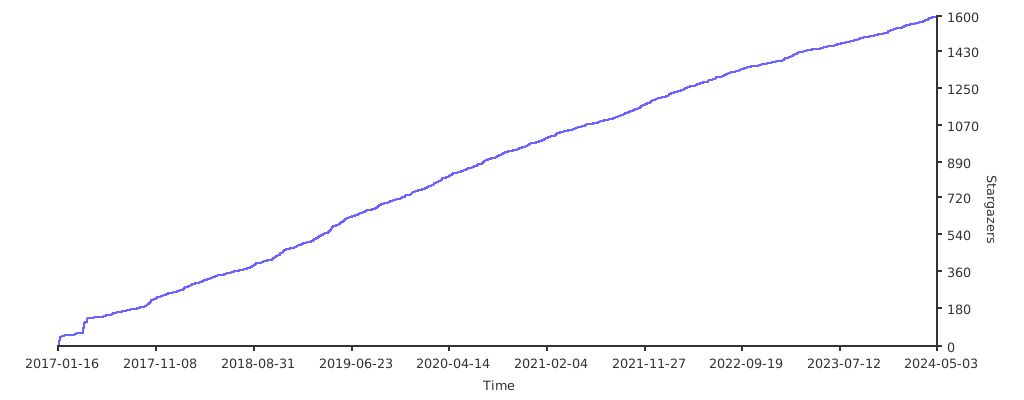
Current Tags
- 6.7.0-beta.0 ... beta (5 years ago)
- 10.3.2 ... latest (8 months ago)
215 Versions
- 10.3.2 ... 8 months ago
- 10.3.1 ... 9 months ago
- 10.3.0 ... 9 months ago
- 10.2.0 ... a year ago
- 10.1.0 ... a year ago
- 10.0.1 ... a year ago
- 10.0.0 ... a year ago
- 10.0.0-beta.3 ... a year ago
- 10.0.0-beta.1 ... a year ago
- 10.0.0-alpha.0 ... a year ago
- 9.4.2 ... a year ago
- 9.4.1 ... a year ago
- 9.4.0 ... a year ago
- 9.3.0 ... 2 years ago
- 9.2.1 ... 2 years ago
- 9.2.0 ... 2 years ago
- 9.1.1 ... 2 years ago
- 9.1.0 ... 2 years ago
- 9.0.1 ... 2 years ago
- 9.0.0 ... 2 years ago
- 8.6.0 ... 2 years ago
- 8.5.0 ... 3 years ago
- 8.4.0 ... 3 years ago
- 8.3.0 ... 3 years ago
- 8.2.0 ... 3 years ago
- 8.1.0 ... 3 years ago
- 8.0.0 ... 3 years ago
- 7.5.0 ... 3 years ago
- 7.4.0 ... 3 years ago
- 7.3.0 ... 4 years ago
- 7.2.1 ... 4 years ago
- 7.2.0 ... 4 years ago
- 7.1.4 ... 4 years ago
- 7.1.3 ... 4 years ago
- 7.1.2 ... 4 years ago
- 7.1.1 ... 4 years ago
- 7.1.0 ... 4 years ago
- 7.0.3 ... 4 years ago
- 7.0.2 ... 4 years ago
- 7.0.1 ... 4 years ago
- 7.0.0 ... 4 years ago
- 6.9.0 ... 5 years ago
- 6.8.3 ... 5 years ago
- 6.8.2 ... 5 years ago
- 6.8.1 ... 5 years ago
- 6.8.0 ... 5 years ago
- 6.7.0 ... 5 years ago
- 6.7.0-beta.0 ... 5 years ago
- 6.6.0 ... 5 years ago
- 6.5.3 ... 5 years ago
- 6.5.2 ... 5 years ago
- 6.5.1 ... 5 years ago
- 6.5.0 ... 5 years ago
- 6.4.0 ... 5 years ago
- 6.3.1 ... 5 years ago
- 6.3.0 ... 5 years ago
- 6.2.0 ... 6 years ago
- 6.1.0 ... 6 years ago
- 6.0.1 ... 6 years ago
- 6.0.0 ... 6 years ago
- 5.13.1 ... 6 years ago
- 5.13.0 ... 6 years ago
- 5.12.1 ... 6 years ago
- 5.12.0 ... 6 years ago
- 5.11.0 ... 6 years ago
- 5.10.0 ... 6 years ago
- 5.9.0 ... 6 years ago
- 5.8.0 ... 6 years ago
- 5.7.0 ... 6 years ago
- 5.6.3 ... 6 years ago
- 5.6.2 ... 6 years ago
- 5.6.1 ... 6 years ago
- 5.6.0 ... 6 years ago
- 5.5.0 ... 6 years ago
- 5.4.3 ... 6 years ago
- 5.4.2 ... 6 years ago
- 5.4.1 ... 6 years ago
- 5.4.0 ... 6 years ago
- 5.3.0 ... 6 years ago
- 5.2.1 ... 6 years ago
- 5.2.0 ... 6 years ago
- 5.1.1 ... 6 years ago
- 5.1.0 ... 6 years ago
- 5.0.0 ... 6 years ago
- 4.6.0 ... 6 years ago
- 4.5.0 ... 6 years ago
- 4.4.0 ... 6 years ago
- 4.3.0 ... 6 years ago
- 4.2.0 ... 6 years ago
- 4.1.0 ... 6 years ago
- 4.0.2 ... 6 years ago
- 4.0.1 ... 6 years ago
- 4.0.0 ... 6 years ago
- 3.3.0 ... 6 years ago
- 3.2.5 ... 6 years ago
- 3.2.1 ... 7 years ago
- 3.2.0 ... 7 years ago
- 3.1.1 ... 7 years ago
- 3.1.0 ... 7 years ago
- 3.0.1 ... 7 years ago
- 3.0.0 ... 7 years ago
- 2.14.5 ... 7 years ago
- 2.14.4 ... 7 years ago
- 2.14.3 ... 7 years ago
- 2.14.2 ... 7 years ago
- 2.14.1 ... 7 years ago
- 2.14.0 ... 7 years ago
- 2.13.1 ... 7 years ago
- 2.13.0 ... 7 years ago
- 2.12.0 ... 7 years ago
- 2.11.2 ... 7 years ago
- 2.11.1 ... 7 years ago
- 2.11.0 ... 7 years ago
- 2.10.2 ... 7 years ago
- 2.10.1 ... 7 years ago
- 2.10.0 ... 7 years ago
- 2.9.0 ... 7 years ago
- 2.8.0 ... 7 years ago
- 2.7.1 ... 7 years ago
- 2.7.0 ... 7 years ago
- 2.6.0 ... 7 years ago
- 2.5.0 ... 7 years ago
- 2.4.1 ... 7 years ago
- 2.4.0 ... 7 years ago
- 2.3.2 ... 7 years ago
- 2.3.1 ... 7 years ago
- 2.3.0 ... 7 years ago
- 2.2.0 ... 7 years ago
- 2.1.1 ... 7 years ago
- 2.1.0 ... 7 years ago
- 2.0.0 ... 7 years ago
- 1.2.6 ... 7 years ago
- 1.2.5 ... 7 years ago
- 1.2.4 ... 7 years ago
- 1.2.2 ... 8 years ago
- 1.2.1 ... 8 years ago
- 1.2.0 ... 8 years ago
- 1.1.5 ... 8 years ago
- 1.1.4 ... 8 years ago
- 1.1.3 ... 8 years ago
- 1.1.2 ... 8 years ago
- 1.1.1 ... 8 years ago
- 1.1.0 ... 8 years ago
- 1.0.13 ... 8 years ago
- 1.0.12 ... 8 years ago
- 1.0.11 ... 8 years ago
- 1.0.10 ... 8 years ago
- 1.0.9 ... 8 years ago
- 1.0.8 ... 8 years ago
- 1.0.7 ... 8 years ago
- 1.0.6 ... 8 years ago
- 1.0.5 ... 8 years ago
- 1.0.4 ... 8 years ago
- 1.0.3 ... 8 years ago
- 1.0.0 ... 8 years ago
- 0.9.8 ... 8 years ago
- 0.9.7 ... 8 years ago
- 0.9.6 ... 8 years ago
- 0.9.5 ... 8 years ago
- 0.9.4 ... 9 years ago
- 0.9.3 ... 9 years ago
- 0.9.2 ... 9 years ago
- 0.9.1 ... 9 years ago
- 0.8.10 ... 9 years ago
- 0.9.0 ... 9 years ago
- 0.8.9 ... 9 years ago
- 0.8.8 ... 9 years ago
- 0.8.7 ... 9 years ago
- 0.8.6 ... 9 years ago
- 0.8.5 ... 9 years ago
- 0.8.4 ... 9 years ago
- 0.8.3 ... 9 years ago
- 0.8.2 ... 9 years ago
- 0.8.1 ... 9 years ago
- 0.8.0 ... 9 years ago
- 0.7.6 ... 9 years ago
- 0.7.5 ... 9 years ago
- 0.7.4 ... 9 years ago
- 0.7.3 ... 9 years ago
- 0.7.2 ... 9 years ago
- 0.7.1 ... 9 years ago
- 0.7.0 ... 9 years ago
- 0.6.1 ... 9 years ago
- 0.5.13 ... 9 years ago
- 0.6.0 ... 9 years ago
- 0.5.12 ... 9 years ago
- 0.5.11 ... 9 years ago
- 0.5.10 ... 9 years ago
- 0.5.9 ... 9 years ago
- 0.5.8 ... 9 years ago
- 0.5.7 ... 9 years ago
- 0.5.6 ... 9 years ago
- 0.5.5 ... 9 years ago
- 0.5.4 ... 9 years ago
- 0.5.3 ... 9 years ago
- 0.5.2 ... 9 years ago
- 0.5.1 ... 9 years ago
- 0.5.0 ... 9 years ago
- 0.4.3 ... 9 years ago
- 0.4.2 ... 9 years ago
- 0.4.1 ... 9 years ago
- 0.4.0 ... 9 years ago
- 0.3.4 ... 9 years ago
- 0.3.3 ... 9 years ago
- 0.3.2 ... 9 years ago
- 0.3.1 ... 9 years ago
- 0.3.0 ... 9 years ago
- 0.2.1 ... 9 years ago
- 0.2.0 ... 9 years ago
- 0.1.5 ... 9 years ago
- 0.1.4 ... 9 years ago
- 0.1.3 ... 9 years ago
- 0.1.2 ... 9 years ago
- 0.1.1 ... 9 years ago
- 0.1.0 ... 9 years ago
- @definitelytyped/dtslint 0.0.182
- @types/mocha 10.0.10
- @types/node 24.0.8
- @vitest/coverage-v8 4.0.0-beta.2
- helpers-fn 2.0.0
- lodash 4.17.21
- radashi 13.0.0-beta.ffa4778
- rambdax 11.3.1
- ramda 0.31.3
- remeda 2.23.2
- rollup 4.44.1
- types-ramda 0.30.1
- typescript 5.9.0-dev.20250630
- vitest 4.0.0-beta.2